
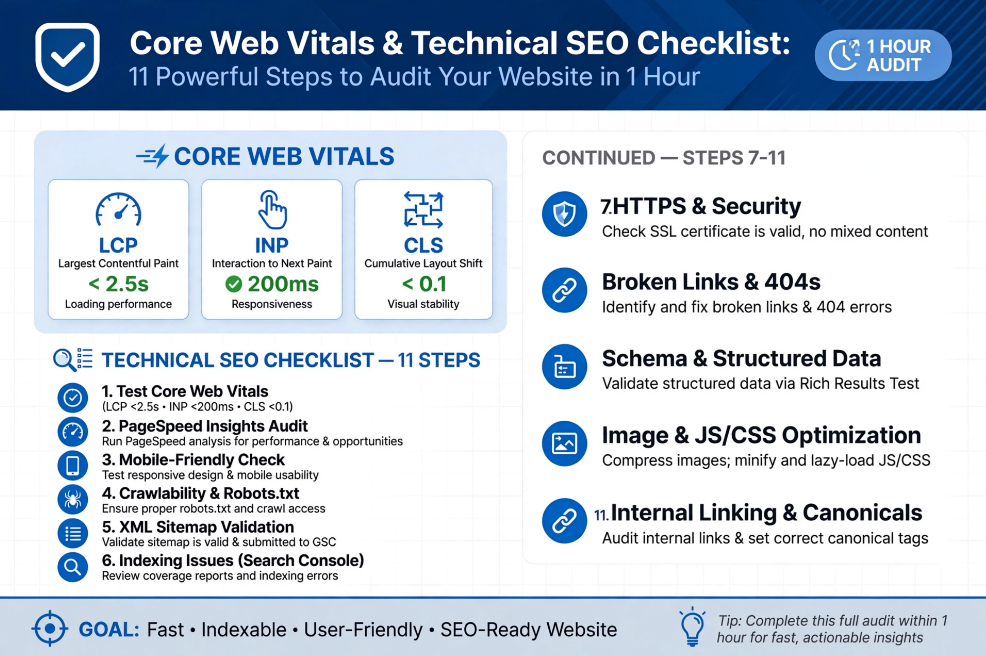
Core Web Vitals & Technical SEO Checklist can help website owners identify technical problems that may affect search visibility, website performance, and user experience.
A website may have excellent content and strong backlinks, but technical problems can still create obstacles for search engines and visitors.
Slow pages, crawling errors, poor mobile performance, broken links, indexing problems, and incorrect redirects are some of the issues that deserve regular attention.
The good news? You do not always need an entire day to perform a basic technical SEO audit.
With the right process, you can complete a practical website check in approximately one hour.
This guide provides a simple Core Web Vitals & Technical SEO Checklist that beginners, webmasters, bloggers, and site owners can follow without getting lost in complicated technical terminology.
Table of Contents
- What Is a Technical SEO Audit?
- Why Core Web Vitals Matter
- Check Your Website Loading Speed
- Understand LCP, INP and CLS
- Check Mobile Performance
- Inspect Crawlability
- Review Your Robots.txt File
- Check Your XML Sitemap
- Find Indexing Problems
- Check Broken Links and Redirects
- Review HTTPS and Website Security
- Check Duplicate and Thin Content
- Improve Internal Linking
- Review Canonical Tags
- Check Structured Data
- Create a One-Hour Technical SEO Workflow
- Common Technical SEO Mistakes
- Conclusion
- FAQs
1. What Is a Technical SEO Audit?
A technical SEO audit is the process of checking the technical health of a website.
Unlike content SEO, which focuses heavily on topics, keywords, and content quality, technical SEO examines how efficiently search engines can access, understand, crawl, and index your website.
Think of your website like a physical store.
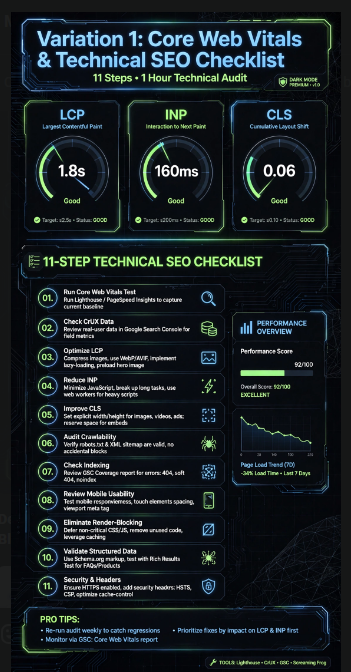
Your content is the merchandise, but Core Web Vitals & Technical SEO Checklist is the building itself.
If the doors are difficult to open, the lights do not work, and visitors cannot find different sections, even excellent products may struggle to perform.
2. Why Core Web Vitals Matter
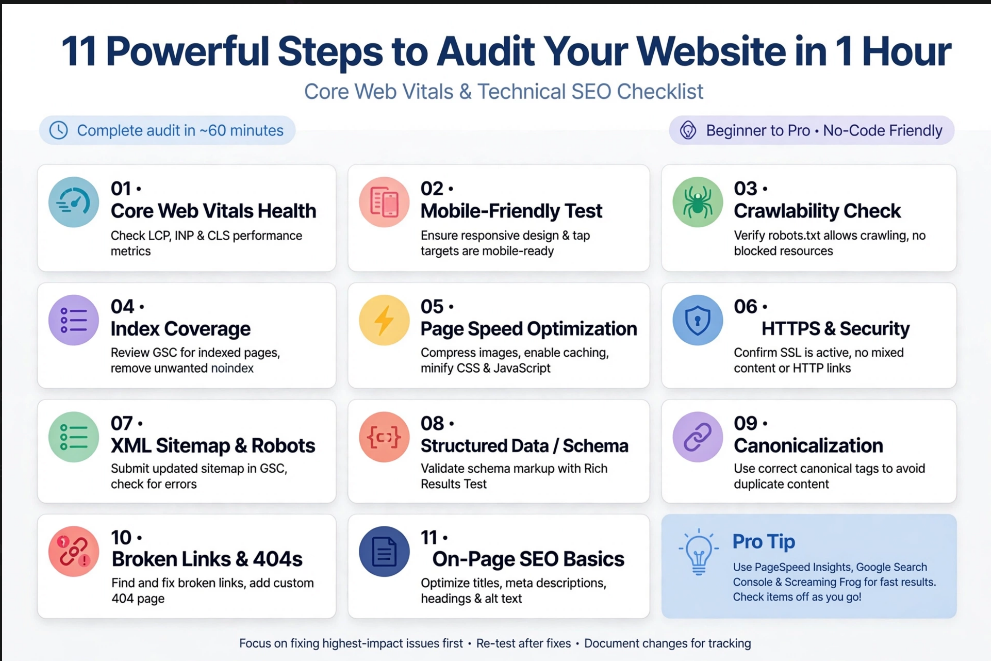
Core Web Vitals & Technical SEO Checklist should always include a performance review.
Core Web Vitals & Technical SEO Checklist are a group of user-focused performance measurements associated with loading experience, responsiveness, and visual stability.
These measurements help website owners understand how visitors experience important pages.
A technically healthy website should not only be accessible to search engines but should also provide a smooth experience for real users.
You can use Google PageSpeed Insights to examine page performance and identify potential improvements.
3. Check Your Website Loading Speed
Website speed is one of the first things you should investigate during an audit.
Open important pages on your website and observe how quickly Core Web Vitals & Technical SEO Checklist become usable.
Do not check only the homepage.
Test important service pages, product pages, blog posts, and landing pages because performance can vary significantly from one page to another.
Large images, unnecessary scripts, excessive plugins, poor hosting, and unoptimized resources can all contribute to slower loading.
Use PageSpeed Insights
PageSpeed Insights can provide performance information for both mobile and desktop experiences.
Enter an important URL and review the recommendations.
You do not need to fix every suggestion immediately in Core Web Vitals & Technical SEO Checklist.
Start with issues that have the greatest potential impact.
4. Understand LCP, INP and CLS
A useful Core Web Vitals & Technical SEO Checklist should include three important performance concepts.
LCP, or Largest Contentful Paint, relates to how quickly the main visible content loads.
INP, or Interaction to Next Paint, measures how responsive a page is to user interactions.
CLS, or Cumulative Layout Shift, focuses on unexpected movement of page elements while the page loads.
Imagine opening a website and trying to click a button, but the page suddenly moves.
That is frustrating.
Reducing layout shifts and improving responsiveness can create a smoother experience in Core Web Vitals & Technical SEO Checklist .
5. Check Mobile Performance
Mobile optimization is essential because many users access websites through smartphones.
Open your website on different mobile devices or use browser developer tools to simulate mobile screens.
Check whether text is readable.
Make sure buttons are easy to tap.
Look for horizontal scrolling, overlapping elements, pop-ups, and menus that are difficult to use.
A website that looks perfect on a desktop computer can still provide a poor mobile experience.
Test Important Mobile Pages
Do not test only one page.
Check your homepage, major service pages, blog posts, contact page, and important landing pages.
If a particular template creates mobile problems, fixing the template may improve many pages at once.
6. Inspect Crawlability
Search engines need to crawl your website before they can properly understand its pages.
Crawlability problems can prevent important URLs from being discovered or processed efficiently.
Use Google Search Console to review information about your website’s search performance and indexing in Core Web Vitals & Technical SEO Checklist .
Look for unexpected errors and investigate pages that should be accessible but appear blocked or problematic.
7. Review Your Robots.txt File
The robots.txt file provides instructions to search engine crawlers about which areas they may or may not access.
A poorly configured robots.txt file can create serious problems.
For example, accidentally blocking an important section of your website may prevent search engines from crawling it as intended.
You can generally view the file by visiting:
Review it carefully.
If you are unsure about a directive, do not remove it randomly.
8. Check Your XML Sitemap
An XML sitemap helps search engines discover important URLs on your website.
Your sitemap should contain URLs that you actually want search engines to access and index.
Avoid filling the sitemap with unnecessary URLs, broken pages, redirected URLs, or pages that should not be indexed.
For many WordPress websites, SEO plugins can automatically generate and maintain an XML sitemap.
After creating the sitemap, submit it through Google Search Console.
9. Find Indexing Problems

One of the most important parts of a Core Web Vitals & Technical SEO Checklist is checking whether important pages are actually indexed.
Open Google Search Console and review the indexing section.
Look for statuses such as:
- Indexed
- Not indexed
- Crawled – currently not indexed
- Discovered – currently not indexed
- Excluded
- Redirected
- Duplicate
Not every non-indexed page is a problem.
For example, some pages should intentionally remain out of search results.
The key is identifying important pages that are unexpectedly missing.
Check Your Important URLs
Create a simple list of your most valuable pages.
These could include your homepage, major service pages, category pages, and high-performing blog posts.
Check whether these URLs are indexed as expected.
10. Check Broken Links and Redirects
Broken links can create a frustrating experience for visitors.
They can also make website maintenance more difficult.
During your audit, look for links that lead to pages returning a 404 error.
If a page has permanently moved, use an appropriate redirect rather than leaving users at a dead end.
Avoid creating unnecessary chains of redirects.
A clean URL structure makes website management easier.
11. Review HTTPS and Website Security
Your website should use HTTPS correctly.
Open important pages and confirm that they load through a secure HTTPS connection.
Also check whether your website creates mixed-content warnings, where secure pages attempt to load certain resources through insecure HTTP connections.
Security problems should be treated seriously because they can affect user trust as well as technical performance.
12. Check Duplicate and Thin Content
Duplicate content occurs when substantially similar content appears across multiple URLs.
This does not mean every similar phrase is automatically a problem.
However, unnecessary duplicate pages can make website management and search visibility more complicated.
Thin content is another issue.
A page with very little useful information may provide limited value to visitors.
Review pages that receive little traffic and ask whether they should be improved, consolidated, redirected, or removed.
Improve Weak Pages
Do not automatically delete every page with low traffic.
Some pages may be valuable for specific searches or customers.
Instead, evaluate their purpose first.
If the page has potential, improve its content, structure, internal links, and user experience.
13. Improve Internal Linking
Internal linking should be included in every practical Core Web Vitals & Technical SEO Checklist.
Internal links connect pages within your website.
For example, if you have an article about technical SEO and another article about keyword research, you can connect them when the relationship is useful to readers.
Use descriptive anchor text.
Instead of writing “click here,” use phrases such as Core Web Vitals & Technical SEO Checklist or another accurate description.
This makes the link more meaningful.
Find Orphan Pages
An orphan page is a page that has little or no internal links pointing toward it.
These pages can be difficult for users and search engines to discover.
Review important pages and make sure they are connected to relevant sections of your website.
14. Review Canonical Tags
Canonical tags help communicate which version of a page should generally be considered the preferred URL when similar or duplicate versions exist.
They can be particularly useful for websites with multiple URL variations.
Check important pages to make sure canonical settings are not pointing to irrelevant URLs.
Incorrect canonical configuration can create confusion about which page you want search engines to prioritize.
If you use WordPress SEO plugins, review the canonical settings before changing them manually.
15. Check Structured Data
Structured data provides machine-readable information about certain types of content.
Depending on the page, structured data can describe things such as articles, products, organizations, events, and other supported content types.
Use appropriate structured data only when it genuinely matches the content on the page.
Do not add markup simply because you want to trigger a particular search feature.
Accuracy is more important than quantity.
16. Create a One-Hour Technical SEO Workflow
Now let’s turn the entire Core Web Vitals & Technical SEO Checklist into a practical one-hour process.
First 10 Minutes: Check Performance
Test your homepage and two important pages using PageSpeed Insights.
Note major performance problems.
Pay special attention to large images, slow resources, and Core Web Vitals-related recommendations.
Next 10 Minutes: Check Mobile Experience
Open important pages on mobile.
Check navigation, readability, buttons, images, menus, and layout.
Write down anything that looks difficult to use.
Next 10 Minutes: Check Indexing
Open Google Search Console.
Review indexing information and investigate unexpected exclusions or errors.
Confirm that your most important pages are available for indexing.
Next 10 Minutes: Check Crawling
Review robots.txt and your XML sitemap.
Make sure important sections are not accidentally blocked.
Confirm that the sitemap contains relevant URLs.
Next 10 Minutes: Check Links
Look for broken internal links, unnecessary redirects, and important orphan pages.
Review your internal linking structure about Core Web Vitals & Technical SEO Checklist.
Final 10 Minutes: Create an Action Plan
Do not attempt to fix everything immediately.
Create three categories:
High Priority: Problems that can significantly affect important pages.
Medium Priority: Issues that should be improved but are not urgent.
Low Priority: Minor improvements that can be handled later.
This makes your audit much easier to manage.
17. Common Technical SEO Mistakes
Many website owners make the same technical SEO mistakes in Core Web Vitals & Technical SEO Checklist.
One common mistake is focusing entirely on speed while ignoring indexing.
Another is checking only the homepage.
Some site owners also install multiple optimization plugins without understanding how they interact.
This can sometimes create unnecessary conflicts.
A better approach is to understand about Core Web Vitals & Technical SEO Checklist each tool does before changing important technical settings.
18. Use Trusted SEO Resources
When working on technical SEO, use reliable sources instead of random recommendations.
Useful resources include:
These resources can help you understand technical requirements in Core Web Vitals & Technical SEO Checklist and performance recommendations.
Note for DoFollow links: when you add these links in WordPress, make sure the links are not marked with rel="nofollow" or another restrictive attribute if you specifically want them to be DoFollow. Only use DoFollow links where appropriate and trustworthy.
19. Build Your Own Technical SEO Routine
A technical SEO audit should not be treated as a one-time activity.
Websites constantly change.
New plugins are installed.
Pages are deleted.
Images are uploaded.
Redirects are created.
Developers change templates.
All of these activities can introduce new technical problems.
A simple monthly or quarterly audit can help you identify issues before they become serious.
20. Conclusion
The Core Web Vitals & Technical SEO Checklist gives website owners a practical framework for identifying important technical problems without spending an entire day on an audit.
Start with website performance and mobile usability about Core Web Vitals & Technical SEO Checklist.
Then check crawling, robots.txt, XML sitemaps, indexing, broken links, redirects, HTTPS, canonical tags, structured data, and internal linking.
Most importantly, do not try to fix every warning at once.
Prioritize problems based on their potential impact on important pages and users.
Technical SEO is not about making a website technically perfect.
It is about creating a website that search engines can access efficiently and visitors can use comfortably.
With a consistent audit routine and the right tools, even beginners can identify many common technical SEO problems and create a stronger foundation for organic search growth .
Frequently Asked Questions
1. What is a Core Web Vitals & Technical SEO Checklist?
A Core Web Vitals & Technical SEO Checklist is a structured list of technical checks used to evaluate website performance, crawlability, indexing, mobile usability, links, redirects, security, and other important SEO factors.
2. Can I complete a Core Web Vitals & Technical SEO Checklist in one hour?
Yes. Core Web Vitals & Technical SEO Checklist can be completed in about one hour if you focus on the most important areas, including performance, mobile usability, indexing, crawling, broken links, and website structure.
3. Which tools can I use for a technical SEO audit?
Google Search Console and Google PageSpeed Insights are excellent starting points. Depending on your website, you can also use crawling and SEO auditing tools for deeper analysis.
4. Why are Core Web Vitals important for websites?
Core Web Vitals provide user-focused measurements related to loading, responsiveness, and visual stability. They can help website owners identify areas where the user experience may need improvement.
5. How often should I perform a technical SEO audit?
A basic technical review can be performed monthly, while a deeper audit can be scheduled quarterly or whenever major website changes are made in Core Web Vitals & Technical SEO Checklist .
Advanced Core Web Vitals & Technical SEO Checklist for Better Website Performance
1. Start With a Technical Baseline
Before making any SEO changes, create a baseline for your website. Record your current page speed, indexed pages, organic traffic, mobile performance, and important technical errors. The Core Web Vitals & Technical SEO Checklist becomes more useful when you can compare the website before and after optimization.
2. Understand Your Website Structure
A website should have a logical structure that connects related pages. Your homepage should lead visitors toward important categories, services, products, and resources. When the Core Web Vitals & Technical SEO Checklist is simple, both visitors and search engines can understand the relationship between different sections more easily.
3. Review Your Most Important Pages
Do not spend the same amount of time on every URL. Start with pages that generate leads, sales, traffic, or important customer interactions. The Core Web Vitals & Technical SEO Checklist should first be applied to these high-value pages because improvements there can potentially create greater business benefits.
4. Look Beyond the Homepage
The homepage is important, but it does not represent your entire website. Blog posts, landing pages, category pages, product pages, and service pages can have completely different technical conditions. Check several templates instead of assuming that one successful homepage audit means the entire website is healthy.
5. Improve Image Delivery
Images often contribute significantly to page weight. Large photographs can take longer to download, especially on mobile networks. Resize images according to their actual display dimensions and choose suitable modern formats when possible. This can reduce unnecessary data without sacrificing visual quality.
6. Optimize Hero Sections
Large hero sections frequently appear at the top of a webpage in Core Web Vitals & Technical SEO Checklist . If the main image or visual element is extremely heavy, it can delay the appearance of important content. Review hero images carefully and avoid using unnecessarily large files simply because they look sharp on a desktop monitor.
7. Reduce Layout Movement
Unexpected movement can make websites frustrating to use. Imagine trying to click a navigation button and suddenly seeing an advertisement or image push it downward. The Core Web Vitals & Technical SEO Checklist should therefore include a review of images, advertisements, banners, fonts, and embedded elements that can change position during loading.
8. Reserve Space for Visual Elements
One simple way to reduce layout shifts is to reserve appropriate space for images and other dynamic elements. When the browser knows how much space an element requires, surrounding content is less likely to jump unexpectedly.
9. Review Font Loading
Custom fonts can improve branding, but they can also influence loading behavior. Avoid loading unnecessary font families and excessive font weights. If your website uses five different font styles when only two are required, simplifying the configuration may reduce unnecessary resource requests.
10. Examine Third-Party Services
Analytics, chat systems, social widgets, advertising scripts, maps, and other external services can add additional requests. Review them regularly and remove services that no longer serve a useful purpose. A lighter website is generally easier to maintain and troubleshoot.
11. Check JavaScript Execution
JavaScript can make websites interactive in Core Web Vitals & Technical SEO Checklist , but excessive scripts may consume browser resources. Review whether scripts are necessary on every page. A booking script, for example, may only be required on a booking page rather than every blog article.
12. Review CSS Resources
Cascading Style Sheets control the visual presentation of your website. Excessive or unused CSS can increase the amount of information browsers need to process. Keep your styling system organized and remove unnecessary resources when it is technically safe to do so.
13. Investigate Server Performance
Sometimes a slow website is not caused by images or front-end code. The server itself may respond slowly. Hosting resources, database queries, server configuration, and traffic levels can all influence response time. If optimization produces limited improvements, investigate your hosting environment.
14. Use Caching Carefully
Caching can help browsers and servers reuse resources instead of processing everything repeatedly. However, caching settings should be tested after implementation. Incorrect configurations can occasionally cause outdated information, broken layouts, or unexpected functionality.
15. Review Database Health
Core Web Vitals & Technical SEO Checklist can accumulate revisions, spam comments, temporary data, and unnecessary database entries over time. A large or poorly maintained database may contribute to slower administrative operations and database queries. Use trusted maintenance methods and create backups before performing major database changes.
16. Examine Crawlable Links
Search engines discover many pages by following links. Make sure important pages can be reached through normal internal navigation. The Core Web Vitals & Technical SEO Checklist should include checking whether valuable pages are isolated or difficult to discover.
17. Avoid Unnecessary Redirects
Redirects are useful in Core Web Vitals & Technical SEO Checklist when URLs genuinely change, but excessive redirects can make website architecture complicated. Review old redirects periodically and remove obsolete rules when appropriate. Always test changes carefully because an incorrect redirect can send users to the wrong destination.
18. Monitor Redirect Chains
A redirect chain occurs when one URL redirects to another URL that redirects again. Long chains can make crawling and page access less efficient. Where practical, point an old URL directly toward the final relevant destination.
19. Review Canonical Configuration
Canonical tags help indicate the preferred version of similar URLs. Check whether important pages point toward the correct canonical destination. An incorrect canonical configuration can potentially cause search engines to prioritize a different URL than the one you actually want.
20. Investigate Duplicate URLs
Duplicate URLs may be generated through filters, parameters, archives, tags, or different versions of the same content under Core Web Vitals & Technical SEO Checklist . Not every duplicate URL is harmful, but unnecessary variations can make your website harder to manage. Review URL patterns and establish a clear structure.
21. Check Indexing Status Regularly
Google Search Console can help you understand how Google processes your website’s URLs. Review important pages and investigate unexpected indexing exclusions. The Core Web Vitals & Technical SEO Checklist should always distinguish between pages intentionally excluded from search and pages that should be indexed but are not.
22. Inspect Noindex Directives
A noindex instruction can prevent a page from appearing in search results. This can be useful for private, duplicate, or low-value pages. However, accidental noindex settings can create serious visibility problems. Check important URLs whenever an unexpected indexing decline occurs.
23. Maintain a Clean Sitemap
Your XML sitemap should primarily contain URLs that are valuable and eligible for search engine discovery. Remove unnecessary redirects, broken URLs, and pages that should not be indexed. A clean sitemap provides a clearer signal about which URLs matter.
24. Review Robots.txt
The robots.txt file should be checked whenever you perform a technical audit. An incorrect directive could prevent crawlers from accessing important resources or sections. Do not modify the file casually; understand what each rule does before making changes.
25. Strengthen Internal Links
Internal linking creates pathways between related pages. Use meaningful anchor text and connect articles naturally. The Core Web Vitals & Technical SEO Checklist should include identifying important pages that receive very few internal links from other relevant content.
26. Find Orphan Pages
Orphan pages have few or no internal links pointing toward them. Core Web Vitals & Technical SEO Checklist can be difficult for users to discover and may receive less attention from search engines. Review your site structure and connect valuable orphan pages to relevant sections.
27. Improve Breadcrumb Navigation
Breadcrumbs can help visitors understand their position within a website. They are particularly useful for ecommerce stores, large blogs, and websites with multiple categories. A clear breadcrumb structure can make navigation more intuitive.
28. Check Mobile Navigation
Mobile visitors often interact with smaller screens and touch controls. Test menus, dropdowns, buttons, forms, and navigation elements manually. A technically optimized website can still lose visitors if mobile navigation is confusing.
29. Test Contact Forms
Forms should be included in your technical checks if your website depends on leads. Submit test forms periodically and confirm that notifications reach the correct destination. A broken contact form can cause direct business losses even when organic traffic remains stable.
30. Check Important Conversion Paths
Follow the journey a visitor takes from landing on your website to completing an important action. Test product purchases, enquiry forms, appointment bookings, downloads, or other conversion paths. Technical problems at the final stage can waste valuable organic traffic.
31. Review Website Accessibility
Technical quality should also support accessibility. Check text readability, keyboard navigation, image descriptions, form labels, and overall usability. A website designed for a broader range of visitors can provide a stronger user experience.
32. Keep URLs Simple
Short, descriptive URLs are generally easier to understand. Avoid unnecessary parameters, random characters, and excessively complicated structures when they are not required. Consistent URLs also make website management easier.
33. Monitor Website Errors
Technical errors should be monitored rather than ignored. Review Search Console reports, analytics information, server logs when available, and website monitoring tools. The Core Web Vitals & Technical SEO Checklist is most effective when it becomes part of continuous website maintenance.
34. Check After Plugin Updates
WordPress plugin updates can sometimes affect layouts, scripts, forms, or page speed. After important updates, test your key pages. Pay particular attention to pages containing forms, ecommerce functionality, custom designs, or interactive features.
35. Test After Theme Changes
A theme redesign can dramatically change website performance and structure. Before launching a new theme, compare important pages with the previous version. Check menus, metadata, headings, images, internal links, mobile layouts, and structured data.
36. Monitor Search Performance
Technical SEO should ultimately support business and search visibility. Use Google Search Console to observe clicks, impressions, indexing changes, and search queries. The Core Web Vitals & Technical SEO Checklist should be combined with performance data rather than used in isolation.
37. Do Not Chase Perfect Scores
SEO tools provide useful information, but their scores should not become the only goal. A website does not need a perfect technical score to succeed. Prioritize improvements that genuinely make the website faster, easier to use, easier to crawl, and more useful.
38. Compare Before and After Results
Whenever you make a significant technical change, record the original condition. After sufficient time, compare performance again. This helps determine whether your optimization produced a meaningful improvement.
39. Prioritize Business-Critical Problems
Not every warning deserves immediate attention. A small issue on an unimportant page may be less urgent than a major problem affecting your primary service page. The Core Web Vitals & Technical SEO Checklist should therefore be used with a priority system based on traffic, conversions, revenue, and importance.
40. Document Every Major Change
Maintain a simple SEO change log. Record the date, page, problem, action taken, and result. Documentation makes future troubleshooting much easier because you can identify what changed before a sudden performance or ranking shift.
41. Schedule Regular Technical Reviews
A website changes constantly. New content, plugins, images, redirects, and design updates can introduce fresh technical problems. Schedule regular reviews instead of waiting until traffic suddenly drops.
42. Combine Technical and Content SEO
Technical SEO cannot replace valuable content. A fast website with weak information may still struggle to satisfy search intent. The strongest strategy combines technical accessibility with original, useful, well-structured content.
43. Focus on User Experience
Search engines are important, but real visitors are the people who ultimately interact with your website. The Core Web Vitals & Technical SEO Checklist should therefore be used to improve practical experiences such as loading, navigation, readability, interaction, and accessibility.
44. Create an Action-Based SEO Plan
After completing your audit, create a prioritized action plan. Mark each issue as high, medium, or low priority and assign a realistic deadline. This approach prevents technical SEO from becoming a never-ending list of warnings.
45. Make Technical SEO Continuous
Technical SEO is not a one-time project. Websites evolve every week, and new technical issues can appear after updates or structural changes. Use the Core Web Vitals & Technical SEO Checklist regularly, monitor important pages, and focus on improvements that create measurable value for both users and search.