
Singh Porperties

SINGH PORPERTIES is a trusted real estate consultancy dedicated to helping individuals, families, and investors make confident property decisions. We provide professional assistance for buying, selling, and investing in residential, commercial, and land properties.

Our goal is to make the property-buying and investment process simple, transparent, and hassle-free. From finding the right property and understanding market opportunities to providing personalized guidance, we help our clients choose properties that match their requirements, budget, and long-term goals.

Core Web Vitals & Technical SEO Checklist

Core Web Vitals & Technical SEO Checklist: 11 Powerful Steps to Audit Your Website in 1 Hour

Core Web Vitals & Technical SEO Checklist can help website owners identify technical problems that may affect search visibility, website performance, and user experience.

A website may have excellent content and strong backlinks, but technical problems can still create obstacles for search engines and visitors.

Slow pages, crawling errors, poor mobile performance, broken links, indexing problems, and incorrect redirects are some of the issues that deserve regular attention.

The good news? You do not always need an entire day to perform a basic technical SEO audit.

With the right process, you can complete a practical website check in approximately one hour.

This guide provides a simple Core Web Vitals & Technical SEO Checklist that beginners, webmasters, bloggers, and site owners can follow without getting lost in complicated technical terminology.


Table of Contents

  1. What Is a Technical SEO Audit?
  2. Why Core Web Vitals Matter
  3. Check Your Website Loading Speed
  4. Understand LCP, INP and CLS
  5. Check Mobile Performance
  6. Inspect Crawlability
  7. Review Your Robots.txt File
  8. Check Your XML Sitemap
  9. Find Indexing Problems
  10. Check Broken Links and Redirects
  11. Review HTTPS and Website Security
  12. Check Duplicate and Thin Content
  13. Improve Internal Linking
  14. Review Canonical Tags
  15. Check Structured Data
  16. Create a One-Hour Technical SEO Workflow
  17. Common Technical SEO Mistakes
  18. Conclusion
  19. FAQs

1. What Is a Technical SEO Audit?

A technical SEO audit is the process of checking the technical health of a website.

Unlike content SEO, which focuses heavily on topics, keywords, and content quality, technical SEO examines how efficiently search engines can access, understand, crawl, and index your website.

Think of your website like a physical store.

singh and sons

Your content is the merchandise, but Core Web Vitals & Technical SEO Checklist is the building itself.

If the doors are difficult to open, the lights do not work, and visitors cannot find different sections, even excellent products may struggle to perform.


2. Why Core Web Vitals Matter

singh and sons

Core Web Vitals & Technical SEO Checklist should always include a performance review.

Core Web Vitals & Technical SEO Checklist are a group of user-focused performance measurements associated with loading experience, responsiveness, and visual stability.

These measurements help website owners understand how visitors experience important pages.

A technically healthy website should not only be accessible to search engines but should also provide a smooth experience for real users.

You can use Google PageSpeed Insights to examine page performance and identify potential improvements.


3. Check Your Website Loading Speed

Website speed is one of the first things you should investigate during an audit.

Open important pages on your website and observe how quickly Core Web Vitals & Technical SEO Checklist become usable.

Do not check only the homepage.

Test important service pages, product pages, blog posts, and landing pages because performance can vary significantly from one page to another.

Large images, unnecessary scripts, excessive plugins, poor hosting, and unoptimized resources can all contribute to slower loading.

Use PageSpeed Insights

PageSpeed Insights can provide performance information for both mobile and desktop experiences.

Enter an important URL and review the recommendations.

You do not need to fix every suggestion immediately in Core Web Vitals & Technical SEO Checklist.

Start with issues that have the greatest potential impact.


4. Understand LCP, INP and CLS

A useful Core Web Vitals & Technical SEO Checklist should include three important performance concepts.

LCP, or Largest Contentful Paint, relates to how quickly the main visible content loads.

INP, or Interaction to Next Paint, measures how responsive a page is to user interactions.

CLS, or Cumulative Layout Shift, focuses on unexpected movement of page elements while the page loads.

Imagine opening a website and trying to click a button, but the page suddenly moves.

That is frustrating.

Reducing layout shifts and improving responsiveness can create a smoother experience in Core Web Vitals & Technical SEO Checklist .


5. Check Mobile Performance

Mobile optimization is essential because many users access websites through smartphones.

Open your website on different mobile devices or use browser developer tools to simulate mobile screens.

Check whether text is readable.

Make sure buttons are easy to tap.

Look for horizontal scrolling, overlapping elements, pop-ups, and menus that are difficult to use.

A website that looks perfect on a desktop computer can still provide a poor mobile experience.

Test Important Mobile Pages

Do not test only one page.

Check your homepage, major service pages, blog posts, contact page, and important landing pages.

If a particular template creates mobile problems, fixing the template may improve many pages at once.


6. Inspect Crawlability

Search engines need to crawl your website before they can properly understand its pages.

Crawlability problems can prevent important URLs from being discovered or processed efficiently.

Use Google Search Console to review information about your website’s search performance and indexing in Core Web Vitals & Technical SEO Checklist .

Look for unexpected errors and investigate pages that should be accessible but appear blocked or problematic.


7. Review Your Robots.txt File

The robots.txt file provides instructions to search engine crawlers about which areas they may or may not access.

A poorly configured robots.txt file can create serious problems.

For example, accidentally blocking an important section of your website may prevent search engines from crawling it as intended.

You can generally view the file by visiting:

Review it carefully.

If you are unsure about a directive, do not remove it randomly.


8. Check Your XML Sitemap

An XML sitemap helps search engines discover important URLs on your website.

Your sitemap should contain URLs that you actually want search engines to access and index.

Avoid filling the sitemap with unnecessary URLs, broken pages, redirected URLs, or pages that should not be indexed.

For many WordPress websites, SEO plugins can automatically generate and maintain an XML sitemap.

After creating the sitemap, submit it through Google Search Console.


9. Find Indexing Problems

singh and sons

One of the most important parts of a Core Web Vitals & Technical SEO Checklist is checking whether important pages are actually indexed.

Open Google Search Console and review the indexing section.

Look for statuses such as:

  • Indexed
  • Not indexed
  • Crawled – currently not indexed
  • Discovered – currently not indexed
  • Excluded
  • Redirected
  • Duplicate

Not every non-indexed page is a problem.

For example, some pages should intentionally remain out of search results.

The key is identifying important pages that are unexpectedly missing.

Check Your Important URLs

Create a simple list of your most valuable pages.

These could include your homepage, major service pages, category pages, and high-performing blog posts.

Check whether these URLs are indexed as expected.


10. Check Broken Links and Redirects

Broken links can create a frustrating experience for visitors.

They can also make website maintenance more difficult.

During your audit, look for links that lead to pages returning a 404 error.

If a page has permanently moved, use an appropriate redirect rather than leaving users at a dead end.

Avoid creating unnecessary chains of redirects.

A clean URL structure makes website management easier.


11. Review HTTPS and Website Security

Your website should use HTTPS correctly.

Open important pages and confirm that they load through a secure HTTPS connection.

Also check whether your website creates mixed-content warnings, where secure pages attempt to load certain resources through insecure HTTP connections.

Security problems should be treated seriously because they can affect user trust as well as technical performance.


12. Check Duplicate and Thin Content

Duplicate content occurs when substantially similar content appears across multiple URLs.

This does not mean every similar phrase is automatically a problem.

However, unnecessary duplicate pages can make website management and search visibility more complicated.

Thin content is another issue.

A page with very little useful information may provide limited value to visitors.

Review pages that receive little traffic and ask whether they should be improved, consolidated, redirected, or removed.

Improve Weak Pages

Do not automatically delete every page with low traffic.

Some pages may be valuable for specific searches or customers.

Instead, evaluate their purpose first.

If the page has potential, improve its content, structure, internal links, and user experience.


13. Improve Internal Linking

Internal linking should be included in every practical Core Web Vitals & Technical SEO Checklist.

Internal links connect pages within your website.

For example, if you have an article about technical SEO and another article about keyword research, you can connect them when the relationship is useful to readers.

Use descriptive anchor text.

Instead of writing “click here,” use phrases such as Core Web Vitals & Technical SEO Checklist or another accurate description.

This makes the link more meaningful.

Find Orphan Pages

An orphan page is a page that has little or no internal links pointing toward it.

These pages can be difficult for users and search engines to discover.

Review important pages and make sure they are connected to relevant sections of your website.


14. Review Canonical Tags

Canonical tags help communicate which version of a page should generally be considered the preferred URL when similar or duplicate versions exist.

They can be particularly useful for websites with multiple URL variations.

Check important pages to make sure canonical settings are not pointing to irrelevant URLs.

Incorrect canonical configuration can create confusion about which page you want search engines to prioritize.

If you use WordPress SEO plugins, review the canonical settings before changing them manually.


15. Check Structured Data

Structured data provides machine-readable information about certain types of content.

Depending on the page, structured data can describe things such as articles, products, organizations, events, and other supported content types.

Use appropriate structured data only when it genuinely matches the content on the page.

Do not add markup simply because you want to trigger a particular search feature.

Accuracy is more important than quantity.


16. Create a One-Hour Technical SEO Workflow

Now let’s turn the entire Core Web Vitals & Technical SEO Checklist into a practical one-hour process.

First 10 Minutes: Check Performance

Test your homepage and two important pages using PageSpeed Insights.

Note major performance problems.

Pay special attention to large images, slow resources, and Core Web Vitals-related recommendations.

Next 10 Minutes: Check Mobile Experience

Open important pages on mobile.

Check navigation, readability, buttons, images, menus, and layout.

Write down anything that looks difficult to use.

Next 10 Minutes: Check Indexing

Open Google Search Console.

Review indexing information and investigate unexpected exclusions or errors.

Confirm that your most important pages are available for indexing.

Next 10 Minutes: Check Crawling

Review robots.txt and your XML sitemap.

Make sure important sections are not accidentally blocked.

Confirm that the sitemap contains relevant URLs.

Next 10 Minutes: Check Links

Look for broken internal links, unnecessary redirects, and important orphan pages.

Review your internal linking structure about Core Web Vitals & Technical SEO Checklist.

Final 10 Minutes: Create an Action Plan

Do not attempt to fix everything immediately.

Create three categories:

High Priority: Problems that can significantly affect important pages.

Medium Priority: Issues that should be improved but are not urgent.

Low Priority: Minor improvements that can be handled later.

This makes your audit much easier to manage.


17. Common Technical SEO Mistakes

Many website owners make the same technical SEO mistakes in Core Web Vitals & Technical SEO Checklist.

One common mistake is focusing entirely on speed while ignoring indexing.

Another is checking only the homepage.

Some site owners also install multiple optimization plugins without understanding how they interact.

This can sometimes create unnecessary conflicts.

A better approach is to understand about Core Web Vitals & Technical SEO Checklist each tool does before changing important technical settings.


18. Use Trusted SEO Resources

When working on technical SEO, use reliable sources instead of random recommendations.

Useful resources include:

These resources can help you understand technical requirements in Core Web Vitals & Technical SEO Checklist and performance recommendations.

Note for DoFollow links: when you add these links in WordPress, make sure the links are not marked with rel="nofollow" or another restrictive attribute if you specifically want them to be DoFollow. Only use DoFollow links where appropriate and trustworthy.


19. Build Your Own Technical SEO Routine

A technical SEO audit should not be treated as a one-time activity.

Websites constantly change.

New plugins are installed.

Pages are deleted.

Images are uploaded.

Redirects are created.

Developers change templates.

All of these activities can introduce new technical problems.

A simple monthly or quarterly audit can help you identify issues before they become serious.


20. Conclusion

The Core Web Vitals & Technical SEO Checklist gives website owners a practical framework for identifying important technical problems without spending an entire day on an audit.

Start with website performance and mobile usability about Core Web Vitals & Technical SEO Checklist.

Then check crawling, robots.txt, XML sitemaps, indexing, broken links, redirects, HTTPS, canonical tags, structured data, and internal linking.

Most importantly, do not try to fix every warning at once.

Prioritize problems based on their potential impact on important pages and users.

Technical SEO is not about making a website technically perfect.

It is about creating a website that search engines can access efficiently and visitors can use comfortably.

With a consistent audit routine and the right tools, even beginners can identify many common technical SEO problems and create a stronger foundation for organic search growth .


Frequently Asked Questions

1. What is a Core Web Vitals & Technical SEO Checklist?

A Core Web Vitals & Technical SEO Checklist is a structured list of technical checks used to evaluate website performance, crawlability, indexing, mobile usability, links, redirects, security, and other important SEO factors.

2. Can I complete a Core Web Vitals & Technical SEO Checklist in one hour?

Yes. Core Web Vitals & Technical SEO Checklist can be completed in about one hour if you focus on the most important areas, including performance, mobile usability, indexing, crawling, broken links, and website structure.

3. Which tools can I use for a technical SEO audit?

Google Search Console and Google PageSpeed Insights are excellent starting points. Depending on your website, you can also use crawling and SEO auditing tools for deeper analysis.

4. Why are Core Web Vitals important for websites?

Core Web Vitals provide user-focused measurements related to loading, responsiveness, and visual stability. They can help website owners identify areas where the user experience may need improvement.

5. How often should I perform a technical SEO audit?

A basic technical review can be performed monthly, while a deeper audit can be scheduled quarterly or whenever major website changes are made in Core Web Vitals & Technical SEO Checklist .

Advanced Core Web Vitals & Technical SEO Checklist for Better Website Performance

1. Start With a Technical Baseline

Before making any SEO changes, create a baseline for your website. Record your current page speed, indexed pages, organic traffic, mobile performance, and important technical errors. The Core Web Vitals & Technical SEO Checklist becomes more useful when you can compare the website before and after optimization.

2. Understand Your Website Structure

A website should have a logical structure that connects related pages. Your homepage should lead visitors toward important categories, services, products, and resources. When the Core Web Vitals & Technical SEO Checklist is simple, both visitors and search engines can understand the relationship between different sections more easily.

3. Review Your Most Important Pages

Do not spend the same amount of time on every URL. Start with pages that generate leads, sales, traffic, or important customer interactions. The Core Web Vitals & Technical SEO Checklist should first be applied to these high-value pages because improvements there can potentially create greater business benefits.

4. Look Beyond the Homepage

The homepage is important, but it does not represent your entire website. Blog posts, landing pages, category pages, product pages, and service pages can have completely different technical conditions. Check several templates instead of assuming that one successful homepage audit means the entire website is healthy.

5. Improve Image Delivery

Images often contribute significantly to page weight. Large photographs can take longer to download, especially on mobile networks. Resize images according to their actual display dimensions and choose suitable modern formats when possible. This can reduce unnecessary data without sacrificing visual quality.

6. Optimize Hero Sections

Large hero sections frequently appear at the top of a webpage in Core Web Vitals & Technical SEO Checklist . If the main image or visual element is extremely heavy, it can delay the appearance of important content. Review hero images carefully and avoid using unnecessarily large files simply because they look sharp on a desktop monitor.

7. Reduce Layout Movement

Unexpected movement can make websites frustrating to use. Imagine trying to click a navigation button and suddenly seeing an advertisement or image push it downward. The Core Web Vitals & Technical SEO Checklist should therefore include a review of images, advertisements, banners, fonts, and embedded elements that can change position during loading.

8. Reserve Space for Visual Elements

One simple way to reduce layout shifts is to reserve appropriate space for images and other dynamic elements. When the browser knows how much space an element requires, surrounding content is less likely to jump unexpectedly.

9. Review Font Loading

Custom fonts can improve branding, but they can also influence loading behavior. Avoid loading unnecessary font families and excessive font weights. If your website uses five different font styles when only two are required, simplifying the configuration may reduce unnecessary resource requests.

10. Examine Third-Party Services

Analytics, chat systems, social widgets, advertising scripts, maps, and other external services can add additional requests. Review them regularly and remove services that no longer serve a useful purpose. A lighter website is generally easier to maintain and troubleshoot.

11. Check JavaScript Execution

JavaScript can make websites interactive in Core Web Vitals & Technical SEO Checklist , but excessive scripts may consume browser resources. Review whether scripts are necessary on every page. A booking script, for example, may only be required on a booking page rather than every blog article.

12. Review CSS Resources

Cascading Style Sheets control the visual presentation of your website. Excessive or unused CSS can increase the amount of information browsers need to process. Keep your styling system organized and remove unnecessary resources when it is technically safe to do so.

13. Investigate Server Performance

Sometimes a slow website is not caused by images or front-end code. The server itself may respond slowly. Hosting resources, database queries, server configuration, and traffic levels can all influence response time. If optimization produces limited improvements, investigate your hosting environment.

14. Use Caching Carefully

Caching can help browsers and servers reuse resources instead of processing everything repeatedly. However, caching settings should be tested after implementation. Incorrect configurations can occasionally cause outdated information, broken layouts, or unexpected functionality.

15. Review Database Health

Core Web Vitals & Technical SEO Checklist can accumulate revisions, spam comments, temporary data, and unnecessary database entries over time. A large or poorly maintained database may contribute to slower administrative operations and database queries. Use trusted maintenance methods and create backups before performing major database changes.

16. Examine Crawlable Links

Search engines discover many pages by following links. Make sure important pages can be reached through normal internal navigation. The Core Web Vitals & Technical SEO Checklist should include checking whether valuable pages are isolated or difficult to discover.

17. Avoid Unnecessary Redirects

Redirects are useful in Core Web Vitals & Technical SEO Checklist when URLs genuinely change, but excessive redirects can make website architecture complicated. Review old redirects periodically and remove obsolete rules when appropriate. Always test changes carefully because an incorrect redirect can send users to the wrong destination.

18. Monitor Redirect Chains

A redirect chain occurs when one URL redirects to another URL that redirects again. Long chains can make crawling and page access less efficient. Where practical, point an old URL directly toward the final relevant destination.

19. Review Canonical Configuration

Canonical tags help indicate the preferred version of similar URLs. Check whether important pages point toward the correct canonical destination. An incorrect canonical configuration can potentially cause search engines to prioritize a different URL than the one you actually want.

20. Investigate Duplicate URLs

Duplicate URLs may be generated through filters, parameters, archives, tags, or different versions of the same content under Core Web Vitals & Technical SEO Checklist . Not every duplicate URL is harmful, but unnecessary variations can make your website harder to manage. Review URL patterns and establish a clear structure.

21. Check Indexing Status Regularly

Google Search Console can help you understand how Google processes your website’s URLs. Review important pages and investigate unexpected indexing exclusions. The Core Web Vitals & Technical SEO Checklist should always distinguish between pages intentionally excluded from search and pages that should be indexed but are not.

22. Inspect Noindex Directives

A noindex instruction can prevent a page from appearing in search results. This can be useful for private, duplicate, or low-value pages. However, accidental noindex settings can create serious visibility problems. Check important URLs whenever an unexpected indexing decline occurs.

23. Maintain a Clean Sitemap

Your XML sitemap should primarily contain URLs that are valuable and eligible for search engine discovery. Remove unnecessary redirects, broken URLs, and pages that should not be indexed. A clean sitemap provides a clearer signal about which URLs matter.

24. Review Robots.txt

The robots.txt file should be checked whenever you perform a technical audit. An incorrect directive could prevent crawlers from accessing important resources or sections. Do not modify the file casually; understand what each rule does before making changes.

25. Strengthen Internal Links

Internal linking creates pathways between related pages. Use meaningful anchor text and connect articles naturally. The Core Web Vitals & Technical SEO Checklist should include identifying important pages that receive very few internal links from other relevant content.

26. Find Orphan Pages

Orphan pages have few or no internal links pointing toward them. Core Web Vitals & Technical SEO Checklist can be difficult for users to discover and may receive less attention from search engines. Review your site structure and connect valuable orphan pages to relevant sections.

27. Improve Breadcrumb Navigation

Breadcrumbs can help visitors understand their position within a website. They are particularly useful for ecommerce stores, large blogs, and websites with multiple categories. A clear breadcrumb structure can make navigation more intuitive.

28. Check Mobile Navigation

Mobile visitors often interact with smaller screens and touch controls. Test menus, dropdowns, buttons, forms, and navigation elements manually. A technically optimized website can still lose visitors if mobile navigation is confusing.

29. Test Contact Forms

Forms should be included in your technical checks if your website depends on leads. Submit test forms periodically and confirm that notifications reach the correct destination. A broken contact form can cause direct business losses even when organic traffic remains stable.

30. Check Important Conversion Paths

Follow the journey a visitor takes from landing on your website to completing an important action. Test product purchases, enquiry forms, appointment bookings, downloads, or other conversion paths. Technical problems at the final stage can waste valuable organic traffic.

31. Review Website Accessibility

Technical quality should also support accessibility. Check text readability, keyboard navigation, image descriptions, form labels, and overall usability. A website designed for a broader range of visitors can provide a stronger user experience.

32. Keep URLs Simple

Short, descriptive URLs are generally easier to understand. Avoid unnecessary parameters, random characters, and excessively complicated structures when they are not required. Consistent URLs also make website management easier.

33. Monitor Website Errors

Technical errors should be monitored rather than ignored. Review Search Console reports, analytics information, server logs when available, and website monitoring tools. The Core Web Vitals & Technical SEO Checklist is most effective when it becomes part of continuous website maintenance.

34. Check After Plugin Updates

WordPress plugin updates can sometimes affect layouts, scripts, forms, or page speed. After important updates, test your key pages. Pay particular attention to pages containing forms, ecommerce functionality, custom designs, or interactive features.

35. Test After Theme Changes

A theme redesign can dramatically change website performance and structure. Before launching a new theme, compare important pages with the previous version. Check menus, metadata, headings, images, internal links, mobile layouts, and structured data.

36. Monitor Search Performance

Technical SEO should ultimately support business and search visibility. Use Google Search Console to observe clicks, impressions, indexing changes, and search queries. The Core Web Vitals & Technical SEO Checklist should be combined with performance data rather than used in isolation.

37. Do Not Chase Perfect Scores

SEO tools provide useful information, but their scores should not become the only goal. A website does not need a perfect technical score to succeed. Prioritize improvements that genuinely make the website faster, easier to use, easier to crawl, and more useful.

38. Compare Before and After Results

Whenever you make a significant technical change, record the original condition. After sufficient time, compare performance again. This helps determine whether your optimization produced a meaningful improvement.

39. Prioritize Business-Critical Problems

Not every warning deserves immediate attention. A small issue on an unimportant page may be less urgent than a major problem affecting your primary service page. The Core Web Vitals & Technical SEO Checklist should therefore be used with a priority system based on traffic, conversions, revenue, and importance.

40. Document Every Major Change

Maintain a simple SEO change log. Record the date, page, problem, action taken, and result. Documentation makes future troubleshooting much easier because you can identify what changed before a sudden performance or ranking shift.

41. Schedule Regular Technical Reviews

A website changes constantly. New content, plugins, images, redirects, and design updates can introduce fresh technical problems. Schedule regular reviews instead of waiting until traffic suddenly drops.

42. Combine Technical and Content SEO

Technical SEO cannot replace valuable content. A fast website with weak information may still struggle to satisfy search intent. The strongest strategy combines technical accessibility with original, useful, well-structured content.

43. Focus on User Experience

Search engines are important, but real visitors are the people who ultimately interact with your website. The Core Web Vitals & Technical SEO Checklist should therefore be used to improve practical experiences such as loading, navigation, readability, interaction, and accessibility.

44. Create an Action-Based SEO Plan

After completing your audit, create a prioritized action plan. Mark each issue as high, medium, or low priority and assign a realistic deadline. This approach prevents technical SEO from becoming a never-ending list of warnings.

45. Make Technical SEO Continuous

Technical SEO is not a one-time project. Websites evolve every week, and new technical issues can appear after updates or structural changes. Use the Core Web Vitals & Technical SEO Checklist regularly, monitor important pages, and focus on improvements that create measurable value for both users and search.

Core Web Vitals & Technical SEO Checklist: 11 Powerful Steps to Audit Your Website in 1 Hour Read More »

Semantic Search & Entity-Based SEO

Semantic Search & Entity-Based SEO: 11 Powerful Strategies for Beginners

Semantic Search & Entity-Based SEO are changing the way beginners should approach modern search engine optimization. Search engines are no longer dependent only on exact keyword matches. They can understand context, relationships, topics, entities, and the intention behind a user’s query.

For bloggers and SEO learners, this means one important thing: writing the same keyword repeatedly is not enough. Instead, your content should answer the user’s main question and cover the important concepts connected to that topic.

This complete guide explains how Semantic Search & Entity-Based SEO work, why they matter, and how beginners can use them to create better and more useful content.

Table of Contents

  1. What Is Semantic Search & Entity-Based SEO?
  2. How Semantic Search Works
  3. Understanding Entities in SEO
  4. Keywords vs. Entities
  5. Search Intent and Semantic Search & Entity-Based SEO
  6. Building Topic Clusters
  7. Creating a Strong Pillar Page
  8. Using Internal Linking
  9. Improving Topical Authority
  10. Common Semantic SEO Mistakes
  11. Practical Semantic SEO Strategy
  12. Final Thoughts
  13. Frequently Asked Questions

1. What Is Semantic Search & Entity-Based SEO?

singh and sons

Semantic Search & Entity-Based SEO focus on the meaning and context behind online content. Instead of looking only for an exact phrase, search engines can consider what a query means and which concepts are connected to it.

For example, someone searching for “SEO for beginners” may want information about keywords, technical SEO, backlinks, search intent, content optimization, and website structure.

These related subjects help create a complete understanding of the main topic.

Why Does Semantic SEO Matter?

Imagine a student asking a teacher about digital marketing. A good teacher would not repeat the words “digital marketing” twenty times.

Instead, the teacher would explain SEO, social media, email marketing, paid advertising, analytics, and content marketing.

Semantic SEO follows a similar idea. It focuses on explaining the subject properly rather than forcing keywords into every sentence.

2. How Semantic Search Works

singh and sons

Semantic Search & Entity-Based SEO search attempts to understand what users actually mean when they enter a query.

For example, the search “best phone for photography” could involve several connected ideas, including camera quality, image processing, lenses, low-light performance, video recording, and price.

The search engine can use these relationships to provide results that better match the user’s underlying requirement.

This is why content creators should think about questions and concepts surrounding their main keyword.

3. Understanding Entities in SEO

singh and sons

An entity is a clearly identifiable person, place, organization, product, brand, concept, or other distinct subject.

For example, in an article about SEO, entities might include Google, Google Search, keywords, backlinks, websites, content marketing, and search engines.

These entities have relationships with one another.

When you naturally explain these relationships, your content can provide greater context around the subject.

How Entities Improve Content Context

Suppose you write about Google Ads.

Simply mentioning “Google Ads” repeatedly does not explain much.

A stronger article could discuss campaigns, keywords, bidding, audiences, conversions, landing pages, advertising goals, and return on ad spend.

These connected concepts create a richer explanation of the topic.

4. Keywords vs. Entities

singh and sons

Keywords and entities are related, but they are not the same thing.

A keyword is generally a word or phrase that people enter into search engines.

An entity is a distinct subject or concept that can be identified.

For example, “best SEO tools” can be a keyword phrase, while Google Search Console can represent a specific tool or platform.

Successful Semantic Search & Entity-Based SEO can use both.

The important point is to avoid treating keyword repetition as the entire optimization strategy.

5. Search Intent and Semantic SEO

Search intent refers to the reason why someone performs a search.

A user searching “what is semantic SEO” probably wants educational information.

Someone searching “best semantic SEO tools” may be comparing solutions.

Another person searching “SEO agency near me” may be looking for a service provider.

Understanding these differences allows you to create content that matches what users actually expect.

Match Your Content With User Intent

Before writing an article, ask one simple question:

What does the searcher want to accomplish?

If the user wants information, explain the topic clearly.

If the user wants instructions, provide practical steps.

If the user wants comparisons, explain the differences.

Matching the format and depth of your content with search intent can make the page more useful.

6. Build Topic Clusters

Topic clusters are groups of related pages organized around a broader subject.

For example, an SEO website could have a main SEO guide supported by articles about keyword research, technical SEO, on-page optimization, backlinks, local SEO, semantic SEO, and content strategy.

Each supporting article covers a narrower part of the broader topic about Semantic Search & Entity-Based SEO .

This approach creates a logical structure instead of a collection of disconnected blog posts.

Choose Supporting Topics Carefully

Do not create supporting articles simply because they contain popular keywords.

Choose topics that genuinely help your audience understand the main subject.

Ask yourself whether the supporting article adds new information or simply repeats something that already exists.

7. Create a Strong Pillar Page

A pillar page is a comprehensive resource covering a broad topic.

For example, a website could create a detailed guide about Semantic Search & Entity-Based SEO for beginners and then connect it to more specific articles.

The pillar page gives readers an overview, while supporting pages provide deeper explanations.

This structure can make website navigation easier and help establish logical relationships between different pieces of content.

8. Use Internal Linking Strategically

Internal links connect pages within the same website.

They help readers discover related information and can also help search engines understand how different pages are connected.

For example, if you discuss keyword research in an article about semantic SEO, you can naturally link to your detailed keyword research guide.

Similarly, you can connect articles about on-page SEO, technical SEO, and content optimization when the context is relevant.

Avoid adding internal links randomly. Every link should provide additional value to the reader.

9. Improve Topical Authority

Topical authority comes from demonstrating useful knowledge across a subject rather than publishing one isolated article.

If your website discusses SEO, you can gradually cover related areas such as keyword research, content strategy, technical optimization, search intent, internal linking, local SEO, and analytics.

The objective is not to publish hundreds of thin articles.

Instead, create a smaller collection of strong resources that collectively provide meaningful coverage.

Update Existing Content

Your SEO strategy should not focus only on new articles.

Review existing pages regularly.

Look for missing subtopics, outdated information, weak internal links, unclear explanations, and opportunities to improve examples.

Refreshing useful content can make your website more comprehensive.

10. Avoid Common Semantic SEO Mistakes

One major mistake is keyword stuffing.

Repeating a phrase excessively can make content unnatural and difficult to read.

Another mistake is adding unrelated keywords simply because they have search volume.

Semantic SEO is not about collecting random words.

It is about creating meaningful connections between relevant concepts.

A third mistake is creating dozens of pages with almost identical information. More content does not automatically mean better SEO.

Quality, relevance, organization, and usefulness should remain the priority.

11. Use Semantic SEO in Your Content Strategy

A practical strategy begins with one primary topic.

Research the keyword and understand its search intent.

Next, identify related questions, concepts, and entities.

Create a detailed article that answers the main question.

Then develop supporting content around important subtopics.

Connect relevant pages using internal links.

Finally, review performance and update content when new information or user needs emerge.

Use Natural Language

Write for humans first.

Instead of asking, “How many times can I insert my keyword?” ask, “What information does my reader need?”

Use synonyms, related phrases, examples, questions, and relevant terminology naturally.

This approach can make the article more readable while also providing broader topical context.

Measure Content Quality Beyond Rankings

Rankings are important, but they are not the only indicators of successful SEO.

Look at organic traffic, engagement, conversions, returning visitors, internal link clicks, and the behaviour of users on important pages.

A page that attracts visitors but fails to answer their questions may need improvement.

Your objective should be to create content that attracts the right audience and helps them take the next useful step.

A Beginner-Friendly Semantic SEO Checklist

Before publishing an article, check the following:

  • Is the main topic clearly defined?
  • Is the focus keyword used naturally?
  • Does the introduction explain the topic immediately?
  • Does the content match search intent?
  • Are related concepts covered?
  • Are relevant entities included naturally?
  • Are headings organized logically?
  • Are internal links added?
  • Are trustworthy external resources referenced?
  • Is the content divided into short paragraphs?
  • Does the article provide original value?
  • Is the information easy to understand?

This checklist can help beginners create more complete and useful content.

Final Thoughts on Semantic Search & Entity-Based SEO

Semantic Search & Entity-Based SEO represent a smarter approach to modern search optimization. The focus is moving away from simply repeating keywords and toward understanding topics, entities, relationships, context, and user intent.

For bloggers and SEO learners, the most useful strategy is straightforward. Start with a clear topic, understand what users want, identify related concepts, create comprehensive content, organize your website into topic clusters, and connect relevant pages with internal links.

Do not write content only because a keyword has search volume. Write because you have something useful to explain.

When your content answers real questions and covers a subject naturally, you create a stronger experience for readers while giving search engines more context about what your website is about.

Frequently Asked Questions About Semantic Search & Entity-Based SEO

1. What is Semantic Search & Entity-Based SEO?

Semantic Search & Entity-Based SEO focus on meaning, context, entities, relationships, and user intent instead of relying only on exact keyword matching.

2. Are keywords still important for Semantic Search & Entity-Based SEO?

Yes. Keywords remain useful for understanding what users search for. However, modern SEO should also consider related topics, entities, questions, and search intent.

3. What is an entity in SEO?

An entity is a clearly identifiable subject such as a person, company, product, place, organization, brand, or concept.

4. What are topic clusters?

Topic clusters are groups of related articles organized around a main pillar topic. Supporting pages cover specific subtopics and are connected through internal links.

5. How can beginners start using Semantic Search & Entity-Based SEO?

Beginners can start by understanding search intent, identifying related entities and questions, creating comprehensive content, building topic clusters, and connecting relevant pages with internal links.


Rank Math Final Setup

Focus Keyword: Semantic Search & Entity-Based SEO

SEO Title: Semantic Search & Entity-Based SEO: 11 Powerful Strategies for Beginners

Meta Description: Learn Semantic Search & Entity-Based SEO with 11 powerful strategies for beginners, including search intent, entities, topic clusters, internal links, and topical authority.

URL: semantic-search-entity-seo

Image ALT: Semantic Search & Entity-Based SEO

Recommended external link: Google Search Central, Google Search Console, or another authoritative SEO resource.

Recommended internal links: Apni website ke relevant pages jaise SEO, Keyword Research, On-Page SEO, Technical SEO, aur Content Marketing ko relevant sentences ke andar link karo.

Table of Contents: Article mein already diya gaya hai, isliye Rank Math/WordPress mein apne TOC plugin ko use karke headings automatically show kara sakte ho.

Important: Focus keyword ko zabardasti har paragraph mein mat bharo. Natural placement rakho, warna readability kharab ho sakti hai.

How Semantic Search Changes Modern SEO

Semantic search has changed the way websites should approach content creation. Search engines can now evaluate a page based on its overall meaning instead of depending only on the presence of a particular phrase.

For beginners, this means SEO is becoming more focused on creating useful resources. A page should answer questions naturally and provide enough context for readers to understand the subject.

The idea is similar to having a conversation with an expert. If you ask a question, a good answer usually includes related information that makes the original explanation easier to understand.

This is exactly why Semantic Search & Entity-Based SEO encourage broader topic coverage. Your content should provide the information a reader is likely to need next.

Understand Context Before Adding Keywords

Keywords are still useful, but context gives them meaning. The same word can have completely different meanings depending on the subject being discussed.

For example, the word “organic” could relate to food, farming, marketing, or search traffic. Search engines use surrounding information to understand which meaning is relevant.

This makes contextual writing extremely important. Do not simply place keywords inside paragraphs without explaining what they actually mean.

Think Like Your Reader

Before publishing an article, read it from the perspective of someone who knows very little about the topic. Would they understand the terminology?

If the answer is no, add explanations, examples, or definitions. Simple explanations can make technical SEO content much more valuable.

Build Content Around Questions

Questions are one of the easiest ways to discover semantic opportunities. Start with the main question behind your target keyword.

Then consider what the reader might ask immediately afterward. These follow-up questions can become additional sections in your article.

For example, someone learning about entity-based SEO might ask how entities differ from keywords. They may then wonder how entities influence content organization.

Answering these connected questions creates a more complete learning experience. It also gives your content greater topical depth.

Use Content Hubs for Larger Topics

Large subjects can become difficult to manage when everything is placed on one page. Content hubs provide a practical solution.

A content hub can contain a central guide supported by several detailed articles. Each article explores a specific aspect of the broader subject.

For an SEO website, a content hub could include pages covering keyword research, technical optimization, content strategy, search intent, semantic SEO, and link building.

Organize Content Logically

Organization matters because readers should be able to move from basic information to more advanced concepts without getting lost.

Start with beginner-friendly explanations and gradually introduce more complex ideas. This creates a natural learning path.

A logical structure also makes internal linking opportunities easier to identify. Related pages can support each other instead of competing unnecessarily.

Strengthen Relationships Between Topics

A strong article does not discuss concepts as isolated pieces. It explains how they relate to each other.

For example, search intent influences content format. Content format influences page structure. Page structure affects how information is presented to users.

These relationships create a meaningful context around your primary subject. They can also make your content more useful for people who want to understand the bigger picture.

Avoid Unnecessary Topic Expansion

There is a difference between comprehensive content and unnecessarily broad content.

Adding every possible SEO concept to an article can make it confusing. Readers should not have to navigate unrelated information to find their answer.

Choose supporting topics based on relevance. If a concept does not help explain the main subject, it may belong in another article.

Prioritize Relevance Over Volume

More words do not automatically create better SEO.

A focused 1,500-word article can provide more value than a 5,000-word article filled with repetition and unrelated information.

Your objective should be to answer the user’s needs completely without adding unnecessary material.

Improve Content With Real Examples

Examples can transform an abstract SEO concept into something easier to understand.

Suppose you are explaining entities. Instead of giving only a definition, demonstrate how a website about digital marketing might connect Google Ads, conversion tracking, keywords, landing pages, and audiences.

The reader can then understand how these concepts work together.

Practical examples also make educational content easier to remember. They give readers something concrete to compare with their own websites.

Use Natural Variations in Language

People do not always describe the same idea using identical words.

One person may search for “SEO tips,” while another may search for “search engine optimization techniques.” Both queries can represent a similar need.

Natural language allows your article to address these variations without forcing exact-match phrases repeatedly.

This is one reason Semantic Search & Entity-Based SEO are useful for modern content strategies.

Create Content for Different Knowledge Levels

Not every visitor will have the same level of SEO knowledge.

A beginner may need definitions and examples, while an experienced marketer may want practical implementation details.

You can accommodate both audiences by structuring your article progressively. Start with the basics and then introduce advanced considerations.

Use H2, H3, and H4 Headings Properly

Headings should represent the hierarchy of information.

An H2 can introduce a major concept, an H3 can explain an important subtopic, and an H4 can cover a smaller detail.

This structure makes long articles easier to scan. It also helps readers quickly locate the information most relevant to them.

Make Your Website Easier to Understand

Semantic SEO should not exist only inside individual articles. Your entire website should communicate a clear subject structure.

If your website is about digital marketing, your categories, pages, articles, and navigation should support that overall theme.

Randomly publishing content about unrelated subjects can make the website’s topical focus less clear.

Use Categories Carefully

Categories can help organize large websites, but too many categories can create unnecessary complexity.

Choose broad categories that represent meaningful sections of your website.

For example, a digital marketing website might use categories such as SEO, Google Ads, Social Media Marketing, Content Marketing, and Analytics.

Keep the structure simple enough that users can understand it immediately.

Review Your Content Connections

Every few months, review how your articles are connected.

Look for pages that discuss similar concepts but have no internal links between them.

You may discover opportunities to connect older articles with newer resources. These connections can improve navigation and create a stronger overall content ecosystem.

Remove Weak Connections

Internal linking should always be relevant.

Do not add links simply to increase the number of internal links on a page.

A useful link should help the reader explore a related subject or find a deeper explanation.

Understand the Role of Structured Data

Structured data can provide additional information about the content of a webpage in a machine-readable format.

Depending on the page, structured data may describe things such as articles, products, organizations, events, or frequently asked questions.

It is important to understand that structured data is not a replacement for high-quality content.

Your first priority should always be useful information, clear organization, and accurate communication.

Strengthen Your Entity Understanding

When researching a topic, create a simple list of important entities associated with it.

For example, if your subject is local SEO, relevant entities may include Google Business Profile, local businesses, locations, reviews, maps, citations, and local search.

Then identify how those entities relate to one another.

This exercise can help you discover missing sections and improve topical completeness.

Use Competitor Research for Ideas

Competitor research can help identify topics that your audience already expects to see.

However, do not simply copy the structure or wording of another website.

Instead, identify gaps. Ask what important questions competitors have not answered clearly.

Creating something more useful, more understandable, or more practical can give your content a stronger purpose.

Look for Content Gaps

A content gap could be a missing explanation, example, comparison, process, or frequently asked question.

For instance, an article may explain what semantic SEO means but fail to explain how a beginner can actually implement it.

That missing implementation section becomes an opportunity to create better content.

Monitor User Behaviour

Once content is published, observe how visitors interact with it.

Look at metrics such as organic traffic, engagement, conversions, and navigation patterns.

If visitors consistently leave after a particular section, examine whether that section answers their question clearly.

Analytics should not replace editorial judgment, but they can provide useful clues about content performance.

Keep Your SEO Strategy Flexible

Search technology continues to evolve, so SEO strategies should not remain completely static.

A technique that worked several years ago may not provide the same value today.

Rather than chasing every new SEO trend, focus on principles that remain useful: relevance, accuracy, helpfulness, clear structure, strong user experience, and trustworthy information.

This creates a more sustainable approach.

Build a Long-Term Content Framework

Successful semantic SEO is usually a long-term process.

You may begin with one pillar article and a few supporting pages. Over time, you can expand the content cluster as you discover new questions and audience needs.

This gradual approach is often easier to manage than trying to create dozens of pages at once.

Document Your Content Strategy

Semantic Search & Entity-Based SEO Keep a simple spreadsheet containing your primary topics, supporting articles, target audiences, search intent, internal links, and content status.

This makes it easier to identify missing topics and prevent unnecessary duplication.

A documented strategy also helps teams maintain consistency when multiple writers work on the same website.

Conclusion

Semantic Search & Entity-Based SEO are not about abandoning keywords. They are about understanding that successful search optimization involves much more than repeating a phrase.

Modern Semantic Search & Entity-Based SEO requires content creators to understand context, search intent, entities, relationships, topic clusters, internal linking, and the questions users genuinely want answered.

For beginners, the best approach is to start small. Choose one important topic, research the questions surrounding it, identify relevant entities, and create useful content that explains the subject clearly.

Then connect that content with related resources. Build supporting articles gradually and review your website regularly for missing information or weak connections.

Most importantly, write for people first. When readers can easily understand your content, find answers to their questions, and discover useful related information, your website becomes more valuable.

The real strength of Semantic Search & Entity-Based SEO comes from creating a connected knowledge base rather than a collection of isolated keyword-focused pages. That approach can provide a stronger foundation for sustainable SEO growth in the long term.

Semantic Search & Entity-Based SEO: 11 Powerful Strategies for Beginners Read More »

Google Performance Max

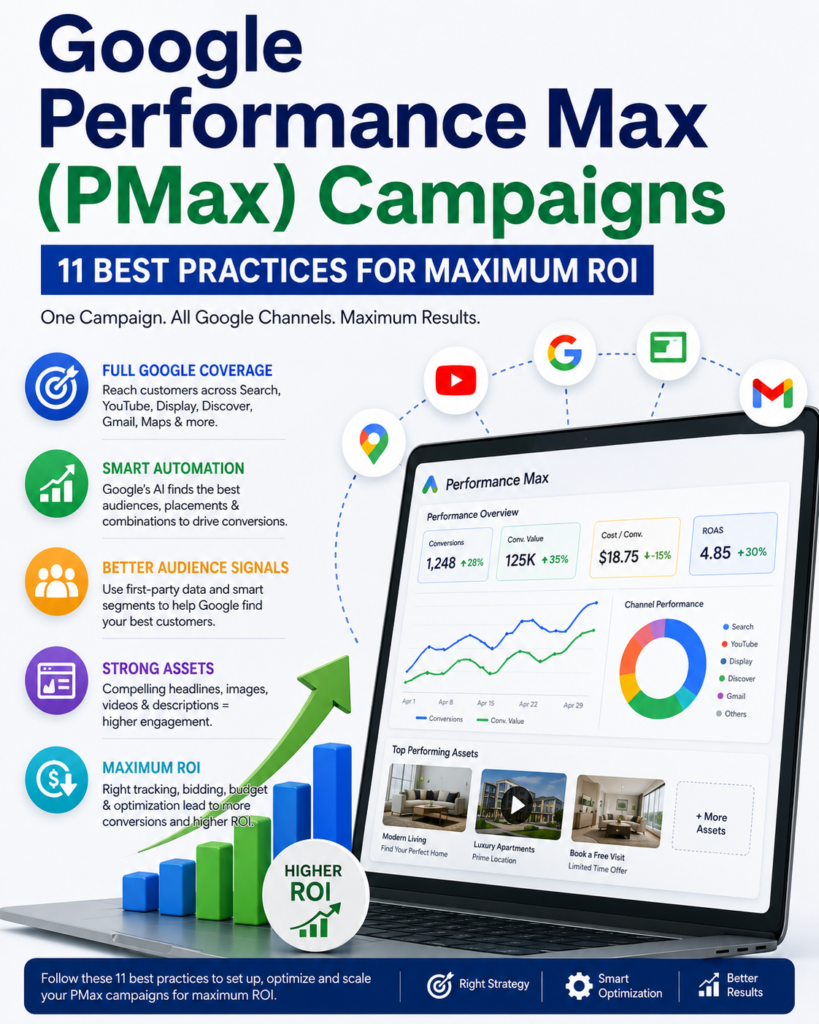
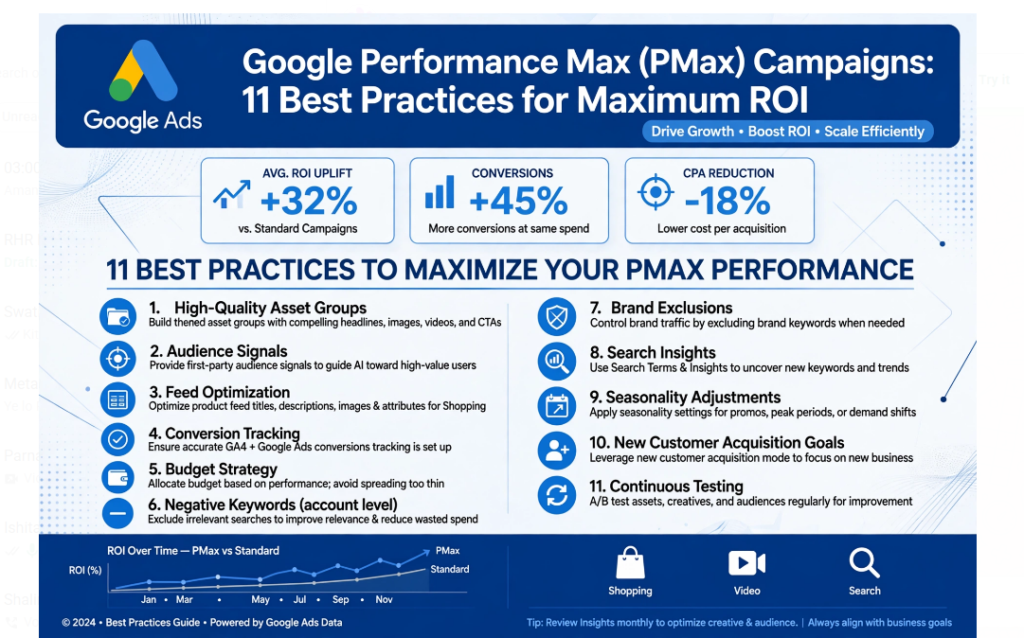
Google Performance Max (PMax) Campaigns: 11 Best Practices for Maximum ROI

Google Performance Max (PMax) Campaigns have become an important part of modern Google Ads strategies. For performance marketers, PMax offers an automated way to reach potential customers across Google’s advertising ecosystem while optimizing toward selected business goals.

However, launching a campaign is only the beginning. To get better results, marketers need accurate conversion tracking, relevant audience signals, strong creative assets, well-structured asset groups, appropriate bidding strategies, and careful performance analysis.

What Are Google Performance Max (PMax) Campaigns?

singh and sons

Google Performance Max (PMax) Campaigns are goal-based Google Ads campaigns designed to help advertisers reach customers across multiple Google properties. Depending on the campaign, settings, eligibility, and available inventory, ads can appear across Search, YouTube, Display, Discover, Gmail, Google Maps, and other Google surfaces.

Rather than manually controlling every placement, PMax uses automation and machine learning to make many campaign decisions. The marketer provides the business objective, conversion data, creative assets, audience information, and budget.

This makes Google Performance Max powerful, but it also creates a responsibility for advertisers. If the information supplied to the campaign is inaccurate or incomplete, automation may optimize toward outcomes that do not represent genuine business value.

Why Performance Max Matters for Performance Marketers

For performance marketers, the central objective is not simply generating traffic. The objective is generating measurable business results.

Google Performance Max (PMax) Campaigns can help marketers consolidate advertising activity while allowing Google Performance Max systems to identify opportunities across different channels.

This approach can be particularly useful for ecommerce brands, lead-generation businesses, local services, and companies with clearly defined conversion goals.

The important point is that automation should support strategy, not replace it.

How to Set Up Google Performance Max (PMax) Campaigns Correctly

singh and sons

A strong campaign begins with a clear objective. Before creating a PMax campaign, determine exactly what action represents success for the business.

For an ecommerce company, that may be a completed purchase. For a service business, it could be a qualified lead, phone enquiry, booking, or consultation.

Choose the Right Conversion Goal

Your campaign should optimize toward actions that genuinely matter.

If your business wants sales, do not treat page views as equivalent to purchases. If your goal is qualified leads, try to distinguish valuable enquiries from low-quality submissions.

The principle is straightforward: give the campaign data that reflects the outcome you actually want to increase.

Use Accurate Conversion Tracking

Conversion tracking is one of the most important components of Google Performance Max (PMax) Campaigns.

Automated bidding relies heavily on conversion signals. If tracking is broken, duplicated, incomplete, or measuring the wrong actions, campaign optimization can become misleading.

Before launching or scaling a campaign, verify that important conversions are being recorded correctly. Check forms, purchases, phone calls, bookings, and other meaningful actions according to your business model.

Use Conversion Values Where Appropriate

Not every conversion necessarily has the same economic value.

For example, an ecommerce business may have products with significantly different order values. Similarly, a lead-generation company may have leads with different probabilities of becoming paying customers.

Where reliable business data is available, assigning appropriate values can help create a closer relationship between advertising optimization and commercial outcomes.

Optimize Audience Signals

Audience signals are another important consideration when managing Google Performance Max (PMax) Campaigns.

Relevant audience information can help Google Performance Max systems understand the types of users who may be valuable to a business.

Depending on your campaign and available Google Ads features, useful inputs may include customer lists, previous purchasers, remarketing audiences, custom segments, and other relevant audience information.

Use First-Party Data Strategically

First-party data can be especially useful because it comes from your own customer or prospect interactions.

For example, an online retailer may have information about previous purchasers. A B2B company may have data about qualified leads. A service company may know which enquiries eventually became customers.

Such information can help communicate what a valuable customer looks like.

However, audience signals should be used responsibly and in accordance with applicable privacy requirements and Google’s policies.

Do Not Treat Audience Signals as Strict Targeting

One important distinction is that audience signals should not automatically be viewed as a rigid targeting restriction.

They provide useful information to Google’s automated systems, which can then help identify additional potential customers.

Therefore, performance marketers should focus on supplying high-quality signals rather than attempting to manually restrict every possible user.

Build Better Asset Groups

Asset groups are a major part of Google Performance Max (PMax) Campaigns.

An asset group should have a logical theme based on a product, service, audience, or business proposition.

For example, a real estate company could have separate themes for luxury properties, residential apartments, and investment properties.

This approach makes it easier to align the creative message with the user’s likely needs.

Create Relevant Headlines and Descriptions

Your headlines and descriptions should communicate clear benefits.

Instead of filling every asset with slightly different versions of the same sentence, develop different messages around:

  • Product benefits
  • Customer problems
  • Unique selling points
  • Offers
  • Service features
  • Trust factors
  • Calls to action

The goal is to give Google’s systems meaningful creative variations rather than repetitive wording.

Use High-Quality Images and Video

Creative quality can have a significant influence on advertising performance.

Use relevant images that clearly communicate the product or service. Where appropriate, provide different visual formats and strong video assets.

Your creative should work even when the user has only a few seconds of attention.

Ask yourself: Can someone understand what I am offering without reading every word?

If the answer is no, your creative may need improvement.

Review Search-Term Insights

Search-term insights can help performance marketers understand the types of searches associated with campaign activity.

Review these insights regularly to identify:

  • Relevant customer themes
  • Unexpected search behavior
  • Irrelevant queries
  • New keyword opportunities
  • Potential content ideas

These insights can also influence your broader Google Ads strategy.

Even though PMax is highly automated, marketers should still analyze the information available and use it to improve their overall advertising decisions.

Use Negative Keywords Carefully

Negative keyword controls can be useful when you identify search themes that are consistently irrelevant to your business.

For example, a premium service provider might discover searches related to free services, employment, training, or unrelated products.

However, avoid creating an enormous exclusion list simply because a keyword looks unusual.

Avoid Over-Exclusion

Overly aggressive negative keyword strategies can restrict potentially valuable traffic.

A better approach is to look for clear patterns of irrelevant intent and evaluate their business impact before adding exclusions.

Think of negative keywords as a filter, not a wall.

Manage Budget and Bidding Strategically

Budget management is critical for Google Performance Max (PMax) Campaigns.

A campaign needs an appropriate budget relative to its goals, conversion volume, market size, and economics.

Avoid changing budgets dramatically without a clear reason. Large or frequent changes can make it harder to understand campaign behavior and evaluate the effect of your strategy.

Instead, monitor metrics such as:

  • Cost per acquisition
  • Conversion value
  • Return on ad spend
  • Conversion volume
  • Qualified lead volume
  • Customer value

The most important metric depends on your business model.

Give Performance Max Time to Learn

Automated campaigns need sufficient data to identify useful patterns.

One common mistake is checking results too quickly and making major changes after every short-term fluctuation.

Performance marketers should evaluate meaningful trends rather than reacting emotionally to individual days.

This does not mean ignoring poor performance. It means distinguishing between normal variation and a genuine strategic problem.

Test Asset Groups and Creative Messages

Testing should be structured.

Instead of changing your budget, audience signals, bidding, landing page, and creative at the same time, create a clear hypothesis.

For example:

“A benefit-focused headline may generate more qualified conversions than a feature-focused headline.”

Make the change, monitor relevant metrics, and compare results over an appropriate period.

This approach makes learning much easier.

Measure PMax Performance Beyond Clicks

Clicks are useful, but clicks alone do not determine profitability.

A campaign can generate thousands of clicks while producing very little business value.

For Google Performance Max (PMax) Campaigns, performance marketers should examine metrics that connect advertising activity with commercial results.

For ecommerce, this could include revenue, conversion value, acquisition cost, and ROAS.

For lead generation, marketers should consider qualified leads, lead-to-customer rates, customer acquisition cost, and eventual sales value.

Avoid Constant Campaign Changes

Another common mistake is excessive intervention.

Changing campaigns every day can make optimization confusing. If the budget, creative, bidding strategy, conversion goals, and audience signals all change simultaneously, it becomes difficult to identify what actually affected performance.

Create a change log and document significant adjustments.

This simple habit can make your optimization process far more systematic.

Build a Consistent PMax Optimization Routine

Successful Google Performance Max (PMax) Campaigns require continuous evaluation.

A weekly review can include:

  1. Checking conversion tracking.
  2. Reviewing conversion volume and value.
  3. Examining search-term insights.
  4. Reviewing asset performance.
  5. Checking budget utilization.
  6. Evaluating lead or customer quality.
  7. Identifying irrelevant traffic.
  8. Reviewing major campaign changes.

A longer-term review can focus on profitability, customer value, creative trends, and scaling opportunities.

Common Google Performance Max Mistakes to Avoid

Several mistakes can limit PMax performance.

First, launching without reliable conversion tracking can send automated bidding in the wrong direction.

Second, optimizing for cheap conversions rather than valuable customers can create misleading performance.

Third, weak or repetitive creative assets can limit the campaign’s ability to communicate effectively.

Fourth, excessive campaign fragmentation can make data harder to interpret.

Finally, constant manual changes can prevent marketers from learning what actually works.

The best approach is not to control everything. It is to control the important things well.

How to Maximize ROI From Google Performance Max (PMax) Campaigns

singh and sons

Maximizing ROI requires a complete Google Performance Max rather than one optimization trick.

Start with accurate conversion tracking. Then establish meaningful business goals. Provide useful audience signals, create strong asset groups, improve creative quality, analyze search-term insights, use negative keyword controls carefully, and manage budgets according to business economics.

Most importantly, measure outcomes that matter.

A campaign with fewer conversions but higher-value customers may be significantly more successful than a Google Performance Max producing a large number of inexpensive conversions.

ROI is ultimately about the relationship between what you spend and what you receive in return.

Frequently Asked Questions About Google Performance Max (PMax) Campaigns

1. What are Google Performance Max (PMax) Campaigns?

Google Performance Max (PMax) Campaigns are goal-based Google Ads campaigns that use automation to help advertisers reach potential customers across multiple Google advertising surfaces.

2. How can I improve the ROI of PMax campaigns?

Improve conversion tracking, use meaningful conversion goals, provide relevant audience signals, create strong creative assets, manage budgets carefully, review search-term insights, and focus on valuable conversions rather than clicks alone.

3. Are audience signals important for PMax?

Yes. Relevant audience signals can provide useful information about potential customers. However, they should generally be treated as signals that guide Google Performance Max systems rather than as rigid targeting restrictions.

4. Should I use negative keywords in PMax campaigns?

Negative keyword controls can help reduce genuinely irrelevant traffic. However, they should be applied carefully because excessive exclusions can potentially remove valuable opportunities.

5. How often should I optimize a Performance Max campaign?

Regular monitoring is useful, but avoid making major changes based on every short-term fluctuation. A structured review schedule allows marketers to identify meaningful trends and make more informed decisions

Google Performance Max (PMax) Campaigns can become a powerful growth channel when advertisers look beyond basic campaign settings. The real opportunity lies in understanding how different parts of the customer journey influence advertising results.

Instead of treating every conversion equally, marketers should examine what happens after someone clicks an advertisement. A campaign becomes more valuable when advertising data is connected with genuine customer behaviour.

1. Understand the Complete Customer Journey

A customer rarely moves directly from seeing an advertisement to making a purchase. They may visit the website, compare alternatives, return later, read reviews, and finally complete a transaction.

Understanding this journey helps marketers identify where potential customers are dropping out. Those insights can be used to improve landing pages, offers, messaging, and the overall advertising experience.

2. Connect Advertising With Business Profit

Revenue alone does not tell the complete story. A campaign can produce impressive sales figures while generating disappointing profits because of product costs, discounts, shipping, or other expenses.

For Google Performance Max (PMax) Campaigns, marketers should therefore understand the relationship between advertising expenditure and actual business profitability before deciding to increase spending.

Look Beyond the Cost Per Conversion

A low cost per conversion may look attractive, but the quality of those conversions matters. A cheaper customer who rarely purchases again may be less valuable than a customer with a higher initial acquisition cost and stronger lifetime value.

3. Improve the Landing Page Experience

Advertising and landing pages should work together. If your advertisement promotes a particular service, product, or offer, visitors should immediately find relevant information after clicking.

Remove unnecessary distractions and make the desired action obvious. A simple layout, clear benefits, visible contact information, and a straightforward conversion process can reduce unnecessary friction.

4. Adapt to Seasonal Customer Behaviour

Customer demand does not remain constant throughout the year. Certain products may become more popular during festivals, holidays, weather changes, academic seasons, or special events.

Marketers should examine historical performance to identify these patterns. Understanding when demand naturally increases can help businesses plan promotional messages and budgets more intelligently.

Monitor Changes in Market Demand

Sudden performance changes are not always caused by Google Performance Max settings. Competitor promotions, economic conditions, new products, and changing consumer preferences can also affect results.

Before making major adjustments, consider what is happening outside the advertising account. Market context can prevent unnecessary campaign changes.

5. Keep Your Creative Strategy Fresh

Creative fatigue can become a challenge when customers repeatedly encounter similar advertisements. Even if the offer remains unchanged, the presentation can evolve.

Experiment with different storytelling approaches, product demonstrations, customer problems, benefits, and emotional triggers. Each creative idea should have a clear purpose rather than simply being another variation.

6. Analyze Performance by Product or Service

Businesses with multiple products or services should avoid looking only at campaign-level results in Google Performance Max . Some categories may generate excellent returns while others consume budget without producing sufficient value.

Breaking performance into meaningful business segments can reveal where opportunities and weaknesses exist. This information can support better promotional priorities and resource allocation.

7. Turn Search Behaviour Into Marketing Insights

Search behaviour can reveal what customers actually want, even when their interests differ from what marketers originally expected.

Look for recurring themes, questions, product combinations, and emerging interests. These insights can inspire new landing pages, blog topics, offers, and advertising messages.

Discover New Customer Opportunities

Unexpected search themes can sometimes expose new market segments. A product may attract customers for reasons that were not part of the original marketing strategy.

Instead of ignoring these patterns, investigate them. Valuable customer insights often appear in places marketers initially overlook.

8. Reduce Friction Before the Conversion

A visitor can have strong purchase intent and still abandon the process because something feels difficult. Complicated forms, unclear pricing, slow pages, or excessive steps can create unnecessary barriers.

Review your conversion process from the customer’s perspective. Ask whether someone using a mobile phone can understand the offer and complete the desired action without confusion.

9. Create a Disciplined Testing System

Effective optimization is easier when experiments are documented. Record what was changed, why it was changed, when the test started, and what result you expected.

This creates a history of campaign learning. Over time, your team can identify patterns instead of repeatedly making decisions based on assumptions.

Measure Long-Term Business Growth

Short-term campaign performance is useful, but long-term trends provide a broader perspective. Customer retention, repeat purchases, qualified leads, and lifetime value can reveal whether advertising is creating sustainable growth.

The best Google Performance Max (PMax) Campaigns are not necessarily those producing the largest number of immediate conversions. They are campaigns that consistently contribute valuable customers and support profitable business growth.

Final Thoughts

Google Performance Max (PMax) Campaigns work best when automation is combined with strong business understanding. Marketers should study customer journeys, profitability, market behaviour, creative performance, product-level results, and conversion experience instead of relying on a single metric.

When these areas are reviewed systematically, PMax becomes more than an advertising campaign. It can become a valuable source of customer intelligence, helping businesses make smarter decisions and build a more sustainable path toward maximum ROI.

Google Performance Max (PMax) Campaigns: 11 Best Practices for Maximum ROI Read More »

Property Paperwork in Delhi

Property Paperwork in Delhi: 7 Crucial Mistakes to Avoid When Buying a Home

Property paperwork in Delhi is one of the most important parts of buying a home safely. Buyers must carefully verify the chain of title, encumbrances, registration records, property tax, approvals, and other documents before paying a token amount or signing a sale agreement.

Buying a property in Delhi can be exciting, but the paperwork involved can also be complicated. From DDA properties and builder floors to independent houses and apartments, every property can have a different documentation history. A single missing document or incorrect record can create serious problems during registration, home loan processing, resale, or future ownership disputes.

For buyers looking at areas such as Vasant Vihar, Greater Kailash, Dwarka, Rohini, Punjabi Bagh, or other parts of Delhi, understanding the documentation process is essential. This guide explains seven common property paperwork mistakes in Delhi and shows how buyers can reduce the risk of legal and financial problems.

Why Property Paperwork in Delhi Matters Before Buying a Home

Property paperwork in Delhi involves more than simply checking the seller’s Sale Deed. Buyers should understand how ownership was created, transferred, recorded, and maintained over the years.

singh and sons

Depending on the property, documents may involve the Delhi Development Authority (DDA), Municipal Corporation of Delhi (MCD), Sub-Registrar Office, Revenue Department, or other authorities.

The Delhi Revenue Department provides information related to property registration, registration records, e-search facilities, encumbrance search, circle rates, and property registration procedures. Buyers should use official government records wherever possible instead of relying only on documents provided by a seller or broker.

You can also review official property registration information from the Delhi Revenue Department before completing your transaction.

Internal resource: Delhi real estate market expertise

Mistake 1: Not Verifying the Complete Chain of Title

singh and sons

One of the biggest mistakes in property paperwork in Delhi is checking only the current owner’s Sale Deed https://singhporperties.com/

A buyer should understand the complete ownership history of the property. This is commonly referred to as the chain of title. It means checking how ownership moved from one owner to another through documents such as Sale Deeds, Conveyance Deeds, inheritance documents, allotment letters, possession letters, or other relevant records.

For example, if the current seller purchased the property from another owner, the buyer should not automatically assume that the seller’s document proves the entire title. Earlier documents may also need to be examined.

For DDA properties, buyers may need to review documents such as the original allotment letter, possession documentation, conveyance deed, or other relevant DDA records depending on the property.

A missing link in the ownership history can create difficulties when you try to sell the property later or obtain financing.

What Buyers Should Check

Before buying a property, check:

  • Previous Sale Deeds or Conveyance Deeds
  • Original allotment documents where applicable
  • Possession documents
  • Inheritance documents, if applicable
  • Death certificates and succession documents where relevant
  • Previous transfer documents
  • Property registration records
  • Seller’s identity and ownership details

Do not depend only on verbal confirmation from the seller. Proper property paperwork in Delhi requires documentary verification.

Mistake 2: Ignoring Encumbrances and Existing Liabilities

Another important part of property paperwork in Delhi is checking whether the property has any registered encumbrance, mortgage, charge, attachment, or other liability.

An Encumbrance Certificate or relevant registration search can help buyers investigate registered transactions affecting a property. However, buyers should understand that no single document should automatically be treated as proof that there can never be any dispute or liability.

The Delhi Revenue Department provides online information and search facilities for property registration records and encumbrance searches. Buyers should verify the relevant records through official sources and, where necessary, conduct additional legal due diligence.

A seller saying that the property is “completely clear” is not enough.

Documents and Checks to Consider

Before paying a substantial amount, consider checking:

  • Registration records
  • Encumbrance or registered charge information
  • Existing mortgage or loan documents
  • Court-related information where relevant
  • Seller’s declaration regarding liabilities
  • Original title documents
  • Bank NOC, if the property was financed
  • Relevant government records

For complicated transactions, professional legal verification can provide an additional layer of protection.

Internal resource: personalized property search in Delhi

Mistake 3: Miscalculating Circle Rate and Stamp Duty

Stamp duty and registration charges are another important part of property paperwork in Delhi.

The amount payable can depend on the applicable consideration value, circle rate, type of document, and other rules. The Delhi Revenue Department currently states that stamp duty for a Sale Deed is 6% for a male buyer and 4% for a female buyer, while registration fee is generally 1% of the total value, subject to applicable rules and charges.

Because government rates and procedures can change, buyers should always verify the latest information from the official Delhi Revenue Department before registration.

Do not simply calculate the charges based on information from an old property agreement, broker, or social media post.

Why Accurate Valuation Matters

A buyer should compare the transaction value with the applicable circle rate and understand which value is relevant for stamp duty and registration.

Under-declaring the value of a transaction to reduce taxes can create legal and financial risks. Buyers should maintain accurate documentation and follow the applicable government requirements.

The official Delhi Revenue Department provides information about property registration, circle rates, and related procedures.

External resource: https://revenue.delhi.gov.in/revenue/property-registration

Mistake 4: Ignoring MCD Property Tax Records

Property tax records are another important part of property paperwork in Delhi.

Before buying a property, buyers should check whether property tax payments are up to date and whether the property details match the actual property being purchased.

The Municipal Corporation of Delhi provides an online property tax portal where users can search property details, manage property tax information, and access services related to mutation or e-change of name.

Buyers should carefully compare the property address, owner details, UPIC information, and available tax records.

Check These Property Tax Details

Before completing the purchase, review:

  • Latest property tax receipts
  • Outstanding tax amounts
  • Property address
  • Owner information
  • UPIC details
  • Property classification
  • Relevant MCD records
  • Mutation or e-change of name information where applicable

The MCD portal states that a UPIC, or Unique Property Identification Code, is used for property tax-related services.

External resource: https://mcdonline.nic.in/

Do not assume that an old tax receipt automatically proves clear ownership. Tax records and title documents serve different purposes and should be checked separately.

Mistake 5: Forgetting to Verify Building Approvals and Occupancy Documents

Another common mistake in property paperwork in Delhi is focusing only on ownership documents while ignoring the legality of the building itself.

A property may have an ownership document but still have issues related to construction approvals, sanctioned plans, additional floors, building permissions, or occupancy requirements.

This is particularly important when buying builder floors, independent houses, or properties that have undergone structural changes.

What Should You Verify?

Depending on the property type, buyers should consider checking:

  • Sanctioned building plan
  • Completion-related documents
  • Occupancy Certificate, where applicable
  • Building permissions
  • Number of approved floors
  • Covered area
  • Property layout
  • Relevant DDA or MCD approvals
  • Any notices or violations affecting the property

Do not assume that every floor visible in a property is automatically approved.

If the actual construction does not match the sanctioned plan, the buyer could face problems later. A professional property lawyer or qualified expert can help determine which approvals are required for the specific property.

Mistake 6: Assuming Sale Deed and Mutation Are the Same

A registered Sale Deed and mutation are not the same thing, and confusing them can create problems in property paperwork in Delhi.

The Sale Deed is the document through which the property transaction is legally documented and registered according to applicable law. Mutation, on the other hand, relates to updating the relevant government or municipal records after a transfer.

MCD provides an online service for mutation or e-change of name in municipal records. The exact process can depend on the type of property and the authority maintaining the relevant record.

Why Mutation Matters

After purchasing a property, buyers should determine whether mutation or e-change of name is required and complete the applicable process.

Depending on the property, this can help update records relating to:

  • Municipal property records
  • Property tax records
  • Owner information
  • UPIC-related information
  • Other applicable government records

Do not assume that registration automatically updates every government record.

External resource: https://mcdonline.nic.in/portal/mService

Mistake 7: Paying Token Money Before Proper Document Verification

One of the most expensive mistakes buyers can make is paying a large token amount before completing document verification.

A property may look perfect during a site visit, but the legal documents can reveal issues that are not visible physically.

Before paying a substantial token amount, buyers should first review the available title documents, seller details, property tax records, registration information, approvals, and other relevant paperwork.

A Simple Pre-Purchase Document Checklist

Before committing to the transaction, check:

  • Seller’s identity documents
  • Complete title chain
  • Current Sale Deed
  • Previous ownership documents
  • Registration records
  • Encumbrance or charge information
  • Property tax receipts
  • UPIC details where applicable
  • Building approvals
  • Occupancy-related documents where applicable
  • Bank NOC if applicable
  • Mutation status
  • Relevant DDA, MCD, or Revenue Department records
  • Any available litigation or dispute information

This checklist does not replace professional legal advice, but it can help buyers identify obvious documentation gaps before moving forward.

Property Paperwork in Delhi: How Singh Properties Can Help

At Singh Properties, we understand that buying a Property Paperwork in Delhi is not only about finding the right location and price. Proper property paperwork in Delhi is equally important for protecting your investment.

Our approach focuses on helping buyers understand the documentation involved in a property transaction and identify areas that require further verification.

From title-related documents and registration records to property tax information and local documentation, each transaction requires careful attention to detail.

Our Delhi real estate market expertise helps buyers understand the local property market, while our personalized property search in Delhi focuses on matching buyers with suitable properties.

For complicated legal matters, we recommend consulting a qualified property lawyer before signing binding documents or making significant payments.

Final Checklist for Property Paperwork in Delhi

Before buying a home, do not rush through the documentation process.

Make sure you have reviewed the ownership history, current title documents, registration records, property tax information, applicable building approvals, and mutation requirements.

Most importantly, never rely only on verbal promises. Proper documentation should support every major claim made about the property.

Final Property Paperwork in Delhi and Buying Checklist

  • Verify the complete chain of title.
  • Check registration records.
  • Investigate encumbrances and registered liabilities.
  • Confirm applicable circle rates and registration charges.
  • Review MCD property tax records.
  • Check UPIC information where applicable.
  • Verify sanctioned building plans.
  • Check occupancy-related documents where applicable.
  • Understand the mutation or e-change of name process.
  • Get legal advice before signing important documents.
  • Keep copies of all important documents and receipts.

Conclusion

Property paperwork in Delhi should never be treated as a minor formality. It is one of the most important parts of protecting your ownership, finances, and future resale prospects.

From verifying the chain of title and checking registration records to reviewing Property Paperwork in Delhi tax, building approvals, and mutation requirements, buyers need to approach the transaction carefully.

If you are planning to buy a home in Delhi, take the time to verify the documents before paying a major amount or signing a binding agreement. A careful documentation process today can help prevent expensive legal and financial problems tomorrow.

For professional assistance with your property search, explore our Delhi real estate market expertise or start a personalized property search in Delhi.

Property paperwork in Delhi is one of the most important parts of buying a home safely. Before making a payment, buyers should carefully check ownership documents, registration records, tax receipts, approvals, and other relevant paperwork.

Buying a home can be exciting, but incorrect or incomplete documents can create serious problems later. A property may look perfect during a site visit while its paperwork contains ownership disputes, unpaid dues, or approval issues.

The first step in property paperwork in Delhi is verifying the seller’s ownership. Buyers should check the current Sale Deed and compare the seller’s name, property address, identification details, and other information with the available official records.

Buyers should also examine the complete chain of title. Previous Sale Deeds, Conveyance Deeds, allotment documents, possession documents, or inheritance papers may be required depending on how the property was originally acquired.

Another important part of property paperwork in Delhi is checking for registered encumbrances. Buyers should investigate whether the property has an existing mortgage, charge, attachment, or other registered liability before completing the transaction.

An Encumbrance Certificate or appropriate registration search can provide useful information about registered transactions. However, buyers should not depend on one document alone when making an important property investment.

Property tax records should also be reviewed before buying a home. Buyers can check available MCD records, tax receipts, outstanding dues, and property identification details to ensure that the information is consistent.

A buyer should pay particular attention to the property’s UPIC details where applicable. Differences between municipal records and the documents provided by the seller should be investigated before moving forward.

Stamp duty and registration charges are another important consideration. The applicable amount can depend on the property’s value, applicable circle rate, ownership structure, and current government rules.

Buyers should always verify the latest circle rates and registration requirements through official government sources. Avoid relying on outdated information provided by an agent, seller, or an old property agreement.

Building approvals are equally important in property paperwork in Delhi. Buyers should check whether the property’s actual construction matches the sanctioned building plan and whether additional floors or modifications have been properly approved.

Occupancy and completion-related documents may also be relevant depending on the type of Property Paperwork in Delhi . These documents can help buyers understand whether the building complies with applicable construction and occupancy requirements.

Builder floors and independent houses require particular attention because unauthorized construction can create significant problems. Buyers should compare the actual property with approved plans before paying a substantial amount.

Mutation is another area that buyers often misunderstand. Registration of a Sale Deed and updating municipal or other relevant records are separate processes, so buyers should understand whether mutation or e-change of name is required.

Before paying token money, buyers should review as many important documents as possible. A large payment should not be made simply because the seller promises that all paperwork will be completed later.

A written agreement should clearly mention important transaction terms, including the property details, payment schedule, responsibilities of both parties, and conditions related to documentation and outstanding dues.

Buyers should keep copies of every document received during the transaction. Digital scans can provide an additional backup, while original documents should be handled carefully and verified whenever required.

Professional legal verification can be especially useful for properties with complicated ownership histories. A qualified property lawyer can review documents and identify potential legal issues that may not be obvious to an ordinary buyer.

At Singh Properties, we understand that property paperwork in Delhi requires careful attention to local documentation and property-specific requirements. Buyers can benefit from a structured approach instead of relying only on verbal assurances.

Our Delhi real estate market expertise helps buyers understand different property options, while our personalized property search in Delhi can help them identify suitable homes according to their requirements.

The safest approach is to complete documentation checks before signing important agreements or making major payments in Property Paperwork in Delhi . Taking extra time during the verification stage can help buyers avoid unnecessary financial and legal complications.

In conclusion, property paperwork in Delhi should never be treated as a simple formality. Checking title documents, registration records, tax information, approvals, mutation requirements, and liabilities can make the home-buying process much safer and more transparent.

If you are planning to purchase a home and Property Paperwork in Delhi, make documentation verification a priority from the beginning. Careful property paperwork in Delhi can help protect your investment and give you greater confidence before completing the purchase.

singh and sons

Thank you https://singhporperties.com/

Property Paperwork in Delhi: 7 Crucial Mistakes to Avoid When Buying a Home Read More »

Property Market

Property Market Cools: 7 Warning Signs Estate Agents Face

Property Market Cools: Summer Slowdown Hits Estate Agents

Long periods of hot weather appear to have added to the traditional summer slowdown in the property market. More than three-quarters of estate agents expect activity to be weaker than usual for this time of year.

A survey of UK estate agents commissioned by GetAgent found that 78% expect property market activity this summer to be below normal holiday-period levels. Just 13% expect a typical summer, while 9% anticipate stronger activity.

Property Market Cools During Summer Holidays

The school holidays already tend to result in fewer people entering the market. Almost two-thirds (64%) of agents said seller activity usually declines during the summer break. Of those, 45% reported a significant reduction.

Buyer demand in the property market follows a similar pattern. Some 58% of agents said they typically receive fewer new buyer enquiries during the school holidays. This includes 27% who described the reduction as significant.

Hot Weather Adds Pressure to the Property Market

This year, however, agents believe prolonged hot weather has put further pressure on activity.

Nine in 10 respondents (91%) said particularly hot weather had reduced activity in their local market this summer. More than half (55%) reported a significant impact.

Property Viewings See the Biggest Impact

Property viewings appear to have been most affected, cited by 53% of agents. A further 28% identified buyer enquiries, while 19% pointed to seller enquiries.

Estate Agents Remain Busy Despite Slower Activity

Despite fewer buyers and sellers entering the property market, agents’ workloads have not necessarily fallen.

Almost three-quarters (74%) said they remain as busy as usual or become busier progressing existing transactions during the summer holidays. Sales agreed earlier in the year continue to move towards exchange and completion.

Staff Holidays Create Additional Pressure

Staff holidays can add to the pressure. Some 45% said annual leave makes workloads harder to manage during the school holidays. More than a quarter (27%) said reduced staffing has a significant impact on operational efficiency.

Property Market Cools as Buyer Demand Falls

Property Market Cools as buyers become more cautious and demand starts to slow. Estate agents are facing increasing pressure as fewer people are actively looking to buy homes.

Rising costs, changing interest rates, economic uncertainty, and limited affordability are influencing buyer decisions. Sellers are also becoming more flexible with prices to attract serious customers.

Lower Buyer Demand

One major warning sign is lower buyer demand. Many potential buyers are delaying their decisions because of affordability concerns, higher living costs, and uncertainty about future property prices.

Longer Property Listing Times

Another challenge is longer property listing times. Homes that previously attracted offers quickly may now remain on the market for several weeks or months, putting additional pressure on estate agents.

Increasing Price Sensitivity

Price sensitivity is also increasing. Buyers are comparing more properties before making an offer, while sellers may need to adjust their asking prices to remain competitive.

Estate Agents Face Stronger Competition

Estate agents are also experiencing stronger competition. With more agencies competing for the same customers, having a strong online presence and effective marketing strategy has become increasingly important.

Digital Marketing for Estate Agents

Digital marketing can help agents reach potential customers more effectively. Google Ads, social media campaigns, SEO, and email marketing can generate valuable enquiries and improve brand visibility.

Changing Buyer Behaviour

Another important factor is changing buyer behaviour. Customers now research properties, prices, locations, and reviews online before contacting an estate agent.

How Estate Agents Can Adapt

Estate agents must now adapt their marketing strategies and focus on understanding changing customer needs. Digital marketing, targeted advertising, and strong online visibility can help agents generate quality leads.

Use SEO and Google Ads

Search engine optimisation can help estate agents reach people actively searching for properties. Google Ads can also target users searching for buying, selling, renting, valuations, and property services.

Improve Online Property Listings

Professional photography, detailed descriptions, virtual tours, and accurate property information can make listings more attractive and encourage potential buyers to enquire.

Focus on Lead Follow-Up

Lead follow-up is equally important. A potential buyer who does not respond immediately may still become a customer later, so consistent and professional follow-up can increase conversion opportunities.

Opportunities Despite a Cooling Property Market

Despite the challenges, opportunities remain available for businesses that adapt. A slower market can encourage estate agents to improve their processes and focus on higher-quality leads.

Agencies that combine SEO, Google Ads, social media, strong listings, and excellent customer service can continue attracting potential buyers even when competition increases.

Conclusion: Property Market Cools but Opportunities Remain

Ultimately, the cooling property market presents challenges, but it also rewards businesses that respond quickly. Estate agents that understand changing buyer behaviour and provide genuine value can continue generating leads and achieving successful sales.

Property Market Cools: 7 Warning Signs Estate Agents Face

Property Market Cools as Summer Activity Slows

Property Market Cools as buyers and sellers become more cautious during the summer period. Hot weather, school holidays, and changing economic conditions are contributing to lower activity across the property sector.

Buyer Demand Begins to Slow

Many potential buyers are taking longer to make decisions. They are comparing prices, checking mortgage costs, and waiting for better opportunities before committing to a property purchase.

Sellers Face New Challenges

Sellers may also need to adjust their expectations. Properties can remain listed for longer, while competitive pricing and effective marketing become increasingly important for attracting serious buyers.

Property Market Cools With Fewer Enquiries

Estate agents are reporting fewer enquiries during the seasonal slowdown. While this can create challenges, genuine buyers and sellers are still active and continue to move transactions forward.

Longer Property Listing Times

Properties that previously attracted quick offers may now take longer to sell. Estate agents need strong property descriptions, professional images, and targeted advertising to maintain visibility.

Importance of Professional Marketing

High-quality photography, virtual tours, SEO, and social media promotion can help properties stand out. A strong online presence can attract potential customers even when overall market activity is weaker.

Digital Marketing Can Generate Leads

Estate agents can use digital marketing to reach customers actively searching for properties. Google Ads, SEO, social media campaigns, and email marketing can support lead generation and improve online visibility.

Google Ads for Estate Agents

Targeted Google Ads campaigns can connect agencies with people searching for properties, valuations, rentals, and estate agent services. Carefully selected keywords can help improve the quality of enquiries.

SEO for Property Websites

SEO can bring long-term organic traffic to property websites. Creating useful content about local areas, property prices, buying advice, and market trends can help agencies attract relevant visitors.

Estate Agents Need to Adapt

A cooling market does not mean opportunities disappear. Estate agents that understand changing buyer behaviour and improve their marketing strategies can continue attracting customers and generating successful property leads.

Focus on Customer Experience

Fast responses, accurate information, flexible viewing appointments, and regular communication can help agencies build trust. Excellent customer service may encourage buyers and sellers to choose one agency over another.

Conclusion

The Property Market Cools during periods of weaker activity, but adaptable estate agents can still succeed. Combining strong marketing, digital visibility, quality listings, and customer service can help businesses maintain their pipeline and convert genuine opportunities into sales.

Property Market Cools: 7 Warning Signs Estate Agents Face

Property Market Cools as Summer Activity Slows

Property Market Cools as buyers and sellers become more cautious during the summer period. Hot weather, school holidays, and economic uncertainty can all contribute to reduced activity across the property sector.

Buyer Demand Starts to Decline

Many potential buyers are taking longer to make purchasing decisions. They are comparing property prices, mortgage costs, locations, and available options before deciding whether to proceed.

Why Buyers Are More Cautious

Affordability remains an important consideration. Rising household expenses can make buyers more careful about taking on a large financial commitment, particularly when borrowing costs are high.

Seller Activity Also Changes

Sellers may become more flexible when market activity slows. Some homeowners may adjust their asking prices, improve their property presentation, or wait for stronger demand before making a final decision.

Longer Property Listing Times

Properties can remain available for longer periods when buyer demand weakens. This can create additional pressure for estate agents who need to manage seller expectations and continue generating enquiries.

Property Market Cools During School Holidays

School holidays traditionally affect property activity because families often focus on travel, holidays, and childcare rather than moving home.

Fewer New Buyer Enquiries

Estate agents may receive fewer enquiries during holiday periods. However, the buyers who remain active can often be more serious about purchasing and may be closer to making a decision.

Serious Buyers Still Remain Active

A reduction in overall enquiries does not necessarily mean demand has disappeared. Genuine buyers can continue searching, arranging viewings, and negotiating on suitable properties.

Property Viewings Can Decline

Hot weather and holiday plans can also discourage people from attending property viewings. This can make it more difficult for agents to arrange appointments and maintain momentum.

Virtual Tours Can Help

Virtual tours and video walkthroughs provide potential buyers with an alternative way to explore properties. These tools can help maintain interest when physical viewings become less convenient.

Estate Agents Face Increasing Competition

As market activity becomes more challenging, competition between estate agencies can increase. Businesses need to demonstrate their value and create strong reasons for customers to choose their services.

Strong Online Presence Is Essential

A professional website can help estate agents attract potential customers. Property listings should include clear information, high-quality photographs, useful descriptions, and easy enquiry options.

Mobile-Friendly Property Websites

Many customers search for properties using smartphones. A mobile-friendly website can make it easier for visitors to browse listings, contact agents, and arrange viewings.

Professional Property Photography Matters

Property images create the first impression for many online buyers. High-quality photographs can make listings more attractive and encourage visitors to learn more.

Virtual Property Tours

Virtual tours can give buyers a better understanding of a property’s layout and features. They can also help agencies attract customers who are unable to attend an immediate viewing.

Digital Marketing Can Generate Leads

Digital marketing has become an important tool for estate agents looking to generate enquiries during a slower market.

Google Ads for Estate Agents

Google Ads can help agencies appear when potential customers search for property-related services. Campaigns can target buyers, sellers, landlords, renters, and people looking for valuations.

Target High-Intent Keywords

Keywords related to buying, selling, property valuation, and local estate agents can attract users with stronger commercial intent. Effective targeting can improve the quality of leads.

SEO Can Build Long-Term Traffic

Search engine optimisation can help property websites gain organic visibility. Useful content about local property markets, neighbourhoods, prices, and buying advice can attract relevant visitors.

Create Local Property Content

Local content can help agencies reach people searching for specific areas. Articles about schools, transport, amenities, house prices, and neighbourhoods can provide useful information while supporting SEO.

Changing Buyer Behaviour Affects Property Market

Modern buyers often conduct extensive research before contacting an estate agent. They may compare multiple properties, read reviews, check prices, and investigate neighbourhoods online.

Buyers Compare More Properties

Customers have access to more information than ever before. This makes it important for estate agents to provide accurate, detailed, and useful property information.

Transparent Property Information

Clear descriptions and realistic pricing can help build trust. Providing accurate details about properties can also reduce unnecessary enquiries and improve the overall customer experience.

Faster Communication Is Important

Potential buyers expect quick responses to their questions. Delayed communication can result in customers moving to another agency or property listing.

Lead Follow-Up Improves Conversions

Following up with potential buyers can increase the chances of converting enquiries into viewings and sales. Consistent communication helps agents maintain relationships with interested customers.

Property Market Cools but Opportunities Remain

A slower market can create challenges, but it can also provide opportunities for businesses that adapt quickly.

Focus on Quality Leads

Estate agents should focus on enquiries that show genuine interest and buying or selling intent. Better lead qualification can help sales teams use their time more effectively.

Use Data to Improve Marketing

Tracking website traffic, enquiries, advertising performance, and viewing requests can help agencies understand which marketing channels produce the best results.

Improve Customer Service

Excellent customer service can become a major competitive advantage. Quick responses, professional advice, flexible appointments, and regular updates can improve customer satisfaction.

Build Long-Term Relationships

Not every enquiry will immediately result in a transaction. Maintaining relationships with potential buyers and sellers can create future opportunities when market conditions improve.

Estate Agents Can Prepare for Recovery

Market conditions can change over time, and agencies should prepare for periods of stronger activity.

Maintain Consistent Marketing

Stopping marketing during a slowdown can reduce visibility. Consistent SEO, advertising, social media activity, and property promotion can help agencies remain visible to potential customers.

Use Social Media Effectively

Social media platforms can showcase new properties, market updates, customer testimonials, neighbourhood information, and useful property advice.

Email Marketing Can Support Leads

Email campaigns can keep potential customers informed about new listings, price changes, property news, and relevant opportunities.

Personalised Property Alerts

Personalised alerts can help customers discover properties that match their requirements. This can improve engagement and encourage more enquiries.

Conclusion: Property Market Cools but Estate Agents Can Adapt

The Property Market Cools when buyers and sellers become more cautious, seasonal activity declines, and economic uncertainty affects purchasing decisions. Estate agents may face fewer enquiries, longer listing times, and stronger competition.

However, a cooling market does not mean that opportunities disappear. Agencies that understand changing customer behaviour and continue investing in effective marketing can remain competitive.

The Importance of Digital Strategy

SEO, Google Ads, social media, email marketing, professional photography, and virtual tours can help estate agents attract and convert potential customers.

Turning Challenges Into Opportunities

By focusing on quality leads, improving customer service, monitoring marketing performance, and maintaining a strong online presence, estate agents can continue generating enquiries and progressing transactions.

Ultimately, businesses that adapt quickly to changing market conditions will be better positioned for long-term success.

Property Market Cools: 7 Warning Signs Estate Agents Face

Property Market Cools as Summer Activity Slows

Property Market Cools as buyers and sellers become more cautious during the summer period. Hot weather, school holidays, and economic uncertainty can reduce activity and make customers more careful about property decisions.

Buyer Demand Starts to Slow

Many potential buyers are taking longer to make decisions. They are comparing property prices, mortgage costs, locations, and available options before deciding whether to make an offer.

Affordability Remains Important

Rising household expenses and borrowing costs can influence purchasing decisions. Some buyers may delay moving plans until they feel more confident about their finances.

Estate Agents Face Longer Sales Cycles

When demand slows, properties can remain on the market for longer. Estate agents may need to work harder to attract enquiries and keep sellers informed throughout the process.

Strong Property Marketing Helps

Professional photography, detailed descriptions, virtual tours, and accurate property information can make listings more attractive to potential buyers.

Digital Visibility Creates Opportunities

SEO, Google Ads, social media, and property portals can help estate agents reach customers who are actively searching for homes and property services.

Property Market Cools but Opportunities Remain

A slower property market does not mean that genuine buyers and sellers disappear. Estate agents can still generate quality leads by understanding changing customer behaviour and providing excellent service.

Focus on Quality Leads

Agents should respond quickly to enquiries and maintain regular communication with potential customers. Effective follow-up can turn initial interest into viewings and successful transactions.

Adapt to Changing Demand

By using digital marketing, improving customer service, and monitoring market trends, estate agents can remain competitive even when the Property Market Cools.

Thank you. https://singhporperties.com/

Property Market Cools: 7 Warning Signs Estate Agents Face Read More »

Real Estate Trends

Top Real Estate Trends in 2026 That Will Rule the Market

Top Real Estate Trends & Forecasts in 2026

:

2024 proved to be a year of a new high for the Indian real estate market. Both, new launches and home sales saw a significant improvement last year and is expected to maintain the same momentum in 2026 as well. The real estate market in India has been tried and tested, and widely thought to be immune to the volatility in the market. Interestingly, the real estate market has stayed true to the expectations of real estate investors despite the number of ups and downs in the last couple of years.

Fortunately, positive expectations and a rise in the momentum of growth have demonstrated the market’s ability to persist and will continue to do so in 2026 and the upcoming years as well.

The real estate market in India offers something for every type of investor out there. Considering 2026, the general Indian economy shows encouraging indicators, including a rebound from the current stock market fall, a predicted increase in the creation of new employment opportunities, and an overall growth. These indicators will ultimately lead to a rise in the demand for housing societies in the country as more and more individuals step into the Real Estate Trends.

Let us take a look at some of the top real estate trends in 2026 that are predicted to rule theReal Estate Trends :

Shop-cum-Offices in Commercial

Shop-cum-offices, also known as SCO, is a commercial real estate class that has seen immense growth in the last few years. Gurugram is known as the most prominent and profitable location for shop-cum-offices in the National Capital Region. SCO plots have been made available for development and investment in several regions of Gurugram. Because of this, a new era of commercial SCO plots has emerged. Fortunately, the SCO markets have seen phenomenal growth and the early investors’ capital has multiplied multiple times as well. An investor in the SCO market can profit from longer leases, a higher income, and consistent cash flow.

House Hunting Going Digital

Digital platforms have existed forever, however, during and after the pandemic, the need for these platforms has multiplied across all industries. The real estate industry is no different. Over the last few months, individuals have made their home bookings via a digital platform. Additionally, other factors involved in a home-buying process such as a home tour, brokerage amount, rent amount, deposit amount, lease agreement, etc., have gone digital too. Furthermore, home loans can now be made online as well. This will serve as the basis for purchasing and selling Real Estate Trends in 2026.

Sellers’ Market

The upcoming housing market in 2026 will be a sellers’ market. It is anticipated that the prices of the housing market will rise for some time due to the growing demand for houses coupled with limited supply. Real Estate Trends , Generation Y will be initiating real estate investments for the first time this year. Accordingly, the housing demand for residential and commercial spaces will see an increase as well. The future of the real estate market in India will be marked by an increase in demand and a limited supply, thereby creating a seller’s market.

=> Read Also: Decoding the Real Estate Laws and Regulations in India – Old and New Property Rules

A Rise in Property Prices

Increased demand and the market becoming a sellers’ market will eventually lead to an increase in property prices. Homebuyers are aware of the rising prices. Interestingly, some buyers are even willing to pay more than the asking price in order to secure the acquisition.

Higher Interest Rates

The era of low-interest rates in Real Estate Trends is now over. The current geo-political scenario along with the mounting inflation will be putting pressure on the lending rates which are, therefore, expected to climb in 2026.

Tier-II Cities Becoming Residential Markets

Real Estate Trends increased proportion of investments will be moving to tier-II and tier-III cities in 2026. Certain government programmes such as AMRUT and Smart Cities Mission have helped these cities turn into excellent residential hubs. Furthermore, with an increase in job opportunities and economic growth, these cities are more likely to experience a dense residential population. Also, several of the tier-II and tier-III cities are either home to some Indian as well as global MNCs, or are well-connected to metropolitan cities in the country. This, in turn, will lead to residents moving to tier-II and tier-III cities and commuting for work every day.

Rental Market Slowing Down

Post-pandemic, the desire to have one’s own home has increased. People who can afford to buy a house will be investing in one. This will reduce the demand for rented properties in large metropolitan cities. Most people these days prefer to have their own house instead of renting one, due to the increase in parity with EMI values. Furthermore, an increase in people’s affordability will lead to the rental market slowing down in 2026.

With the rental market slowing down, the demand for homeownership will increase too. The market will see an increase in younger and first-time home buyers as well.

=> Read Also: Duplex House: Meaning, Type, Difference, Pros and Cons In 2026!

Growth in Office Leasing

The demand for office spaces, especially the IT and retail businesses will see a rise in 2026. Real Estate Trends,Furthermore, e-commerce and third-party logistics companies will feel the need to invest in warehousing, which will make them the fastest-growing commercial real estate segment. Apart from these, investments in data centres will see an increase too.

Summing Up

Real estate investment in India has never been an easy choice. With sales in various locations increasing significantly, it will make people understand the importance of owning their own real estate assets. With 2024 picking up some real estate trends, it is likely that these trends will continue in 2026 as well, along with any new real estate trends and forecasts that the market might see.

Adani Realty, one of the top real estate companies in India, is known for its stellar delivery reputation and legacy of building some of the most luxurious structures in the country. We promise a comfortable yet luxuriant lifestyle to our residents, along with access to world-class amenities and facilities for a secure living experience. Their trust and excellence are integrated with beautiful design aesthetics and cutting-edge construction techniques to develop exemplary projects in India’s most promising cities.

Top Real Estate Trends in 2026 That Will Rule the Market Read More »

Real Estate Marketing

10 strong Standards for Real Estate Marketing – In Conversation with Tata Housing’s Marketing Stalwart

10 strong Standards for Real Estate Marketing, When Tata Housing’s Sr. VP and Chief Marketing & Sales Officer, Sarthak Seth talks about his start in marketing, he goes back to one simple question: “How do brands influence behaviour and create value?” That curiosity led him to an MBA in Marketing and Finance and later to a career focused on people and stories.

“Marketing is about people,” he says. “Even when tools change, the work is about listening and shaping stories that matter.” That belief now guides campaigns for residential properties at Tata Housing.

Creativity plus measurement

Seth describes 10 strong Standards for Real Estate Marketing his edge as a combination of brand storytelling and clear goals. He does not chase awards. He looks for impact. At Tata Housing this means tying real estate marketing strategies to business outcomes. One small example: an Instagram-first push that grew the brand’s followers by 175 percent. It was creative. It was measurable. And it fed into lead generation.

He also stresses modern marketing strategies that balance intuition with data. Insights shape who to talk to and how. Creative ideas are then tested and scaled. The result is campaigns that feel human and perform well.

Learning fast, staying flexible

10 strong Standards for Real Estate Marketing Early on, the hardest part was understanding how different buyers are across India. “One size does not fit all,” he says. Today, the layer of complexity is deeper. Consumers want personalization. New tools arrive fast. Expectations for seamless experiences are higher.

in Real Estate Marketing ,Tata Housing responded by building agile teams and investing in marketing technology. The company uses platforms such as Salesforce to track interactions and tailor communications. 10 strong Standards for Real Estate Marketing, Training and a culture of continuous learning help the team adapt when market trends in india shift. and we give you here why 10 strong Standards for Real Estate Marketing

Technology that listens

10 strong Standards for Real Estate Marketing ,Seth sees technology in Real Estate Marketing as a way to make marketing more precise. Analytics and AI allow teams to spot patterns and optimize campaigns in real time. But technology is a tool, not the goal. “We use systems to listen better and make our brand storytelling more relevant,” he says.

He is excited about the phygital model where online and offline experiences work together in Real Estate Marketing . Virtual tours and digital content help buyers explore, while human conversations build trust. For buyers of residential properties, that mix helps speed decisions without losing the personal touch.

Leading by trust

Seth’s leadership style is simple. He empowers people and keeps communication open. He looks for ownership in Real Estate Marketing . He rewards initiative. That approach paid off during a market slowdown when the marketing team shifted to empathy-led messaging instead of cutting back. The result was a 135 percent year-on-year increase in sales for the period they focused on. The effort also helped Tata Housing earn recognition among India’s purposeful brands in 2021.

Advice for founders and young marketers

His advice is practical. 10 strong Standards for Real Estate Marketing to Know your audience. Solve a real problem. Use digital tools to scale, but keep your brand true to its purpose. Be agile and invest in people. For anyone building teams, he says, agility is not only speed. It is a mindset that makes it possible to respond to change.

Looking ahead

10 strong Standards for Real Estate Marketing, Seth expects hyper-personalization, immersive experiences, and better integration of analytics to shape the future of marketing. For a real estate developer, those shifts mean marketing must become part of the overall customer experience. His long-term goal is clear: make Tata Housing a leader in customer-centric innovation and keep building value for customers and communities.

If there is one thread through his career in Real Estate Marketing , it is this: listen, tell true stories, and use tools to serve people better. That is how a marketing leader turns ideas into lasting trust.

1. As a trailblazing marketing leader in the industry, take us to the beginning of your journey. What was your inspiration behind venturing into the marketing industry?

Every person comes with a story; every person is a story! 10 strong Standards for Real Estate Marketing have always fascinated me because of its ability to connect people, stories, and ideas. Even in the age of all things digital, marketing continues to be a people-driven pursuit, asking the questions to connect deeply with customers. For me, the journey began with a simple question, “how do brands influence behaviour and create value?” With this curiosity at heart, I pursued an MBA in Marketing and Finance, which gave me the foundation to understand both the creative and analytical sides of marketing.

What inspired me the most was the challenge of building something meaningful taking an idea, shaping it into a story, and watching it resonate with people. Over the years, my passion for storytelling, coupled with an ability to adapt to market dynamics, has driven my career forward.

2. What are the USPs that make you stand out as one of the most dynamic marketing leaders? What kind of modern services do you provide to your clients?

As a marketer, you can never rely too much on one skill set. You have to don many hats and play many roles, to ensure the results stand impeccable. But I believe what sets me apart is my ability to blend creativity with strategy. Ideas need execution and execution needs to be rooted in a customer-centric approach. Good ideas will only work, if you do. And so, while I am passionate about brand storytelling, I always ensure that every campaign aligns with broader business goals.

At Tata Realty, for instance, we’ve implemented data-driven strategies that help us understand our customers better and create meaningful connections. By using every touchpoint as an opportunity to understand our customers better, I have been able to contribute to shaping strategic business decisions with a data-centric approach.

And this approach is not held back by outdated insights but rooted in innovation. Whether it’s launching an Instagram-first strategy that grew our follower base by 175% or leveraging digital tools to engage consumers more effectively, I constantly along with me team look for ways to adapt and evolve. It’s about staying ahead of the curve and delivering value that goes beyond expectations.  

3. Describe your marketing philosophy in a few words. What were the initial challenges after venturing into this sector, and considering the changing industry dynamics, what are the challenges now? How do you overcome them?

8 words: “Put your customer at the centre of everything.” Understand what customers want and align your strategy to deliver on those needs. Because I believe that customers are one such metric that guarantees success. 

When you are in the real estate business, listening is a critical skill and a responsibility too. Homes are deeply personal, emotional investments, and understanding what your customers truly want is at the heart of creating spaces they will cherish.

In the early days, the biggest challenge was understanding the diversity of consumer behaviour across markets. Marketing isn’t one-size-fits-all—it requires adaptability and keen observation. Today, the challenge has extended on a greater scale. We have to consistently keep up with rapid technological advancements and consumer demands for personalization and ensure we do not compromise our work.

To overcome these challenges, 10 strong Standards for Real Estate Marketing, I focus on building agile teams and fostering a culture of continuous learning. By staying curious and open to new ideas, we’ve been able to navigate shifts in the industry effectively.

4. Being an experienced leader, share with us your opinion on how technology is further transforming the marketing industry, and how your company is embracing the change. In today’s digital age, how are you building and nurturing strong brand loyalty?

Technology is revolutionizing marketing by making it more precise and personalized. Data analytics and AI have given us the ability to predict trends, understand customer behaviour in real-time, and optimize campaigns for better results. Technology has allowed us to deeply associate with the marketing funnel and reach the customer at every touchpoint.

At Tata Realty, we’ve embraced these changes wholeheartedly. From creating immersive digital experiences to using analytics for better customer insights, we’re continuously innovating. For instance, we’ve integrated Salesforce to refine personalization strategies and enhance customer experience. This platform enables us to deliver tailored content, streamline communication, and provide seamless service, fostering meaningful connections that go beyond transactional interactions.

Also, our commitment to leveraging customer feedback to refine our offerings ensures that we’re always evolving alongside their needs. Building brand loyalty in today’s digital age is about consistency and trust. We focus on delivering what we promise and engaging with our customers on platforms where they feel heard and valued. We give you here 10 strong Standards for Real Estate Marketing to make urself aware before investing in real estate.

5. Your dynamic leadership style is often recognized as a driving force behind your company’s achievements. Could you shed light on your approach to leadership and team building within the organization?

My approach relies on keeping things simple and direct. For me, leadership is about collaboration and empowerment. I believe in creating an environment where everyone feels valued and motivated to contribute. Open communication, mutual respect, and a shared vision are the pillars of my leadership style.

For me, leadership is as much about being reliant on the team as it is about leading them. It is a two-way street; backing my team means creating an atmosphere where mutual trust fosters innovation, and mutual growth becomes the norm.

To mirror these values at Tata Realty, I have built a culture of ownership where team members feel empowered to take initiative. so we give you 10 strong Standards for Real Estate Marketing for recognizing and celebrating individual contributions goes a long way in building a strong, cohesive team.

6. The workforce is the cornerstone of any successful organization. How does your company foster a culture of growth, skill development, and empowerment among its employees?

We believe in investing in our people. At Tata Realty, we offer training programs, workshops, and opportunities for employees to enhance their skills and grow within the organization. For instance, we actively encourage our team members to pursue advanced courses and certifications that not only contribute to their professional development but also keep them aligned with the latest industry trends. This proactive approach ensures that both our employees and the organization stay ahead of the curve, benefiting from continuous learning and innovation.

Empowerment, for us, is deeply intertwined with accountability. By giving our employees the freedom to take risks and innovate, we ensure they feel confident and motivated. 10 strong Standards for Real Estate Marketing to set your goal is to create an environment where everyone feels they’re contributing to something meaningful.

7. How are marketing strategies crucial today, and what advancements can be expected in the future? What emerging marketing trends are you most excited about, and how are you incorporating them into your strategies?

Things are changing at a pace that makes it hard to adhere to a set of guidelines. But a resilient strategy can help thrive even in the most turbulent times. The keyword here is ‘resilient’. Adaptive marketing strategies are critical because they align business goals with customer needs. In today’s landscape, advancements like AI, AR/VR, and data-driven personalization are shaping the future.

I’m particularly excited about hyper-personalization and immersive experiences. Customers want brands to understand them on an individual level. At Tata Realty, we’re exploring these trends by integrating analytics and digital tools to create tailored campaigns that resonate deeply with our audience.

The future is “PHYGITAL”, especially, in a field as intimate and personal as real estate, where in-person interactions are being complemented by digital innovation in Real Estate Marketing .

8. As a leader in India’s marketing sector, your company has likely faced its share of challenges. Could you share an instance where your team’s resilience and ingenuity triumphed over adversity?

One memorable instance that I can recall was during a real Estate Marketing slowdown. Instead of cutting back, we launched an innovative campaign focused on customer aspirations. The impact was driven by our emphasis on customer empathy. We found a problem worth solving and sought to collaborate with the customers living in the development projects that were affected by the slowdown. By understanding their concerns and aligning our messaging accordingly, we not only maintained sales but grew by 135% year-on-year.

This empathy and customer-centric approach also helped us during the pandemic and our initiatives to promote the brand in ways that look beyond the function of product or service helped us feature amongst Top 05 ‘India’s Most Purposeful Brands’ in the Non FMCG Category by Kantar in 2021.

This experience reinforced the importance of resilience, adaptability, and listening to customers even during challenging times.

9. Marketing is a way for Indian businesses to boost their economic potential and capacity. What would be your advice to other budding entrepreneurs who aspire to venture into the startup space?

I believe that the best advice I can offer is something even I try to live by: “Focus on understanding your audience in Real Estate Marketing deeply.” Success only comes from solving real problems and creating value for your customers. Leverage digital tools to scale your reach but stay true to your brand’s purpose. Be adaptable, take calculated risks, and always prioritize building trust with your audience.

However, the most important advice to young entrepreneurs would be to stay agile in delivering results. The competition could always outpace you and the customer is seeking more. So, young entrepreneurs building their work, need to be agile. And agility is more than just speed. Being agile is more about being proactive and holding the customer at the helm of your strategy.

10. Looking to the future, what is your vision for your company? How do you aspire to continue making a significant impact on India’s dynamic future marketing landscape?

The vision has always been to make Tata Realty, a leader in customer-centric innovation. By blending technology, creativity, and strategy, we aim to set benchmarks in the real estate sector.

I see a future where Real Estate Marketing becomes a seamless part of the customer experience, creating value not just for businesses but for the communities we serve. For me, it’s about creating impact and driving sustainable growth.

The future of Real Estate Marketing will demand a dynamic balance between data-driven analysis (DARS), strategic foresight, and agile innovation. This means not just anticipating trends but also responding to them in real-time with creative and impactful solutions.

However, as we innovate and grow, we recognize that every aspect of this growth must be rooted in the principles of Responsible Real Estate. The customer cares and so should you. The approach needs to integrate seamlessly with the future of marketing, as customers increasingly seek brands that align with their values in Real Estate Marketing .

10 strong Standards for Real Estate Marketing – In Conversation with Tata Housing’s Marketing Stalwart Read More »

Property Investment

Property Investment in Kolkata: 7 Powerful Benefits

Spend enough time around serious property buyers and Property Investment in Kolkata and a pattern becomes clear: the ones who made the most of their investments, decade over decade, almost always bought in Alipore.

Some bought early. Some bought late. The address, more than the timing, did the heavy lifting.

That is not a coincidence. It reflects something that is genuinely hard to manufacture: a neighbourhood with roots deep enough that its reputation outlasts market cycles.

What Makes Different From the Rest of Kolkata

Most parts of any city change faster than people expect. Neighbourhoods that feel premium today can look very different ten years from now as density increases, infrastructure ages, or new development corridors pull attention and money elsewhere. Alipore has resisted that pattern for decades.

Part of it is geography. The neighbourhood’s layout, its proximity to the city’s civic and commercial core, and the way it sits at a remove from the congestion of central Kolkata have all worked in its favour.

Part of it is the institutional density: schools, clubs, courts, hospitals. These do not relocate. They anchor a neighbourhood’s identity and keep drawing the same profile of residents across generations.

The result, for property investors who did property Investment, is a micro-market where genuine scarcity does the work. Large parcels of land do not surface often.

Meaningful new real estate projects in South Kolkata in this belt are rare enough that when a credible developer does move here, buyers pay attention.

Scarcity Is the Property Investmet Thesis

In most parts of Kolkata ,Property Investment , an investor can reasonably worry about supply. Build enough new flats in a given corridor and prices soften. That is how open-land markets work. Alipore does not work that way.

The land constraints here are real. Plots worth building on are held tightly, often fragmented, and difficult to assemble at the scale a serious residential project needs.

Getting a Property Investment in the ground in this neighbourhood requires patience, relationships, capital, and a developer brand credible enough that buyers will commit to pre-launch units.

This supply ceiling is precisely whyProperty Investment in Alipore Kolkata has held value through cycles that eroded returns elsewhere.

When demand is steady and new supply is structurally limited, prices move in one direction over time. Buyers who understood this ten or fifteen years ago are sitting on that proof today.

New Alipore follows the same logic southward. Property Investment in New Alipore Kolkata draw on the same address equity and the same supply dynamics, while offering more recently built formats that suit buyers who want contemporary homes without sacrificing location quality.

88 East by Tata Housing : What It Represents

Among current real estate projects and Property Investment in Kolkata, 88 East by Tata Housing stands out for reasons beyond the address. Projects in Alipore are rare. Projects in Alipore by a developer with a national track record are rarer still.

Tata Housing and Property Investment brings to this project the same governance and construction standards it applies across its portfolio. For buyers evaluating flats for sale nd Property Investment in Kolkata, that matters more than it might first appear.

The luxury flats in Kolkata that genuinely hold and grow value over time share certain qualities: well-designed floor plates, specifications, amenities that residents actually use, and common areas maintained to a standard that reflects well on the.

These are not marketing points. They are the factors that determine whether a resale in year seven happens at a premium or a discount.

88 East is designed with that horizon in mind. The flats in New Alipore that this project brings to market are built for buyers thinking in years, not quarters.

The property Investment Story for South Kolkata’s Premium Belt

Kolkata’s broader residential market has seen activity across many corridors over the past decade. The eastern suburbs absorbed considerable volume. New Town emerged as a destination for institutional buyers and IT-sector residents. Each corridor has its logic and its buyer profile.

Within that landscape, investment opportunities in Kolkata’s premium southern belt play a different game. Transaction volumes are lower.

Holding periods tend to be longer. The buyer profile skews toward families, established professionals, and NRIs with Kolkata connections who are looking for capital preservation with modest appreciation, not a speculative flip.

That profile creates a more stable market. Fewer distress sales. Better occupier quality when leasing. Prices that hold during downturns because the sellers are rarely forced.

Buyers who understand this are drawn to premium properties in Kolkata’s south specifically because the floor is higher, even if the ceiling is also less dramatic than peripheral markets in boom phases.

For the right buyer, Property Investment in Alipore is less a bet on growth and more a bet on permanence. Those are different things, and the distinction matters when putting serious capital to work.

Tata Housing’s presence in the Alipore belt through 88 East is relevant for exactly this reason. A real estate, Property Investment, developer with Tata Housing’s scale and governance record reduces the execution risk that colours almost every other decision a buyer makes. The project will be delivered. The specifications will hold. The building will be managed to a standard that protects asset value over time.

For buyers who have spent any time researching the Kolkata market, that kind of certainty is worth paying for.

The Buyer This Market Suits

The profile of someone who buys in Alipore is fairly consistent. These are buyers who have usually been around the market long enough to know what they are doing. Many are upgrading from an earlier home in the city. Some are returning NRIs who want a credible Kolkata address that holds value in real terms. A few are family offices or multi-generational households consolidating assets into quality real estate.

What they share is a preference for getting it right over getting it cheap. They are not chasing the highest projected returns in the market. They are buying into a neighbourhood where the fundamentals are proven, with a developer whose execution track record gives them confidence, in a format that suits how they want to live.

For that buyer, 88 East by Tata Housing is one of the stronger arguments available in the Kolkata market right now.

The Main Takeaway

Real estate rewards has rewarded location quality consistently. Everything else, the market timing, the launch pricing, the amenity checklist, matters much less over a fifteen-year horizon than those two factors.

Alipore is a neighbourhood that has proven its staying power across multiple economic cycles and multiple generations of buyers. The scarcity is structural, not manufactured. The demand is genuine. And now, with 88 East by Tata Housing bringing a properly executed luxury project to this address, there is a real entry point for buyers who want to own something here.

Property Investment in Kolkata: 7 Powerful Benefits

Kolkata is becoming an increasingly attractive destination for property investors who want affordability, connectivity, and long-term growth potential. In 2026, the city continues to see significant residential and commercial development across emerging and established locations.

1. Strong Long-Term Appreciation Potential: One of the biggest benefits of investing in Kolkata property is the potential for capital appreciation. JLL reported that Kolkata’s residential capital values increased by 13.1% annually in Q2 2026, despite some moderation in apartment sales.

2. Excellent Connectivity Improvements: Infrastructure development is transforming several parts of Kolkata. Metro expansion and improved road connectivity are making locations such as New Town, Rajarhat, Joka, and other developing corridors more accessible, which can support future property demand.

3. Affordable Compared With Major Metros: Kolkata continues to offer comparatively accessible property options for buyers. This affordability can make it easier for first-time investors to enter the market without requiring the extremely high capital often needed in cities such as Mumbai or Bengaluru.

4. Growing Rental Demand: Areas close to IT parks, commercial centres, educational institutions, hospitals, and transportation hubs can attract tenants. New Town, Rajarhat, Salt Lake, and other employment-linked areas can therefore provide opportunities for investors seeking rental income alongside long-term ownership.

5. Expanding Commercial Real Estate: Kolkata’s commercial property market is also showing encouraging activity. Cushman & Wakefield reported strong office leasing demand in Q2 2026, particularly in Salt Lake Sector V and Rajarhat, driven by IT-BPM companies and Global Capability Centres.

6. Multiple Investment Options: Investors are not limited to apartments. Kolkata offers residential flats, independent homes, plots, commercial spaces, and other property formats. This variety allows investors to select opportunities according to their budget, risk tolerance, and investment objectives.

7. Emerging Growth Locations: Developing areas can provide opportunities for investors willing to take a longer-term approach. New Town, Rajarhat, Joka, EM Bypass, and parts of South and East Kolkata are receiving attention because of infrastructure development, housing activity, and improving connectivity.

Another advantage is the city’s established social infrastructure. Schools, hospitals, shopping centres, offices, entertainment facilities, and transportation networks contribute to everyday convenience and can influence buyer and tenant preferences.

Kolkata also has a diverse buyer base, including local residents, professionals, business owners, NRIs, and investors from other parts of India. This diversity can help maintain demand across different property segments.

However, property investment should never be based only on expected appreciation. Location, developer reputation, construction quality, legal documentation, connectivity, maintenance costs, and future development plans should all be carefully evaluated before purchasing.

Investors should also compare the property’s purchase price with realistic rental income and potential resale demand. A property that appears inexpensive may not necessarily deliver strong returns if rental demand or future connectivity is weak.

For investors considering 2026 opportunities, understanding individual micro-markets is especially important. Kolkata’s overall market performance can differ considerably between established neighbourhoods and developing corridors.

Professional guidance can make the process easier by helping investors compare properties, understand local market conditions, evaluate available options, and identify properties that match their investment goals.

At Singh Porperties, the focus should be on helping buyers make informed property decisions through transparent information and personalized assistance. Whether you are looking for a residential property, commercial space, plot, or investment opportunity, the right property should match your budget and long-term objectives.

Ultimately, Kolkata offers a combination of affordability, infrastructure development, rental opportunities, commercial growth, and diverse property choices. These seven benefits make it a market worth researching for investors with a long-term perspective—but every investment should be evaluated carefully rather than relying on guaranteed-return claims.

That combination does not appear often. Worth paying attention to when it does.

To know more about 88 East by Tata Housing and explore luxury flats in Property Investment Kolkata’s Alipore, get in touch with the Tata Housing sales team.

Property Investment in Kolkata: 7 Powerful Benefits

Kolkata is emerging as an attractive destination for real estate investors seeking affordability, improving infrastructure, and long-term growth opportunities. The city offers a wide range of residential and commercial properties across established and developing locations.

1. Strong Capital Appreciation Potential: Property investment can offer long-term wealth creation when investors select the right location and property. In Q2 2026, Kolkata’s residential capital values increased 13.1% year-on-year, according to JLL.

2. Affordable Entry Prices: Compared with several major Indian metropolitan cities, Kolkata remains relatively affordable. This gives first-time investors an opportunity to enter the real estate market with comparatively lower capital requirements while still accessing established and emerging locations.

3. Improving Infrastructure: Infrastructure development is strengthening Kolkata’s real estate potential. Metro expansion and improved connectivity are supporting demand across corridors such as New Town, Rajarhat, Joka, and other developing areas.

4. Growing Rental Opportunities: Properties located near IT parks, business districts, educational institutions, hospitals, and transportation hubs can benefit from rental demand. Areas such as Salt Lake, Rajarhat, and New Town can be particularly interesting for investors targeting working professionals.

5. Expanding Commercial Market: Kolkata’s commercial real estate sector is also showing healthy activity. Salt Lake Sector V and Rajarhat continue to attract office demand from IT-BPM companies and Global Capability Centres, strengthening their importance as employment-driven real estate markets.

6. Multiple Property Choices: Investors can choose from apartments, independent houses, plots, commercial spaces, and other property types. This variety allows buyers to select an investment according to their budget, expected returns, preferred location, and long-term financial goals.

7. Emerging Growth Locations: Developing areas can provide opportunities for investors who are comfortable taking a longer-term approach. New Town, Rajarhat, Joka, EM Bypass, and parts of South Kolkata continue to attract attention because of infrastructure and housing development.

Another important benefit is Kolkata’s established social infrastructure. Schools, hospitals, shopping centres, offices, restaurants, and entertainment facilities contribute to the overall livability of different neighbourhoods and can influence both buyer and tenant demand.

The city’s diverse property market also attracts different types of buyers, including end-users, professionals, business owners, and long-term investors. This creates opportunities across multiple price segments rather than limiting investment to luxury properties.

However, investors should remember that real estate returns are never guaranteed. A property’s performance depends on factors such as location, purchase price, construction quality, legal documentation, connectivity, rental demand, and future development.

Before purchasing, investors should carefully examine the property’s title documents, approvals, developer reputation, maintenance costs, taxes, and resale prospects. Proper due diligence can reduce avoidable risks and help buyers make more informed decisions.

Location selection is particularly important in Kolkata. A property close to employment centres, transportation facilities, and major infrastructure may have stronger demand than a similarly priced property in a less-connected area.

For rental-focused investors, it is also important to calculate realistic rental income rather than relying only on advertised figures. Comparing purchase cost, expected rent, maintenance expenses, taxes, and vacancy periods provides a clearer picture of potential returns.

The current market also shows that demand can vary between different submarkets. JLL reported strong activity in areas including Tollygunge, Joka, Rajarhat, New Town, Howrah, and EM Bypass, demonstrating the importance of evaluating individual locations rather than Kolkata as one single market.

For investors considering property in Kolkata, professional guidance can simplify the process. A knowledgeable property consultant can help compare locations, shortlist suitable properties, understand pricing, arrange site visits, and evaluate opportunities according to individual requirements.

At Singh Porperties, the objective is to help buyers make informed real estate decisions through transparent information and personalized assistance. Whether you are searching for a residential property, commercial space, plot, or investment opportunity, professional guidance can make the buying journey more structured.

Overall, Kolkata offers a compelling combination of affordability, infrastructure development, rental potential, commercial growth, and diverse property choices. These seven benefits make the city worth considering for investors with a long-term perspective, provided every opportunity is evaluated carefully before investment.

Disclaimer: The contents of this blog are provided by a third-party vendor on behalf of Tata Housing. All rights, including copyright, to the content within this blog remain the sole Property Investment of Tata Housing.

The information and opinions expressed in the blog posts are those of the third-party vendor and do not necessarily reflect the views or opinions of Tata Housing. While, we strive for accuracy and quality, we do not guarantee the completeness, accuracy, or reliability of the information presented in these blog posts.

Readers are encouraged to consult additional sources and exercise their own judgment when interpreting or implementing any information found in this blog. Tata Housing is not responsible for any actions taken based on the information provided in these blog posts, and we disclaim any liability for errors, omissions, or consequences arising from the use of this content.

Property Investment in Kolkata: 7 Powerful Benefits Read More »

Restorative Living Environments

7 Powerful Ways Homes Can Heal: The Rise of Restorative Living Environments

The concept of home is undergoing a profound transformation. For a long time, residential design was focused on three primary factors: location, aesthetics, and resale value. While these remain important, a new priority has taken center stage in the minds of homeowners and architects alike. This priority is restoration. We are moving away from the era of the house as a mere machine for living and entering the era of the home as a sanctuary for healing. 

Restorative living environments are designed with a singular goal: to return the inhabitant to a state of physical and mental balance. In a world characterized by constant digital noise, environmental pollution, and high stress levels, the home is being asked to do more than just provide shelter. It is being asked to actively repair the damage caused by the outside world. To understand how this works, we must explore the scientific and design principles that make a home a place of true healing. 

The Science of Environmental Psychology 

Restorative design is rooted in environmental psychology, which studies the relationship between humans and their surroundings. Our nervous systems are constantly scanning our environment for cues of safety or threat. Restorative Living Environments home that feels cluttered, dark, or noisy sends subtle signals of stress to the brain. Over time, this chronic activation of the stress response can lead to fatigue, anxiety, and even physical illness. 

Restorative Living Environments works in the opposite way. It uses specific design elements to trigger the parasympathetic nervous system, which is responsible for rest and digestion. When we enter a space that feels open, quiet, and connected to nature, our heart rate slows, our cortisol levels drop, and our bodies begin to repair. This is not just a feeling; it is a measurable biological shift. Designing for restoration means being intentional about every sensory input, from the air we breathe to the textures we touch. 

Air as a Foundation for Health 

The most basic requirement for a healing home is clean air. Most people are unaware that indoor air quality can be significantly worse than outdoor air quality due to limited circulation and the presence of synthetic chemicals. A Restorative Living Environments air as a vital nutrient. 

In these homes, ventilation is a top priority. This involves using high-efficiency particulate air filtration systems that remove allergens, dust, and microscopic pollutants. However, it goes beyond mechanical filtration. It also involves eliminating toxic materials. Restorative homes are built using low-VOC paints, natural wood finishes, and formaldehyde-free cabinetry. By removing the source of chemical off-gassing, the Restorative Living Environments becomes a clean slate for the lungs. 

When you breathe in a Restorative Living Environments home, the air feels crisp and light. This reduces the burden on the immune system and allows for deeper, more refreshing sleep. It is the silent foundation upon which all other wellness efforts are built. 

The Role of Water and Hydration 

Water is another essential element that is being reimagined in the Restorative Living Environments home. Beyond just being a utility for cleaning, water is a primary input for our bodies. A home that heals often features whole-house water filtration systems. These systems ensure that every drop of water, whether for drinking, cooking, or bathing, is free of chlorine, heavy metals, and microplastics. 

Restorative Living Environments, Showering in filtered water is gentler on the skin and hair, reducing irritation and dryness. Drinking pure, structured water encourages better hydration habits. Some restorative designs even incorporate water as a visual and auditory element. The sound of a small fountain or the sight of a still pond can have a profound calming effect on the mind, grounding the inhabitant in the present moment. 

Light and the 24-hour Cycle 

Light is perhaps the most powerful tool in the restorative design toolkit. Our bodies are governed by a circadian rhythm, an internal clock that regulates sleep, energy, and mood. The quality and timing of light exposure set this clock. 

A restorative living environment maximizes natural light during the day. Large, strategically placed windows and skylights allow the sun to flood the interior, boosting serotonin levels and helping maintain a positive mood. As the day ends, the home transitions into an evening mode. Smart lighting systems shift from cool blue tones to warm, amber hues that mimic the sunset. This shift signals the brain to begin producing melatonin, the hormone responsible for sleep. 

By aligning the home with the sun’s natural cycle, we allow our bodies to function as they were intended. We wake up feeling naturally alert and fall asleep without the need for artificial aids. This biological alignment is a cornerstone of restorative living. 

Biophilia: The Human Connection to Nature 

Biophilic design is the practice of incorporating natural elements into the built environment. Humans have an innate biological need to be connected to nature, a concept known as biophilia. When we are deprived of this connection, our mental health suffers. 

A restorative home brings the outside in. This includes using indoor plants, which not only clean the air but also provide a visual connection to growth and vitality. It also involves the use of natural materials like stone, wood, and clay. These materials have a tactile honesty that synthetic materials lack. 

Beyond its literal nature, biophilic design uses natural patterns and fractals. The movement of leaves in the wind, the pattern of wood grain, or the dappled light through a canopy are all visual cues that our brains find inherently relaxing. A home that heals feels like an extension of the natural world, providing a sense of belonging and peace. 

Acoustic Sanctuary and the Power of Silence 

Silence is a rare luxury in the modern world, yet it is essential for mental restoration. Constant noise from traffic, construction, or loud neighbors keeps the brain on high alert. A restorative home is designed as an acoustic sanctuary. 

Restorative Living Environments are achieved through thick insulation, sound-dampened windows, and soft interior finishes that absorb echo. When you close the front door of a restorative home, the noise of the world should vanish. This silence allows the mind to decompress. It creates a space for deep work, meaningful conversation, and quiet reflection. In the absence of external noise, we can hear our own thoughts and reconnect with our inner selves. 

Sensory Comfort and Ergonomics 

Restorative Living Environments also involves physical comfort. A home that heals is one where every surface and piece of furniture supports the body. Ergonomics is not just for the office; it is vital for the home. This means chairs that support the spine, countertops at the correct height, and mattresses made from supportive, breathable materials. 

Texture plays a significant role in sensory comfort. Soft, natural fabrics like linen, cotton, and wool invite the body to relax. The feeling of a plush rug underfoot or a smooth wooden banister provides a grounding sensory experience. When the physical environment is comfortable, the body does not have to work as hard to find a state of ease, leaving more energy for healing and creativity. 

The Psychology of Space and Order 

The layout of a home significantly impacts our mental state. A restorative Living environments avoids the feeling of being cramped or cluttered. It prioritizes open sightlines and a sense of volume. When we have space to move, our minds feel more expansive. 

Order is equally important. Clutter is a source of visual noise that the brain must process. A restorative home features thoughtful, hidden storage that helps its inhabitants keep their environment tidy with minimal effort. When a room is organized and purposeful, it creates a sense of predictability and safety. This allows the inhabitant to let down their guard and truly relax. 

Movement and the Active Home 

While rest is vital, restoration also involves movement. A Restorative Living Environments home encourages its inhabitants to be active in gentle, natural ways. This might include wide staircases that are pleasant to climb, dedicated spaces for yoga or stretching, or a garden that requires mindful tending. 

The kitchen is a key area for restorative activity. When a kitchen is designed to be a joy to work in, cooking becomes a therapeutic process rather than a chore. Preparing fresh, whole foods is a form of self-care that nourishes both the body and the soul. A home that facilitates these healthy behaviors makes restoration an effortless part of daily life. 

The Healing Power of the Bedroom and Restorative Living Environments

If the home is a sanctuary, the bedroom is its inner sanctum. This is where the most critical healing happens. A Restorative Living Environments bedroom is designed to be a total sleep sanctuary. It is kept cool, dark, and quiet. 

The absence of technology in the bedroom is a hallmark of restorative design. By removing screens and charging ports, we eliminate blue light and the temptation of digital distraction. This creates a clear boundary between the waking world and the world of rest. When the bedroom is dedicated solely to sleep and intimacy, the brain learns to associate the space with total relaxation, leading to a profound improvement in sleep quality. 

Social Health and Connection 

True health is not just individual; it is social. Restorative Living Environments is designed to foster genuine connection between people. This means creating spaces that invite conversation and shared experiences. 

A large dining table, a comfortable seating arrangement that faces inward, or a fire pit in the backyard are all elements that encourage people to gather. These social connections are vital for emotional health and resilience. A home that fosters these bonds helps its inhabitants feel cared for and loved, which is a powerful driver of the healing process. 

Technology as a Silent Partner to Restorative Living Environments

In a Restorative Living Environments home, technology is a silent partner. It works in the background to maintain air quality, adjust lighting, and monitor security. It does not demand constant attention or interrupt the peace of the home with loud alerts. 

The goal of technology and Restorative Living Environments in a healing environment is to reduce the friction of daily life. It handles the repetitive tasks so that the inhabitants can focus on what truly matters. By keeping technology invisible and purposeful, we prevent it from becoming another source of stress, ensuring that the home remains a human-centric space. 

7 Powerful Ways Homes Can Heal: The Rise of Restorative Living Environments Read More »

Ghansoli Real Estate

Ghansoli Real Estate Growth Story : A 5-Year Market Analysis

Navi Mumbai keeps changing. Anyone who has driven down Palm Beach Road over the last few years knows that the skyline does not stay still for very long. Some nodes grow in fits and starts. Others kind of explode overnight. Ghansoli falls into the second category.

 It used to be that spot you passed through on the way to somewhere else. That is no longer the case. If you are looking at ghansoli real estate property right now, you are looking at a place that has fundamentally rewritten its own story in about sixty months.

What happened? A bunch of things happened. Roads got wider. Trains got a little less packed thanks to better frequency. Offices started popping up where there used to be just scrubland and the odd shed. And when offices show up, people follow. People who need places to live.

 That simple equation explains a huge chunk of the real estate growth this node has witnessed. But the numbers are worth a closer peek because the velocity of change here surprises even long-time watchers of property in navi mumbai.

What Five Years Can Do to a Price Tag

Let us talk about money for a second. Back in 2021, you could walk into a decent society in Ghansoli Real Estate and find a 2 BHK for something around twenty thousand to twenty one thousand rupees per square foot. Maybe a touch more if the building was brand new and right across from the station. Those figures look almost quaint now. Ghansoli Real Estate look like a different era entirely.

Today, Ghansoli Navi Mumbai property rates have climbed up with a purpose. Pull up any registration data from the IGR Maharashtra website for the last six months and you will see the writing on the wall. Ready homes are swapping hands anywhere between twenty six thousand to twenty seven thousand rupees per square foot. 

Some of the newer towers with a view of the creek or right on the Palm Beach Road extension are kissing twenty nine thousand. That is not inflation talking. That is property appreciation driven by a genuine shift in perception. The discount Ghansoli once offered compared to Kopar Khairane has shrunk dramatically. People have stopped viewing it as a compromise. They view it as a destination.

This real estate growth did not happen in a vacuum. It tracked the completion of the Ghansoli flyover pretty closely. That piece of concrete shaved a solid ten to twelve minutes off the morning commute. In a city like Mumbai, twelve minutes is not trivial. It is the difference between catching the 8:17 local with a seat and standing for forty minutes pressed against a door. Infrastructure growth makes those tiny quality-of-life gains possible. And those gains add up in the price per square foot.

The Trains, The Roads, and The Jobs

Why are so many people suddenly looking for new property in navi mumbai ? The answer lies mostly in how the Ghansoli Real Estate,connects to the rest of the world now. The Harbour Line has always been the lifeline. But the roads have caught up. The drive to Airoli and the big IT parks there does not require the patience of a saint anymore. The upgrades to the Thane-Belapur Road and the network of internal connectors mean you are not stuck in a snarl for the last mile of your journey.

Then there is the work thing. Ghansoli Real Estate, is no longer just a bedroom community for Vashi and Belapur. The MIDC area has seen a wave of new construction. Data centers have chosen this belt as their home base. That matters. Data centers employ a specific kind of workforce. Ghansoli Real Estate also bring in ancillary services. This commercial density creates a steady drumbeat of housing demand.

 When a thousand people take up new jobs within a three-kilometer radius, they start checking out flats on the weekend. They rent first, maybe. But eventually, many of them buy. This kind of end-user driven navi mumbai investment is sticky. It does not flee at the first sign of a market correction.

The schools have improved too. So have the clinics and the full-fledged hospitals. Five years ago, a family might hesitate to move here because of concerns about where the kids would study. 

That friction is mostly gone now. Several well-regarded CBSE and ICSE schools have either opened branches or expanded their existing campuses in the sectors flanking Ghansoli Real Estate. These are the quiet, boring details that make property trends sustainable over a decade, not just a year or two.

What Kind of Home Are People Buying Here?

There has been a noticeable change in the mix of inventory over the last few years. The days of Ghansoli Real Estate being solely a market for compact 1 BHKs and small 2 BHKs are fading. Ghansoli Real Estate have clearly read the room. 

They see the profile of the buyer shifting. Consequently, new property in Navi mumbai launches in There has been a noticeable change in the mix of inventory over the last few years.

 The days of Ghansoli Real Estate being solely a market for compact 1 BHKs and small 2 BHKs are fading. Builders have clearly read the room. They see the profile of the buyer shifting. Consequently, new property in Navi mumbai launches in are leaning toward larger configurations.

 You see more larger  2 bhk  and 3 BHK layouts on offer. The kind of place where you do not have to choose between a dining table and a work desk. 

This shift in product mix also pushes the average navi mumbai property rates higher. It is a combination of organic price rise and a more premium supply entering the market.

are leaning toward larger configurations. You see more larger  2 bhk  and 3 BHK layouts on offer. The kind of place where you do not have to choose between a dining table and a work desk. This shift in product mix also pushes the average navi mumbai property rates higher. It is a combination of organic price rise and a more premium supply entering the market.

Despite the climb in rates, the value play holds up well.Ghansoli Real Estate, Compare it to the Western Suburbs. The commute to BKC over the Atal Setu is remarkably smooth on most days. And the air feels a little lighter out here. The streets are wider. 

CIDCO has done a respectable job with the drainage, which means the annual monsoon anxiety that grips other parts of the MMR is somewhat muted in this node. These are not glamorous selling points, but they are the things that make a house feel like a home over the long haul.

Looking Down the Road a Bit

What Does the Next Stretch Look Like?

What does the next stretch look like? There is still a fair bit of infrastructure growth in the pipeline that has not been fully priced in yet.

The metro connectivity will tighten the link to the southern nodes even further. And while the new airport sits a good distance away, the economic ripples from that facility will travel north.

People who work in aviation, logistics, and hospitality will need housing. This could support housing demand in the coming years.

There has also been a noticeable change in the mix of inventory over the last few years.

The days of Ghansoli Real Estate being solely a market for compact 1 BHKs and small 2 BHKs are fading.

Builders have clearly read the room. They see the profile of the buyer shifting.

Consequently, new property in Navi Mumbai is increasingly leaning toward larger configurations.

You can now see more larger 2 BHK and 3 BHK layouts on offer. These homes provide enough space for modern needs, including a dining area and a work desk.

This shift in product mix can also push average Navi Mumbai property rates higher.

It is a combination of organic price growth and a more premium supply entering the market.

The housing demand curve does not appear ready to flatten out. Supply is being absorbed at a healthy pace.

The resale market is also active. These are signs of a mature and liquid market.

For anyone who has been watching property appreciation charts and wondering where the next pocket of sustained value lies, Ghansoli Real Estate makes a persuasive case.

The easy bargains may have sailed. However, the underlying fundamentals suggest there is still room for healthy real estate growth in the years ahead.

The last five years were about Ghansoli Real Estate arriving. The next five might be about Ghansoli Real Estate establishing itself as a permanent fixture in the top tier of Navi Mumbai’s residential landscape.

That shift from “up and coming” to “established prime” is often where meaningful Navi Mumbai investment returns can be created.

Ghansoli Real Estate Growth Story : A 5-Year Market Analysis Read More »