
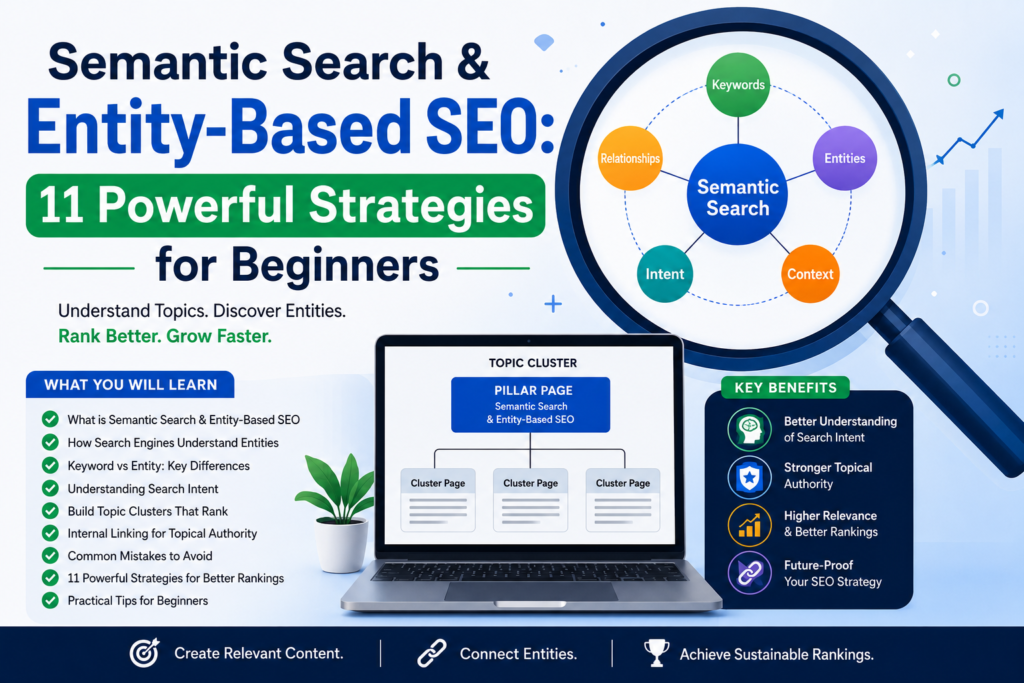
Semantic Search & Entity-Based SEO are changing the way beginners should approach modern search engine optimization. Search engines are no longer dependent only on exact keyword matches. They can understand context, relationships, topics, entities, and the intention behind a user’s query.
For bloggers and SEO learners, this means one important thing: writing the same keyword repeatedly is not enough. Instead, your content should answer the user’s main question and cover the important concepts connected to that topic.
This complete guide explains how Semantic Search & Entity-Based SEO work, why they matter, and how beginners can use them to create better and more useful content.
Table of Contents
- What Is Semantic Search & Entity-Based SEO?
- How Semantic Search Works
- Understanding Entities in SEO
- Keywords vs. Entities
- Search Intent and Semantic Search & Entity-Based SEO
- Building Topic Clusters
- Creating a Strong Pillar Page
- Using Internal Linking
- Improving Topical Authority
- Common Semantic SEO Mistakes
- Practical Semantic SEO Strategy
- Final Thoughts
- Frequently Asked Questions
1. What Is Semantic Search & Entity-Based SEO?
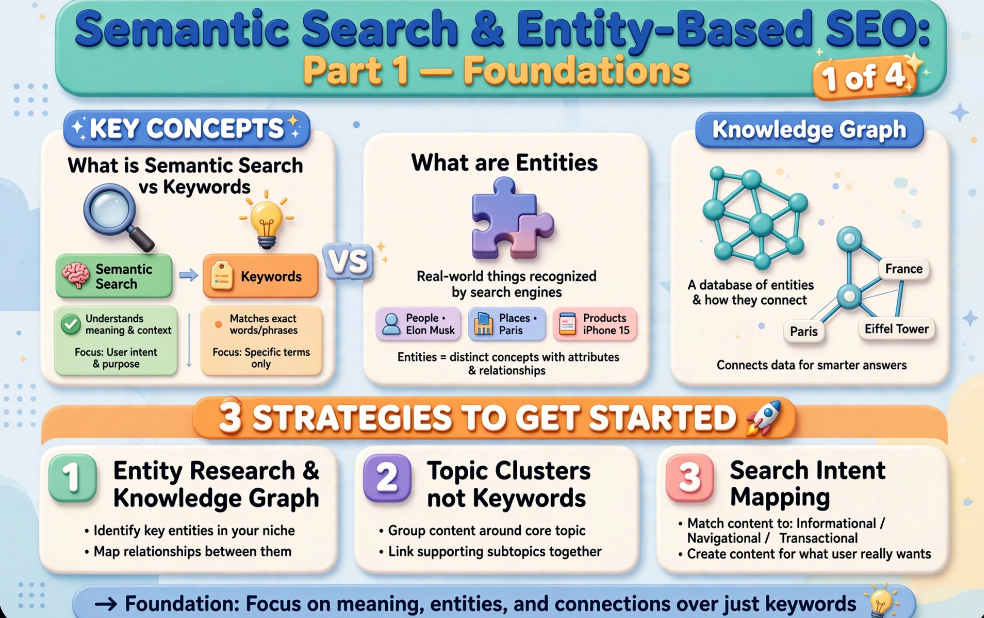
Semantic Search & Entity-Based SEO focus on the meaning and context behind online content. Instead of looking only for an exact phrase, search engines can consider what a query means and which concepts are connected to it.
For example, someone searching for “SEO for beginners” may want information about keywords, technical SEO, backlinks, search intent, content optimization, and website structure.
These related subjects help create a complete understanding of the main topic.
Why Does Semantic SEO Matter?
Imagine a student asking a teacher about digital marketing. A good teacher would not repeat the words “digital marketing” twenty times.
Instead, the teacher would explain SEO, social media, email marketing, paid advertising, analytics, and content marketing.
Semantic SEO follows a similar idea. It focuses on explaining the subject properly rather than forcing keywords into every sentence.
2. How Semantic Search Works
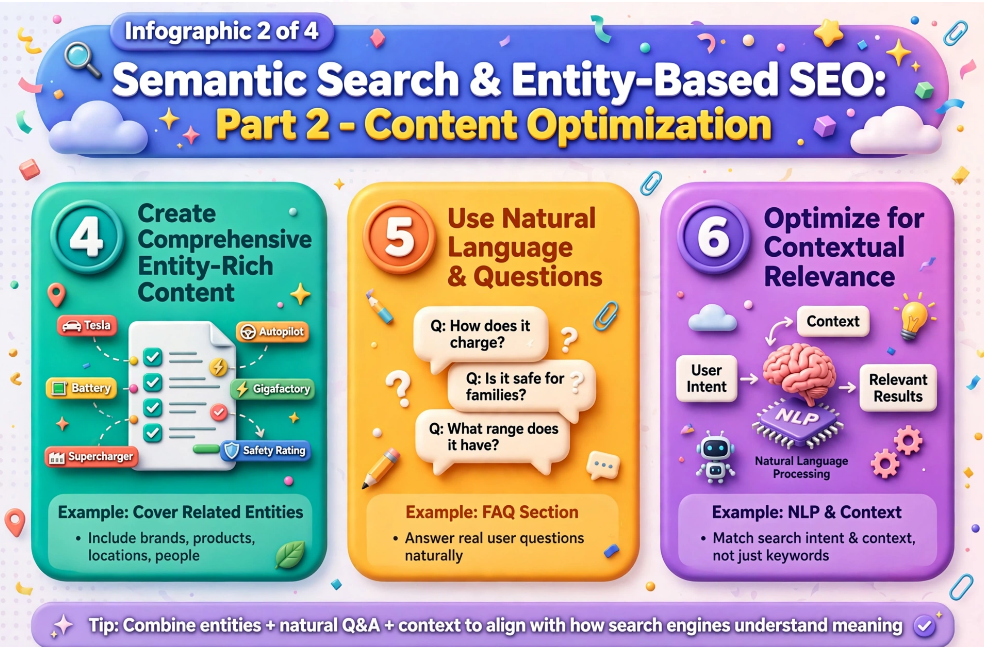
Semantic Search & Entity-Based SEO search attempts to understand what users actually mean when they enter a query.
For example, the search “best phone for photography” could involve several connected ideas, including camera quality, image processing, lenses, low-light performance, video recording, and price.
The search engine can use these relationships to provide results that better match the user’s underlying requirement.
This is why content creators should think about questions and concepts surrounding their main keyword.
3. Understanding Entities in SEO
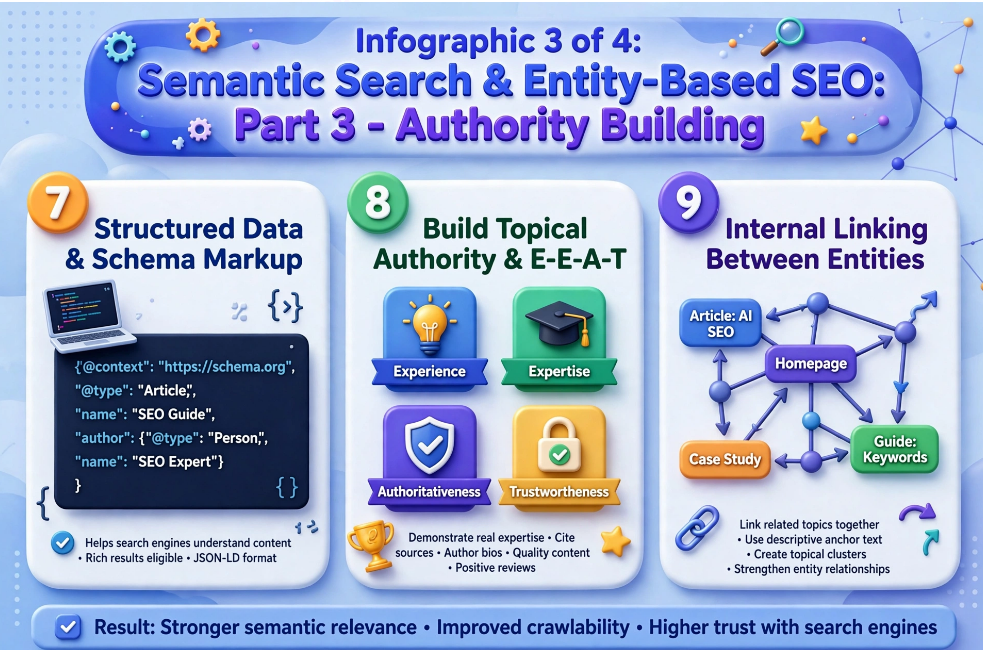
An entity is a clearly identifiable person, place, organization, product, brand, concept, or other distinct subject.
For example, in an article about SEO, entities might include Google, Google Search, keywords, backlinks, websites, content marketing, and search engines.
These entities have relationships with one another.
When you naturally explain these relationships, your content can provide greater context around the subject.
How Entities Improve Content Context
Suppose you write about Google Ads.
Simply mentioning “Google Ads” repeatedly does not explain much.
A stronger article could discuss campaigns, keywords, bidding, audiences, conversions, landing pages, advertising goals, and return on ad spend.
These connected concepts create a richer explanation of the topic.
4. Keywords vs. Entities
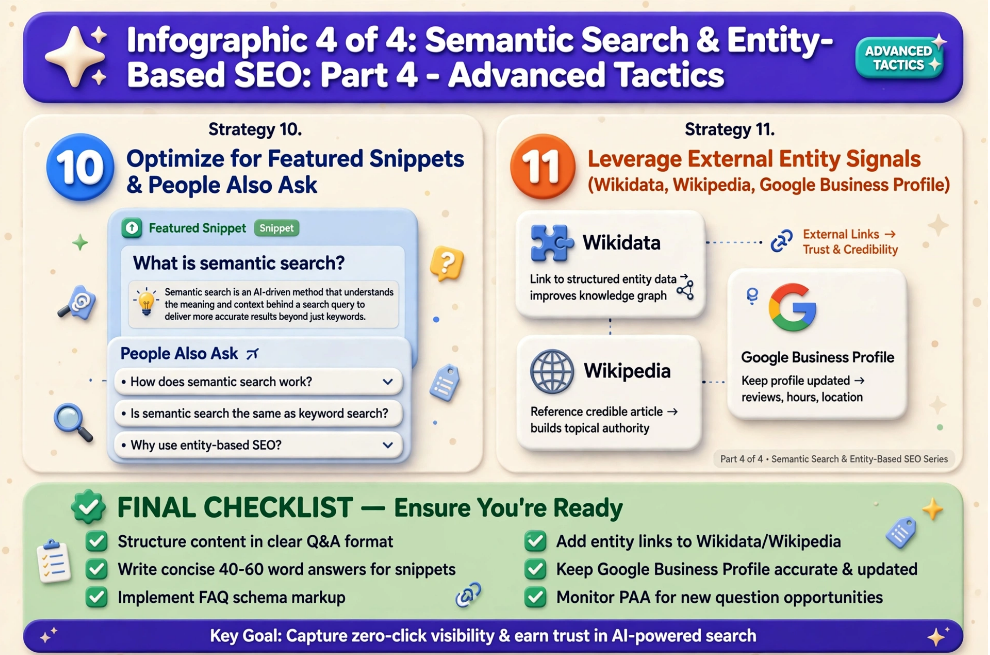
Keywords and entities are related, but they are not the same thing.
A keyword is generally a word or phrase that people enter into search engines.
An entity is a distinct subject or concept that can be identified.
For example, “best SEO tools” can be a keyword phrase, while Google Search Console can represent a specific tool or platform.
Successful Semantic Search & Entity-Based SEO can use both.
The important point is to avoid treating keyword repetition as the entire optimization strategy.
5. Search Intent and Semantic SEO
Search intent refers to the reason why someone performs a search.
A user searching “what is semantic SEO” probably wants educational information.
Someone searching “best semantic SEO tools” may be comparing solutions.
Another person searching “SEO agency near me” may be looking for a service provider.
Understanding these differences allows you to create content that matches what users actually expect.
Match Your Content With User Intent
Before writing an article, ask one simple question:
What does the searcher want to accomplish?
If the user wants information, explain the topic clearly.
If the user wants instructions, provide practical steps.
If the user wants comparisons, explain the differences.
Matching the format and depth of your content with search intent can make the page more useful.
6. Build Topic Clusters
Topic clusters are groups of related pages organized around a broader subject.
For example, an SEO website could have a main SEO guide supported by articles about keyword research, technical SEO, on-page optimization, backlinks, local SEO, semantic SEO, and content strategy.
Each supporting article covers a narrower part of the broader topic about Semantic Search & Entity-Based SEO .
This approach creates a logical structure instead of a collection of disconnected blog posts.
Choose Supporting Topics Carefully
Do not create supporting articles simply because they contain popular keywords.
Choose topics that genuinely help your audience understand the main subject.
Ask yourself whether the supporting article adds new information or simply repeats something that already exists.
7. Create a Strong Pillar Page
A pillar page is a comprehensive resource covering a broad topic.
For example, a website could create a detailed guide about Semantic Search & Entity-Based SEO for beginners and then connect it to more specific articles.
The pillar page gives readers an overview, while supporting pages provide deeper explanations.
This structure can make website navigation easier and help establish logical relationships between different pieces of content.
8. Use Internal Linking Strategically
Internal links connect pages within the same website.
They help readers discover related information and can also help search engines understand how different pages are connected.
For example, if you discuss keyword research in an article about semantic SEO, you can naturally link to your detailed keyword research guide.
Similarly, you can connect articles about on-page SEO, technical SEO, and content optimization when the context is relevant.
Avoid adding internal links randomly. Every link should provide additional value to the reader.
9. Improve Topical Authority
Topical authority comes from demonstrating useful knowledge across a subject rather than publishing one isolated article.
If your website discusses SEO, you can gradually cover related areas such as keyword research, content strategy, technical optimization, search intent, internal linking, local SEO, and analytics.
The objective is not to publish hundreds of thin articles.
Instead, create a smaller collection of strong resources that collectively provide meaningful coverage.
Update Existing Content
Your SEO strategy should not focus only on new articles.
Review existing pages regularly.
Look for missing subtopics, outdated information, weak internal links, unclear explanations, and opportunities to improve examples.
Refreshing useful content can make your website more comprehensive.
10. Avoid Common Semantic SEO Mistakes
One major mistake is keyword stuffing.
Repeating a phrase excessively can make content unnatural and difficult to read.
Another mistake is adding unrelated keywords simply because they have search volume.
Semantic SEO is not about collecting random words.
It is about creating meaningful connections between relevant concepts.
A third mistake is creating dozens of pages with almost identical information. More content does not automatically mean better SEO.
Quality, relevance, organization, and usefulness should remain the priority.
11. Use Semantic SEO in Your Content Strategy
A practical strategy begins with one primary topic.
Research the keyword and understand its search intent.
Next, identify related questions, concepts, and entities.
Create a detailed article that answers the main question.
Then develop supporting content around important subtopics.
Connect relevant pages using internal links.
Finally, review performance and update content when new information or user needs emerge.
Use Natural Language
Write for humans first.
Instead of asking, “How many times can I insert my keyword?” ask, “What information does my reader need?”
Use synonyms, related phrases, examples, questions, and relevant terminology naturally.
This approach can make the article more readable while also providing broader topical context.
Measure Content Quality Beyond Rankings
Rankings are important, but they are not the only indicators of successful SEO.
Look at organic traffic, engagement, conversions, returning visitors, internal link clicks, and the behaviour of users on important pages.
A page that attracts visitors but fails to answer their questions may need improvement.
Your objective should be to create content that attracts the right audience and helps them take the next useful step.
A Beginner-Friendly Semantic SEO Checklist
Before publishing an article, check the following:
- Is the main topic clearly defined?
- Is the focus keyword used naturally?
- Does the introduction explain the topic immediately?
- Does the content match search intent?
- Are related concepts covered?
- Are relevant entities included naturally?
- Are headings organized logically?
- Are internal links added?
- Are trustworthy external resources referenced?
- Is the content divided into short paragraphs?
- Does the article provide original value?
- Is the information easy to understand?
This checklist can help beginners create more complete and useful content.
Final Thoughts on Semantic Search & Entity-Based SEO
Semantic Search & Entity-Based SEO represent a smarter approach to modern search optimization. The focus is moving away from simply repeating keywords and toward understanding topics, entities, relationships, context, and user intent.
For bloggers and SEO learners, the most useful strategy is straightforward. Start with a clear topic, understand what users want, identify related concepts, create comprehensive content, organize your website into topic clusters, and connect relevant pages with internal links.
Do not write content only because a keyword has search volume. Write because you have something useful to explain.
When your content answers real questions and covers a subject naturally, you create a stronger experience for readers while giving search engines more context about what your website is about.
Frequently Asked Questions About Semantic Search & Entity-Based SEO
1. What is Semantic Search & Entity-Based SEO?
Semantic Search & Entity-Based SEO focus on meaning, context, entities, relationships, and user intent instead of relying only on exact keyword matching.
2. Are keywords still important for Semantic Search & Entity-Based SEO?
Yes. Keywords remain useful for understanding what users search for. However, modern SEO should also consider related topics, entities, questions, and search intent.
3. What is an entity in SEO?
An entity is a clearly identifiable subject such as a person, company, product, place, organization, brand, or concept.
4. What are topic clusters?
Topic clusters are groups of related articles organized around a main pillar topic. Supporting pages cover specific subtopics and are connected through internal links.
5. How can beginners start using Semantic Search & Entity-Based SEO?
Beginners can start by understanding search intent, identifying related entities and questions, creating comprehensive content, building topic clusters, and connecting relevant pages with internal links.
Rank Math Final Setup
Focus Keyword: Semantic Search & Entity-Based SEO
SEO Title: Semantic Search & Entity-Based SEO: 11 Powerful Strategies for Beginners
Meta Description: Learn Semantic Search & Entity-Based SEO with 11 powerful strategies for beginners, including search intent, entities, topic clusters, internal links, and topical authority.
URL: semantic-search-entity-seo
Image ALT: Semantic Search & Entity-Based SEO
Recommended external link: Google Search Central, Google Search Console, or another authoritative SEO resource.
Recommended internal links: Apni website ke relevant pages jaise SEO, Keyword Research, On-Page SEO, Technical SEO, aur Content Marketing ko relevant sentences ke andar link karo.
Table of Contents: Article mein already diya gaya hai, isliye Rank Math/WordPress mein apne TOC plugin ko use karke headings automatically show kara sakte ho.
Important: Focus keyword ko zabardasti har paragraph mein mat bharo. Natural placement rakho, warna readability kharab ho sakti hai.
How Semantic Search Changes Modern SEO
Semantic search has changed the way websites should approach content creation. Search engines can now evaluate a page based on its overall meaning instead of depending only on the presence of a particular phrase.
For beginners, this means SEO is becoming more focused on creating useful resources. A page should answer questions naturally and provide enough context for readers to understand the subject.
The idea is similar to having a conversation with an expert. If you ask a question, a good answer usually includes related information that makes the original explanation easier to understand.
This is exactly why Semantic Search & Entity-Based SEO encourage broader topic coverage. Your content should provide the information a reader is likely to need next.
Understand Context Before Adding Keywords
Keywords are still useful, but context gives them meaning. The same word can have completely different meanings depending on the subject being discussed.
For example, the word “organic” could relate to food, farming, marketing, or search traffic. Search engines use surrounding information to understand which meaning is relevant.
This makes contextual writing extremely important. Do not simply place keywords inside paragraphs without explaining what they actually mean.
Think Like Your Reader
Before publishing an article, read it from the perspective of someone who knows very little about the topic. Would they understand the terminology?
If the answer is no, add explanations, examples, or definitions. Simple explanations can make technical SEO content much more valuable.
Build Content Around Questions
Questions are one of the easiest ways to discover semantic opportunities. Start with the main question behind your target keyword.
Then consider what the reader might ask immediately afterward. These follow-up questions can become additional sections in your article.
For example, someone learning about entity-based SEO might ask how entities differ from keywords. They may then wonder how entities influence content organization.
Answering these connected questions creates a more complete learning experience. It also gives your content greater topical depth.
Use Content Hubs for Larger Topics
Large subjects can become difficult to manage when everything is placed on one page. Content hubs provide a practical solution.
A content hub can contain a central guide supported by several detailed articles. Each article explores a specific aspect of the broader subject.
For an SEO website, a content hub could include pages covering keyword research, technical optimization, content strategy, search intent, semantic SEO, and link building.
Organize Content Logically
Organization matters because readers should be able to move from basic information to more advanced concepts without getting lost.
Start with beginner-friendly explanations and gradually introduce more complex ideas. This creates a natural learning path.
A logical structure also makes internal linking opportunities easier to identify. Related pages can support each other instead of competing unnecessarily.
Strengthen Relationships Between Topics
A strong article does not discuss concepts as isolated pieces. It explains how they relate to each other.
For example, search intent influences content format. Content format influences page structure. Page structure affects how information is presented to users.
These relationships create a meaningful context around your primary subject. They can also make your content more useful for people who want to understand the bigger picture.
Avoid Unnecessary Topic Expansion
There is a difference between comprehensive content and unnecessarily broad content.
Adding every possible SEO concept to an article can make it confusing. Readers should not have to navigate unrelated information to find their answer.
Choose supporting topics based on relevance. If a concept does not help explain the main subject, it may belong in another article.
Prioritize Relevance Over Volume
More words do not automatically create better SEO.
A focused 1,500-word article can provide more value than a 5,000-word article filled with repetition and unrelated information.
Your objective should be to answer the user’s needs completely without adding unnecessary material.
Improve Content With Real Examples
Examples can transform an abstract SEO concept into something easier to understand.
Suppose you are explaining entities. Instead of giving only a definition, demonstrate how a website about digital marketing might connect Google Ads, conversion tracking, keywords, landing pages, and audiences.
The reader can then understand how these concepts work together.
Practical examples also make educational content easier to remember. They give readers something concrete to compare with their own websites.
Use Natural Variations in Language
People do not always describe the same idea using identical words.
One person may search for “SEO tips,” while another may search for “search engine optimization techniques.” Both queries can represent a similar need.
Natural language allows your article to address these variations without forcing exact-match phrases repeatedly.
This is one reason Semantic Search & Entity-Based SEO are useful for modern content strategies.
Create Content for Different Knowledge Levels
Not every visitor will have the same level of SEO knowledge.
A beginner may need definitions and examples, while an experienced marketer may want practical implementation details.
You can accommodate both audiences by structuring your article progressively. Start with the basics and then introduce advanced considerations.
Use H2, H3, and H4 Headings Properly
Headings should represent the hierarchy of information.
An H2 can introduce a major concept, an H3 can explain an important subtopic, and an H4 can cover a smaller detail.
This structure makes long articles easier to scan. It also helps readers quickly locate the information most relevant to them.
Make Your Website Easier to Understand
Semantic SEO should not exist only inside individual articles. Your entire website should communicate a clear subject structure.
If your website is about digital marketing, your categories, pages, articles, and navigation should support that overall theme.
Randomly publishing content about unrelated subjects can make the website’s topical focus less clear.
Use Categories Carefully
Categories can help organize large websites, but too many categories can create unnecessary complexity.
Choose broad categories that represent meaningful sections of your website.
For example, a digital marketing website might use categories such as SEO, Google Ads, Social Media Marketing, Content Marketing, and Analytics.
Keep the structure simple enough that users can understand it immediately.
Review Your Content Connections
Every few months, review how your articles are connected.
Look for pages that discuss similar concepts but have no internal links between them.
You may discover opportunities to connect older articles with newer resources. These connections can improve navigation and create a stronger overall content ecosystem.
Remove Weak Connections
Internal linking should always be relevant.
Do not add links simply to increase the number of internal links on a page.
A useful link should help the reader explore a related subject or find a deeper explanation.
Understand the Role of Structured Data
Structured data can provide additional information about the content of a webpage in a machine-readable format.
Depending on the page, structured data may describe things such as articles, products, organizations, events, or frequently asked questions.
It is important to understand that structured data is not a replacement for high-quality content.
Your first priority should always be useful information, clear organization, and accurate communication.
Strengthen Your Entity Understanding
When researching a topic, create a simple list of important entities associated with it.
For example, if your subject is local SEO, relevant entities may include Google Business Profile, local businesses, locations, reviews, maps, citations, and local search.
Then identify how those entities relate to one another.
This exercise can help you discover missing sections and improve topical completeness.
Use Competitor Research for Ideas
Competitor research can help identify topics that your audience already expects to see.
However, do not simply copy the structure or wording of another website.
Instead, identify gaps. Ask what important questions competitors have not answered clearly.
Creating something more useful, more understandable, or more practical can give your content a stronger purpose.
Look for Content Gaps
A content gap could be a missing explanation, example, comparison, process, or frequently asked question.
For instance, an article may explain what semantic SEO means but fail to explain how a beginner can actually implement it.
That missing implementation section becomes an opportunity to create better content.
Monitor User Behaviour
Once content is published, observe how visitors interact with it.
Look at metrics such as organic traffic, engagement, conversions, and navigation patterns.
If visitors consistently leave after a particular section, examine whether that section answers their question clearly.
Analytics should not replace editorial judgment, but they can provide useful clues about content performance.
Keep Your SEO Strategy Flexible
Search technology continues to evolve, so SEO strategies should not remain completely static.
A technique that worked several years ago may not provide the same value today.
Rather than chasing every new SEO trend, focus on principles that remain useful: relevance, accuracy, helpfulness, clear structure, strong user experience, and trustworthy information.
This creates a more sustainable approach.
Build a Long-Term Content Framework
Successful semantic SEO is usually a long-term process.
You may begin with one pillar article and a few supporting pages. Over time, you can expand the content cluster as you discover new questions and audience needs.
This gradual approach is often easier to manage than trying to create dozens of pages at once.
Document Your Content Strategy
Semantic Search & Entity-Based SEO Keep a simple spreadsheet containing your primary topics, supporting articles, target audiences, search intent, internal links, and content status.
This makes it easier to identify missing topics and prevent unnecessary duplication.
A documented strategy also helps teams maintain consistency when multiple writers work on the same website.
Conclusion
Semantic Search & Entity-Based SEO are not about abandoning keywords. They are about understanding that successful search optimization involves much more than repeating a phrase.
Modern Semantic Search & Entity-Based SEO requires content creators to understand context, search intent, entities, relationships, topic clusters, internal linking, and the questions users genuinely want answered.
For beginners, the best approach is to start small. Choose one important topic, research the questions surrounding it, identify relevant entities, and create useful content that explains the subject clearly.
Then connect that content with related resources. Build supporting articles gradually and review your website regularly for missing information or weak connections.
Most importantly, write for people first. When readers can easily understand your content, find answers to their questions, and discover useful related information, your website becomes more valuable.
The real strength of Semantic Search & Entity-Based SEO comes from creating a connected knowledge base rather than a collection of isolated keyword-focused pages. That approach can provide a stronger foundation for sustainable SEO growth in the long term.