
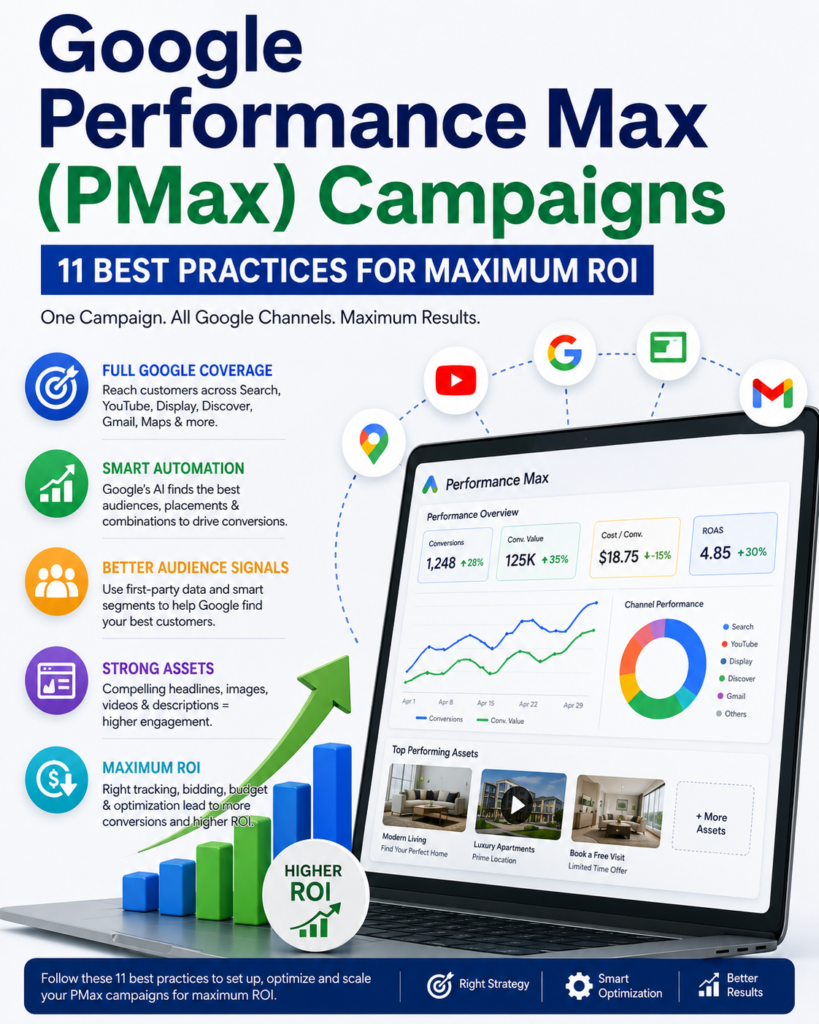
Google Performance Max (PMax) Campaigns have become an important part of modern Google Ads strategies. For performance marketers, PMax offers an automated way to reach potential customers across Google’s advertising ecosystem while optimizing toward selected business goals.
However, launching a campaign is only the beginning. To get better results, marketers need accurate conversion tracking, relevant audience signals, strong creative assets, well-structured asset groups, appropriate bidding strategies, and careful performance analysis.
What Are Google Performance Max (PMax) Campaigns?
Google Performance Max (PMax) Campaigns are goal-based Google Ads campaigns designed to help advertisers reach customers across multiple Google properties. Depending on the campaign, settings, eligibility, and available inventory, ads can appear across Search, YouTube, Display, Discover, Gmail, Google Maps, and other Google surfaces.
Rather than manually controlling every placement, PMax uses automation and machine learning to make many campaign decisions. The marketer provides the business objective, conversion data, creative assets, audience information, and budget.
This makes Google Performance Max powerful, but it also creates a responsibility for advertisers. If the information supplied to the campaign is inaccurate or incomplete, automation may optimize toward outcomes that do not represent genuine business value.
Why Performance Max Matters for Performance Marketers
For performance marketers, the central objective is not simply generating traffic. The objective is generating measurable business results.
Google Performance Max (PMax) Campaigns can help marketers consolidate advertising activity while allowing Google Performance Max systems to identify opportunities across different channels.
This approach can be particularly useful for ecommerce brands, lead-generation businesses, local services, and companies with clearly defined conversion goals.
The important point is that automation should support strategy, not replace it.
How to Set Up Google Performance Max (PMax) Campaigns Correctly
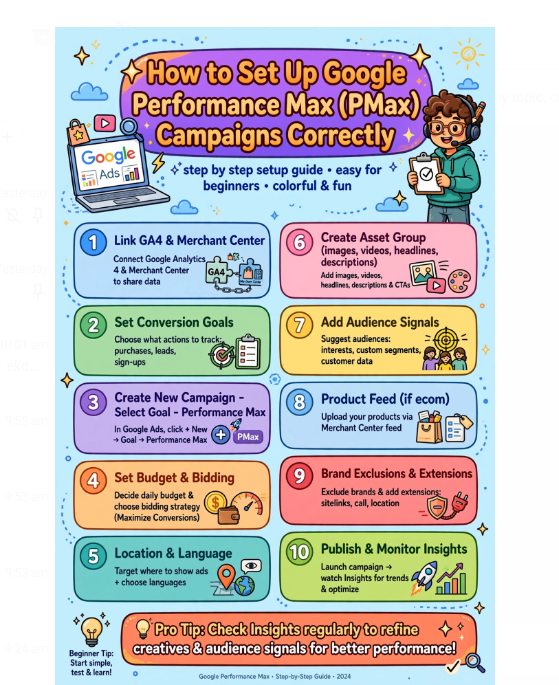
A strong campaign begins with a clear objective. Before creating a PMax campaign, determine exactly what action represents success for the business.
For an ecommerce company, that may be a completed purchase. For a service business, it could be a qualified lead, phone enquiry, booking, or consultation.
Choose the Right Conversion Goal
Your campaign should optimize toward actions that genuinely matter.
If your business wants sales, do not treat page views as equivalent to purchases. If your goal is qualified leads, try to distinguish valuable enquiries from low-quality submissions.
The principle is straightforward: give the campaign data that reflects the outcome you actually want to increase.
Use Accurate Conversion Tracking
Conversion tracking is one of the most important components of Google Performance Max (PMax) Campaigns.
Automated bidding relies heavily on conversion signals. If tracking is broken, duplicated, incomplete, or measuring the wrong actions, campaign optimization can become misleading.
Before launching or scaling a campaign, verify that important conversions are being recorded correctly. Check forms, purchases, phone calls, bookings, and other meaningful actions according to your business model.
Use Conversion Values Where Appropriate
Not every conversion necessarily has the same economic value.
For example, an ecommerce business may have products with significantly different order values. Similarly, a lead-generation company may have leads with different probabilities of becoming paying customers.
Where reliable business data is available, assigning appropriate values can help create a closer relationship between advertising optimization and commercial outcomes.
Optimize Audience Signals
Audience signals are another important consideration when managing Google Performance Max (PMax) Campaigns.
Relevant audience information can help Google Performance Max systems understand the types of users who may be valuable to a business.
Depending on your campaign and available Google Ads features, useful inputs may include customer lists, previous purchasers, remarketing audiences, custom segments, and other relevant audience information.
Use First-Party Data Strategically
First-party data can be especially useful because it comes from your own customer or prospect interactions.
For example, an online retailer may have information about previous purchasers. A B2B company may have data about qualified leads. A service company may know which enquiries eventually became customers.
Such information can help communicate what a valuable customer looks like.
However, audience signals should be used responsibly and in accordance with applicable privacy requirements and Google’s policies.
Do Not Treat Audience Signals as Strict Targeting
One important distinction is that audience signals should not automatically be viewed as a rigid targeting restriction.
They provide useful information to Google’s automated systems, which can then help identify additional potential customers.
Therefore, performance marketers should focus on supplying high-quality signals rather than attempting to manually restrict every possible user.
Build Better Asset Groups
Asset groups are a major part of Google Performance Max (PMax) Campaigns.
An asset group should have a logical theme based on a product, service, audience, or business proposition.
For example, a real estate company could have separate themes for luxury properties, residential apartments, and investment properties.
This approach makes it easier to align the creative message with the user’s likely needs.
Create Relevant Headlines and Descriptions
Your headlines and descriptions should communicate clear benefits.
Instead of filling every asset with slightly different versions of the same sentence, develop different messages around:
- Product benefits
- Customer problems
- Unique selling points
- Offers
- Service features
- Trust factors
- Calls to action
The goal is to give Google’s systems meaningful creative variations rather than repetitive wording.
Use High-Quality Images and Video
Creative quality can have a significant influence on advertising performance.
Use relevant images that clearly communicate the product or service. Where appropriate, provide different visual formats and strong video assets.
Your creative should work even when the user has only a few seconds of attention.
Ask yourself: Can someone understand what I am offering without reading every word?
If the answer is no, your creative may need improvement.
Review Search-Term Insights
Search-term insights can help performance marketers understand the types of searches associated with campaign activity.
Review these insights regularly to identify:
- Relevant customer themes
- Unexpected search behavior
- Irrelevant queries
- New keyword opportunities
- Potential content ideas
These insights can also influence your broader Google Ads strategy.
Even though PMax is highly automated, marketers should still analyze the information available and use it to improve their overall advertising decisions.
Use Negative Keywords Carefully
Negative keyword controls can be useful when you identify search themes that are consistently irrelevant to your business.
For example, a premium service provider might discover searches related to free services, employment, training, or unrelated products.
However, avoid creating an enormous exclusion list simply because a keyword looks unusual.
Avoid Over-Exclusion
Overly aggressive negative keyword strategies can restrict potentially valuable traffic.
A better approach is to look for clear patterns of irrelevant intent and evaluate their business impact before adding exclusions.
Think of negative keywords as a filter, not a wall.
Manage Budget and Bidding Strategically
Budget management is critical for Google Performance Max (PMax) Campaigns.
A campaign needs an appropriate budget relative to its goals, conversion volume, market size, and economics.
Avoid changing budgets dramatically without a clear reason. Large or frequent changes can make it harder to understand campaign behavior and evaluate the effect of your strategy.
Instead, monitor metrics such as:
- Cost per acquisition
- Conversion value
- Return on ad spend
- Conversion volume
- Qualified lead volume
- Customer value
The most important metric depends on your business model.
Give Performance Max Time to Learn
Automated campaigns need sufficient data to identify useful patterns.
One common mistake is checking results too quickly and making major changes after every short-term fluctuation.
Performance marketers should evaluate meaningful trends rather than reacting emotionally to individual days.
This does not mean ignoring poor performance. It means distinguishing between normal variation and a genuine strategic problem.
Test Asset Groups and Creative Messages
Testing should be structured.
Instead of changing your budget, audience signals, bidding, landing page, and creative at the same time, create a clear hypothesis.
For example:
“A benefit-focused headline may generate more qualified conversions than a feature-focused headline.”
Make the change, monitor relevant metrics, and compare results over an appropriate period.
This approach makes learning much easier.
Measure PMax Performance Beyond Clicks
Clicks are useful, but clicks alone do not determine profitability.
A campaign can generate thousands of clicks while producing very little business value.
For Google Performance Max (PMax) Campaigns, performance marketers should examine metrics that connect advertising activity with commercial results.
For ecommerce, this could include revenue, conversion value, acquisition cost, and ROAS.
For lead generation, marketers should consider qualified leads, lead-to-customer rates, customer acquisition cost, and eventual sales value.
Avoid Constant Campaign Changes
Another common mistake is excessive intervention.
Changing campaigns every day can make optimization confusing. If the budget, creative, bidding strategy, conversion goals, and audience signals all change simultaneously, it becomes difficult to identify what actually affected performance.
Create a change log and document significant adjustments.
This simple habit can make your optimization process far more systematic.
Build a Consistent PMax Optimization Routine
Successful Google Performance Max (PMax) Campaigns require continuous evaluation.
A weekly review can include:
- Checking conversion tracking.
- Reviewing conversion volume and value.
- Examining search-term insights.
- Reviewing asset performance.
- Checking budget utilization.
- Evaluating lead or customer quality.
- Identifying irrelevant traffic.
- Reviewing major campaign changes.
A longer-term review can focus on profitability, customer value, creative trends, and scaling opportunities.
Common Google Performance Max Mistakes to Avoid
Several mistakes can limit PMax performance.
First, launching without reliable conversion tracking can send automated bidding in the wrong direction.
Second, optimizing for cheap conversions rather than valuable customers can create misleading performance.
Third, weak or repetitive creative assets can limit the campaign’s ability to communicate effectively.
Fourth, excessive campaign fragmentation can make data harder to interpret.
Finally, constant manual changes can prevent marketers from learning what actually works.
The best approach is not to control everything. It is to control the important things well.
How to Maximize ROI From Google Performance Max (PMax) Campaigns
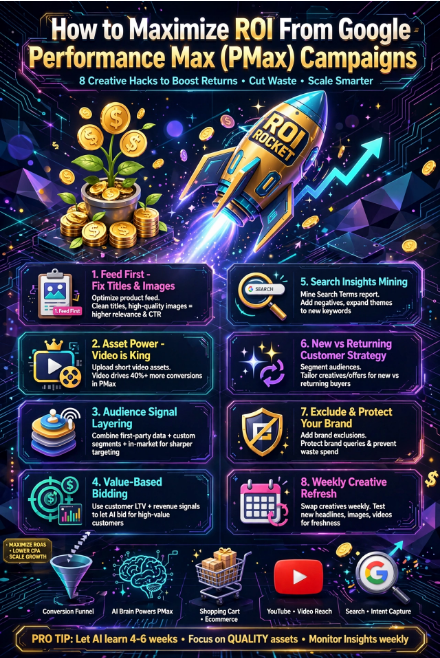
Maximizing ROI requires a complete Google Performance Max rather than one optimization trick.
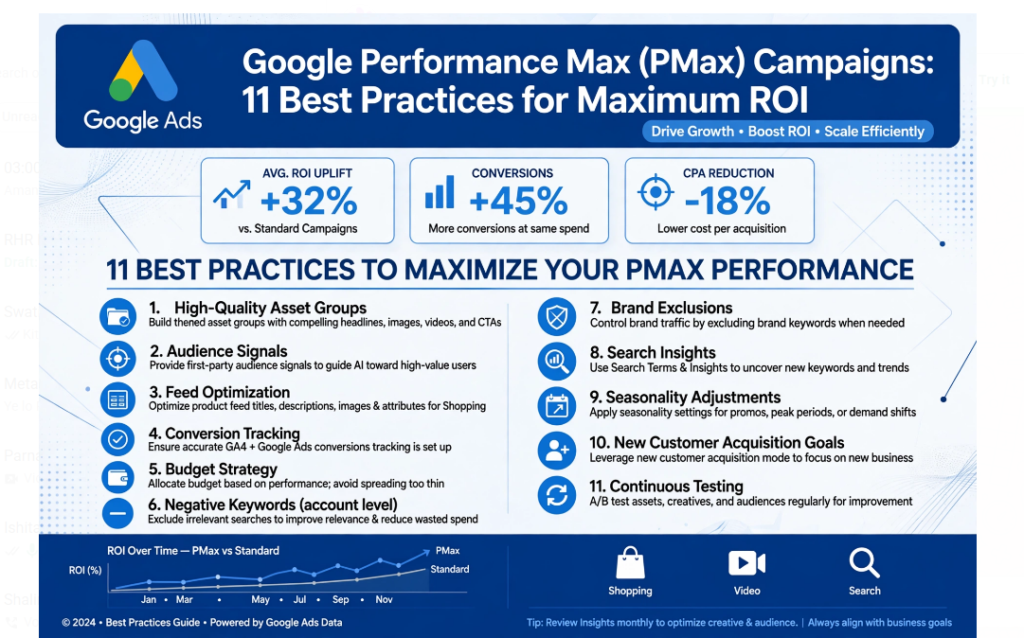
Start with accurate conversion tracking. Then establish meaningful business goals. Provide useful audience signals, create strong asset groups, improve creative quality, analyze search-term insights, use negative keyword controls carefully, and manage budgets according to business economics.
Most importantly, measure outcomes that matter.
A campaign with fewer conversions but higher-value customers may be significantly more successful than a Google Performance Max producing a large number of inexpensive conversions.
ROI is ultimately about the relationship between what you spend and what you receive in return.
Frequently Asked Questions About Google Performance Max (PMax) Campaigns
1. What are Google Performance Max (PMax) Campaigns?
Google Performance Max (PMax) Campaigns are goal-based Google Ads campaigns that use automation to help advertisers reach potential customers across multiple Google advertising surfaces.
2. How can I improve the ROI of PMax campaigns?
Improve conversion tracking, use meaningful conversion goals, provide relevant audience signals, create strong creative assets, manage budgets carefully, review search-term insights, and focus on valuable conversions rather than clicks alone.
3. Are audience signals important for PMax?
Yes. Relevant audience signals can provide useful information about potential customers. However, they should generally be treated as signals that guide Google Performance Max systems rather than as rigid targeting restrictions.
4. Should I use negative keywords in PMax campaigns?
Negative keyword controls can help reduce genuinely irrelevant traffic. However, they should be applied carefully because excessive exclusions can potentially remove valuable opportunities.
5. How often should I optimize a Performance Max campaign?
Regular monitoring is useful, but avoid making major changes based on every short-term fluctuation. A structured review schedule allows marketers to identify meaningful trends and make more informed decisions
Google Performance Max (PMax) Campaigns can become a powerful growth channel when advertisers look beyond basic campaign settings. The real opportunity lies in understanding how different parts of the customer journey influence advertising results.
Instead of treating every conversion equally, marketers should examine what happens after someone clicks an advertisement. A campaign becomes more valuable when advertising data is connected with genuine customer behaviour.
1. Understand the Complete Customer Journey
A customer rarely moves directly from seeing an advertisement to making a purchase. They may visit the website, compare alternatives, return later, read reviews, and finally complete a transaction.
Understanding this journey helps marketers identify where potential customers are dropping out. Those insights can be used to improve landing pages, offers, messaging, and the overall advertising experience.
2. Connect Advertising With Business Profit
Revenue alone does not tell the complete story. A campaign can produce impressive sales figures while generating disappointing profits because of product costs, discounts, shipping, or other expenses.
For Google Performance Max (PMax) Campaigns, marketers should therefore understand the relationship between advertising expenditure and actual business profitability before deciding to increase spending.
Look Beyond the Cost Per Conversion
A low cost per conversion may look attractive, but the quality of those conversions matters. A cheaper customer who rarely purchases again may be less valuable than a customer with a higher initial acquisition cost and stronger lifetime value.
3. Improve the Landing Page Experience
Advertising and landing pages should work together. If your advertisement promotes a particular service, product, or offer, visitors should immediately find relevant information after clicking.
Remove unnecessary distractions and make the desired action obvious. A simple layout, clear benefits, visible contact information, and a straightforward conversion process can reduce unnecessary friction.
4. Adapt to Seasonal Customer Behaviour
Customer demand does not remain constant throughout the year. Certain products may become more popular during festivals, holidays, weather changes, academic seasons, or special events.
Marketers should examine historical performance to identify these patterns. Understanding when demand naturally increases can help businesses plan promotional messages and budgets more intelligently.
Monitor Changes in Market Demand
Sudden performance changes are not always caused by Google Performance Max settings. Competitor promotions, economic conditions, new products, and changing consumer preferences can also affect results.
Before making major adjustments, consider what is happening outside the advertising account. Market context can prevent unnecessary campaign changes.
5. Keep Your Creative Strategy Fresh
Creative fatigue can become a challenge when customers repeatedly encounter similar advertisements. Even if the offer remains unchanged, the presentation can evolve.
Experiment with different storytelling approaches, product demonstrations, customer problems, benefits, and emotional triggers. Each creative idea should have a clear purpose rather than simply being another variation.
6. Analyze Performance by Product or Service
Businesses with multiple products or services should avoid looking only at campaign-level results in Google Performance Max . Some categories may generate excellent returns while others consume budget without producing sufficient value.
Breaking performance into meaningful business segments can reveal where opportunities and weaknesses exist. This information can support better promotional priorities and resource allocation.
7. Turn Search Behaviour Into Marketing Insights
Search behaviour can reveal what customers actually want, even when their interests differ from what marketers originally expected.
Look for recurring themes, questions, product combinations, and emerging interests. These insights can inspire new landing pages, blog topics, offers, and advertising messages.
Discover New Customer Opportunities
Unexpected search themes can sometimes expose new market segments. A product may attract customers for reasons that were not part of the original marketing strategy.
Instead of ignoring these patterns, investigate them. Valuable customer insights often appear in places marketers initially overlook.
8. Reduce Friction Before the Conversion
A visitor can have strong purchase intent and still abandon the process because something feels difficult. Complicated forms, unclear pricing, slow pages, or excessive steps can create unnecessary barriers.
Review your conversion process from the customer’s perspective. Ask whether someone using a mobile phone can understand the offer and complete the desired action without confusion.
9. Create a Disciplined Testing System
Effective optimization is easier when experiments are documented. Record what was changed, why it was changed, when the test started, and what result you expected.
This creates a history of campaign learning. Over time, your team can identify patterns instead of repeatedly making decisions based on assumptions.
Measure Long-Term Business Growth
Short-term campaign performance is useful, but long-term trends provide a broader perspective. Customer retention, repeat purchases, qualified leads, and lifetime value can reveal whether advertising is creating sustainable growth.
The best Google Performance Max (PMax) Campaigns are not necessarily those producing the largest number of immediate conversions. They are campaigns that consistently contribute valuable customers and support profitable business growth.
Final Thoughts
Google Performance Max (PMax) Campaigns work best when automation is combined with strong business understanding. Marketers should study customer journeys, profitability, market behaviour, creative performance, product-level results, and conversion experience instead of relying on a single metric.
When these areas are reviewed systematically, PMax becomes more than an advertising campaign. It can become a valuable source of customer intelligence, helping businesses make smarter decisions and build a more sustainable path toward maximum ROI.