
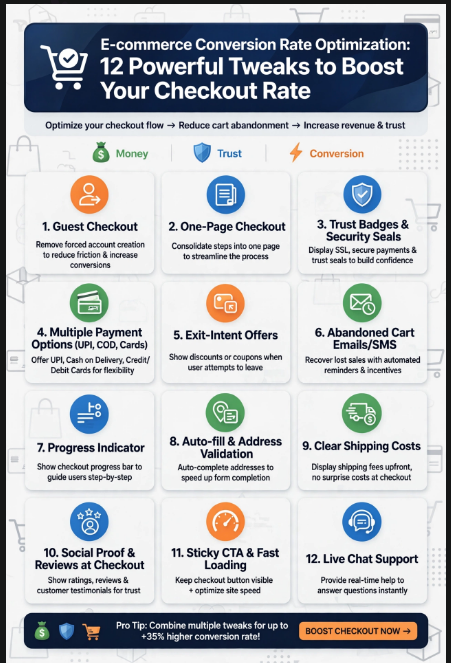
E-commerce Conversion Rate Optimization is one of the most effective ways to improve online store performance without depending entirely on increasing website traffic.
Getting thousands of visitors to your Shopify or WooCommerce store is valuable, but traffic alone does not guarantee sales.
If visitors browse products, add items to their carts, and leave before completing payment, your business is losing potential revenue.
This is where E-commerce Conversion Rate Optimization becomes important.
CRO focuses on improving the customer journey so that more visitors take valuable actions such as adding products to the cart, starting checkout, completing purchases, or signing up for offers.
The good news is that you do not always need a complete website redesign.
Small improvements to product pages, navigation, checkout forms, payment options, trust signals, and mobile experiences can make a significant difference.
In this guide, we will explore 12 powerful E-commerce Conversion Rate Optimization tweaks that Shopify and WooCommerce store owners can implement to create a smoother buying experience.
Table of Contents
- Improve Your Product Page Design
- Create Strong Product Descriptions
- Use High-Quality Product Images
- Make Your Add-to-Cart Button Stand Out
- Simplify the Checkout Process
- Reduce Cart Abandonment
- Add Trust Signals and Security Badges
- Optimize Your Store for Mobile Users
- Offer Multiple Payment Options
- Use Reviews and User-Generated Content
- Improve Website Speed
- Test and Optimize Continuously
- Final Thoughts about E-commerce Conversion Rate
1. Improve Your Product Page Design
Your product page is one of the most important areas of your online store.
A visitor should be able to understand what you sell, why the product is useful, how much it costs, and how to purchase it without confusion.
A clean product page can make the buying decision easier.
Keep important information visible and easy to scan.
Your product title, price, product images, key benefits, variations, shipping information, reviews, and call-to-action should have a logical structure.
Avoid filling the page with unnecessary information.
A focused product page helps visitors concentrate on the product instead of becoming distracted by unrelated elements.
For Shopify and WooCommerce owners, improving product-page UX should be one of the first priorities in an E-commerce Conversion Rate Optimization strategy.
You can also link your product pages to useful internal resources such as your blog or contact page where appropriate.
2. Create Strong Product Descriptions
A weak product description can make an excellent product look ordinary.
Instead of simply listing features, explain how the product can help the customer.
For example, instead of saying:
“Made from premium cotton.”
You could explain:
“Made from soft, breathable cotton to provide comfortable everyday wear.”
The second version connects about E-commerce Conversion Rate the feature with a customer benefit.
Good product descriptions should answer important questions before the customer has to ask them.
What is the product?
Who is it for?
What problem does it solve?
What makes it different?
How should it be used?
What materials or specifications does it have?
Answering these questions E-commerce Conversion Rate can reduce uncertainty and support better purchasing decisions.
Clear copy is an important part of E-commerce Conversion Rate Optimization because customers need enough information to feel confident about buying.
3. Use High-Quality Product Images
Online shoppers cannot physically touch or examine your products.
Images therefore become extremely important.
Use multiple high-quality images that show your product from different angles.
Whenever possible, include close-up images that demonstrate important details such as texture, stitching, material, buttons, packaging, or product features.
Lifestyle images can also help customers understand how the product looks or works in a real-world situation.
For fashion stores, show products being worn.
For furniture stores, show products inside realistic rooms.
For electronics, demonstrate how the product is used.
The goal is to reduce uncertainty.
Your images should also be optimized for performance so that high-quality visuals do not make your website E-commerce Conversion Rate unnecessarily slow.
Strong visuals combined with clear product information can significantly improve E-commerce Conversion Rate Optimization results.
4. Make Your Add-to-Cart Button Stand Out
Your Add to Cart button should be easy to find.
Visitors should never have to search around a product page to discover how to purchase an item.
Use clear and action-oriented button text.
Examples include:
- Add to Cart
- Buy Now
- Shop Now
- Get Yours Today
- Start Your Order
The button should have enough visual contrast to separate it from surrounding content.
However, avoid using too many competing buttons on the same screen.
The primary action should be obvious.
On mobile devices, make sure the button is large enough to tap comfortably.
A strategically placed CTA can make a noticeable difference in E-commerce Conversion Rate Optimization because it reduces friction between product discovery and purchase.
5. Simplify the Checkout Process
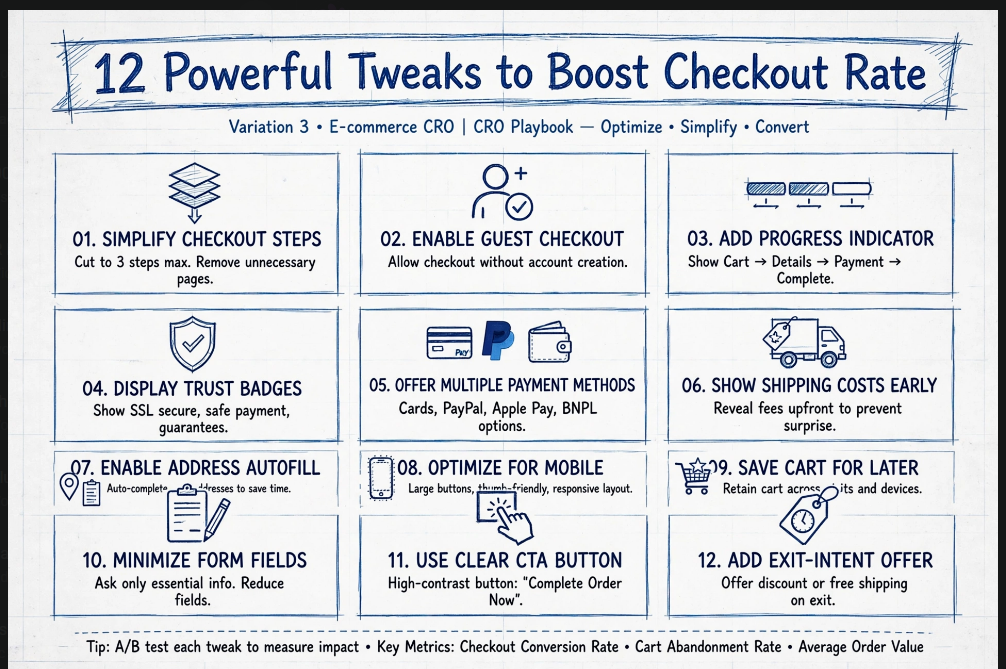
One of the biggest conversion problems for E-commerce Conversion Rate is a complicated checkout.
Customers may leave when they are asked to complete too many fields.
Only request information that is genuinely necessary.
For example, if a customer does not need to create an account to purchase, consider offering guest checkout.
Avoid unnecessary distractions during checkout.
The checkout page should focus primarily on completing the transaction.
Clearly display:
- Product details
- Quantity
- Price
- Shipping cost
- Taxes where applicable
- Discounts
- Final order total
- Payment options
Customers should understand exactly what they are paying before submitting the order.
Simplifying checkout is one of the most important E-commerce Conversion Rate Optimization techniques because unnecessary friction can cause customers to abandon their purchases.
6. Reduce Cart Abandonment
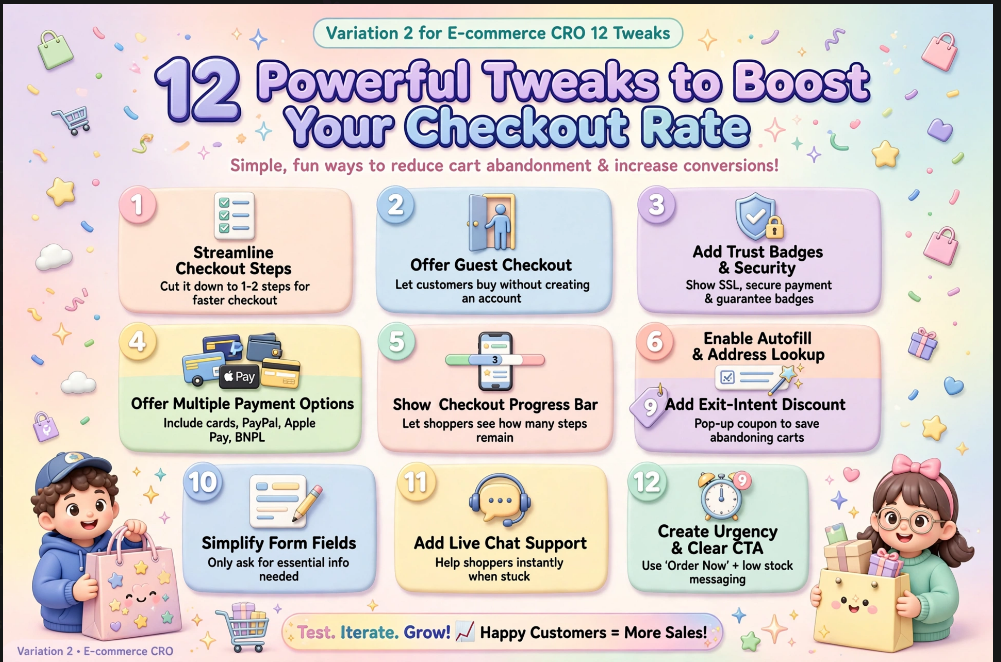
Cart abandonment happens when customers add products E-commerce Conversion Rate to their carts but leave without completing the purchase.
There can be many reasons for this.
Unexpected shipping costs are one common reason.
A complicated checkout process is another.
E-commerce Conversion Rate may also leave because they are comparing prices, are not ready to purchase, or do not trust the website.
Your first step should be identifying where customers are dropping off.
Google Analytics can help you understand user behaviour and conversion journeys.
You can also use cart recovery emails to remind customers about products they left behind.
A good abandoned-cart message should be helpful rather than aggressive.
You might remind the customer about the product, answer common questions, provide customer support information, or offer an incentive where appropriate.
Reducing abandonment should be a major objective of your E-commerce Conversion Rate Optimization campaign.
7. Add Trust Signals and Security Badges
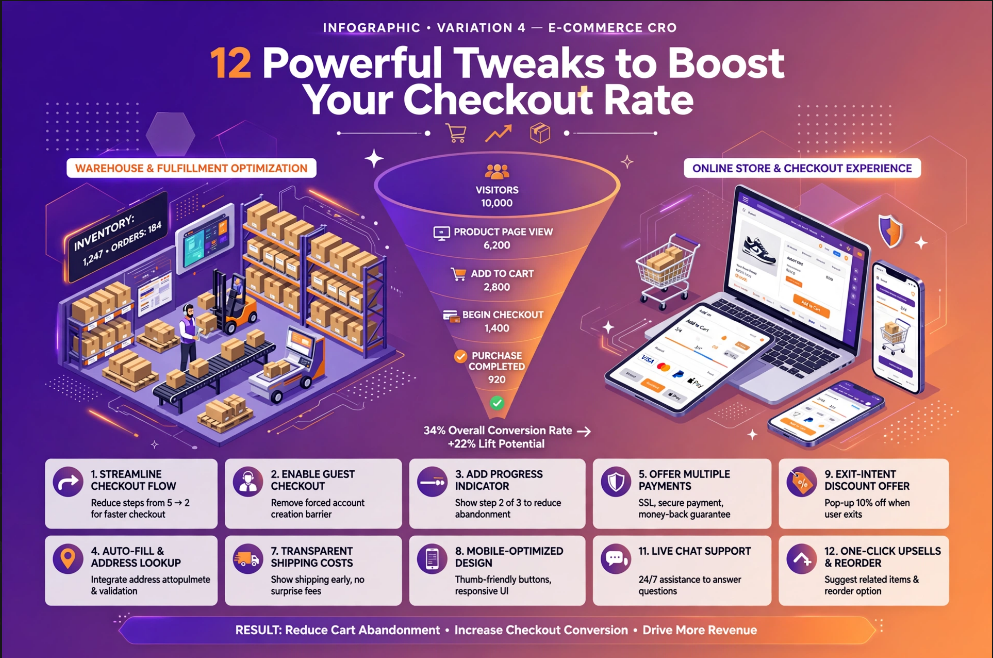
Customers need to trust an online store before entering personal and payment information.
Trust signals can help reduce hesitation.
Examples include:
- Secure payment information
- SSL/HTTPS
- Customer reviews
- Return policies
- Money-back guarantees
- Contact information
- Shipping information
- Recognizable payment methods
- Privacy information
Do not add fake or unnecessary badges simply because they look professional.
Every trust signal should represent something genuine about your business.
Your return policy should also be easy to understand.
If customers cannot determine what happens when they need to return a product, they may hesitate before purchasing.
Trust-building is an essential part of E-commerce Conversion Rate Optimization, particularly for new stores without strong brand recognition.
For technical guidance about website security, you can refer to resources from the Google Search Central website.
8. Optimize Your Store for Mobile Users
Mobile shopping has become a critical part of E-commerce Conversion Rate.
If your store looks excellent on a desktop but performs poorly on smartphones, you may lose a significant number of potential customers.
Your mobile website should be easy to navigate.
Menus should be simple.
Buttons should be easy to tap.
Product images should load correctly.
Text should be readable without excessive zooming.
Checkout forms should be comfortable to complete on a small screen.
Pay particular attention to mobile checkout.
Typing long forms on a smartphone can be frustrating.
Use autofill and appropriate input types whenever possible.
Mobile optimization should therefore be treated as a core component of E-commerce Conversion Rate Optimization, rather than an optional improvement.
9. Offer Multiple Payment Options
Different customers prefer different payment methods.
Some shoppers may prefer credit or debit cards.
Others may prefer digital wallets, bank transfers, or other available payment methods.
If customers reach checkout and discover that their preferred payment option is unavailable, they may leave.
Offering multiple legitimate payment options can make checkout more convenient.
However, do not overload customers with unnecessary choices.
Provide the payment methods E-commerce Conversion Rate that are relevant to your target audience and market.
Clearly communicate payment availability before customers reach the final checkout stage when possible.
Convenient payment choices can reduce friction and support better E-commerce Conversion Rate Optimization.
10. Use Reviews and User-Generated Content
Customers often want reassurance from other buyers before making a purchase.
Product reviews provide social proof.
A product with genuine positive reviews can appear more trustworthy than an identical product with no customer feedback.
Encourage customers to leave honest reviews after purchasing.
You can also display ratings, written reviews, customer photographs, videos, and other forms of user-generated content when appropriate.
Do not create fake reviews.
Authenticity matters.
Negative reviews can also provide useful information.
Instead of hiding every negative comment, use feedback to identify product or service problems and improve the customer experience.
Social proof is especially useful for customers who are unfamiliar with your brand.
As part of E-commerce Conversion Rate Optimization, strategically placing reviews near product information or purchase areas can help reduce hesitation.
11. Improve Website Speed
Website speed has a direct relationship with user experience.
A slow store can frustrate visitors before they even see your products.
Large images, unnecessary plugins, excessive scripts, poor hosting, and inefficient code can all contribute to performance problems.
Start by testing your website.
Google’s PageSpeed Insights can help you identify performance issues and optimization opportunities.
For WordPress and WooCommerce websites, review installed plugins and remove anything unnecessary.
Compress images before uploading them.
Use modern image formats where appropriate.
Consider caching and content delivery solutions when they make sense for your website.
Speed optimization should not be treated as a one-time task.
Monitor performance regularly, especially after installing new plugins, themes, apps, or tracking tools.
A faster website creates a smoother experience and strengthens your overall E-commerce Conversion Rate Optimization strategy.
12. Test and Optimize Continuously
CRO is not a one-time project.
Even after improving your website, you should continue measuring performance.
What works for one store may not work for another.
Your audience, products, pricing, traffic sources, brand positioning, and customer expectations are unique.
This is why testing is important.
You can test different headlines, product images, CTA wording, layouts, offers, trust signals, and checkout experiences.
For example, you might test:
Version A: Buy Now
Version B: Get Yours Today
After collecting enough data, compare the results.
Do not make decisions based only on E-commerce Conversion a Rate few visits.
Use meaningful data to understand whether a change genuinely improves performance.
You can also use tools such as Google Analytics to monitor important user and conversion behaviour.
Continuous testing makes E-commerce Conversion Rate Optimization an ongoing growth process rather than a single website update.
Internal Linking Strategy for E-commerce Conversion Rate
Internal links can help both users and search engines discover important pages on your website.
For example, a product page can link to a relevant buying guide.
A blog article can link to a product category.
A product category can link to related products.
Your content can also link naturally to pages such as:
- Home
- Products
- Categories
- About Us
- Contact
- Shipping Policy
- Return Policy
- Privacy Policy
- Blog
For example, if your website has an article about online shopping strategies, you can naturally link it to your Blog.
Similarly, customers who want additional assistance can be directed toward your Contact Us page.
Internal linking creates a better navigation structure and helps visitors move deeper into your website.
How Shopify Owners Can Apply CRO
Shopify store owners can begin by reviewing their product pages and checkout journey.
Start with the areas that directly influence purchasing decisions.
Review product images, product descriptions, prices, shipping information, reviews, CTAs, and mobile presentation.
Then examine your analytics data to identify pages where users are leaving.
Do not change everything simultaneously.
If you make ten changes at once, it becomes difficult to determine which change created the improvement.
Instead, prioritize the most important problem and test a focused solution.
This approach makes your E-commerce Conversion Rate Optimization strategy more measurable.
How WooCommerce Owners Can Apply CRO
WooCommerce gives store owners significant flexibility, but that flexibility can also create complexity.
Too many plugins can slow down your website or create conflicts.
Start by reviewing your installed plugins and removing unnecessary functionality.
Then examine your checkout page.
Look for unnecessary fields, confusing messages, slow-loading elements, or unexpected costs.
Review your product templates as well.
Make sure important information appears clearly on both desktop and mobile devices.
WooCommerce owners should also regularly test the complete buying journey from product discovery to payment confirmation.
A smooth purchasing journey is one of the strongest foundations for E-commerce Conversion Rate Optimization.
Common CRO Mistakes to Avoid
One common mistake is focusing only on increasing traffic.
More traffic is useful, but sending more visitors to a website with poor UX does not solve the underlying conversion problem.
Another mistake is copying competitors.
Your competitors may have different audiences, products, pricing, and brand positioning.
What works for them may not work for you.
Another problem is making decisions based entirely on personal opinions.
You may prefer one design, while your customers prefer another.
Data can help separate personal preference from actual customer behaviour.
Finally, avoid changing your website too frequently without allowing enough time to measure results.
Good E-commerce Conversion Rate Optimization requires patience, testing, measurement, and continuous improvement.
E-commerce CRO Checklist
Before finishing your optimization process, review the following checklist:
☑ Is your product page easy to understand?
☑ Are your product images high quality?
☑ Is your product description benefit-focused?
☑ Is the Add to Cart button clearly visible?
☑ Is your checkout simple?
☑ Do you offer guest checkout where appropriate?
☑ Are shipping costs clearly communicated?
☑ Are trust signals visible?
☑ Does your website work properly on mobile?
☑ Are multiple relevant payment methods available?
☑ Are genuine customer reviews displayed?
☑ Is your website loading quickly?
☑ Are you monitoring cart abandonment?
☑ Are you testing different CRO ideas?
☑ Are your internal links helping users discover relevant pages?
Final Thoughts about E-commerce Conversion Rate
E-commerce Conversion Rate Optimization is ultimately about making it easier for customers to buy.
You do not necessarily need a complete redesign or a massive marketing budget.
Sometimes a better product page, clearer CTA, faster website, simpler checkout, stronger trust signals, or improved mobile experience can make a meaningful difference.
Start by identifying the biggest problem in your customer journey.
Then make one focused improvement.
Measure the result.
Learn from the data.
Repeat the process.
For Shopify and WooCommerce owners, this continuous approach can create a stronger shopping experience while helping turn more existing visitors into customers.
The most successful e-commerce stores understand that conversion optimization is not only about selling more.
It is about understanding customers better.
When your website answers questions, removes friction, builds trust, and makes purchasing simple, customers have fewer reasons to leave.
That is the real power of E-commerce Conversion Rate Optimization.
Advanced E-commerce Conversion Rate Optimization Strategies
Understanding Customer Intent
Every visitor who lands on an E-commerce Conversion Rate has a different level of buying intent. Some visitors are only researching products, while others are ready to purchase immediately.
Understanding this difference is essential for effective E-commerce Conversion Rate Optimization. Your website should provide the right information for visitors at every stage of the buying journey.
A visitor searching for product comparisons may need educational content before purchasing. A returning customer may need a quick checkout experience with minimal distractions.
You can use analytics data to understand how different visitors behave. Look at landing pages, product views, cart additions, checkout starts, and completed purchases.
This information can help you identify where potential customers are losing interest. Instead of guessing what needs improvement, you can make decisions based on actual user behaviour.
Search intent can also influence your product page content. Visitors arriving from informational searches may need more explanations, while transactional visitors may respond better to clear pricing and strong CTAs.
Your website should therefore support multiple customer journeys. Providing relevant information at the right moment can make the buying experience more comfortable.
Improving Product Discovery
Product discovery is another important part of E-commerce Conversion Rate Optimization. Customers cannot purchase products they cannot easily find.
Your navigation menu should be simple and logically organised. E-commerce Conversion Rate Categories should use language that customers understand instead of complicated internal terminology.
Search functionality is particularly important for stores with large product catalogues. Customers should be able to search for products quickly without receiving irrelevant results.
Search filters can make product discovery easier. Depending on your store, useful filters may include price, size, colour, brand, material, rating, or product type.
Do not provide too many filters without purpose. An excessive number of options can make the shopping experience confusing instead of helpful.
Category pages should also provide enough information to help customers compare products. Clear images, prices, ratings, availability, and short descriptions can make browsing easier.
Recommended products can encourage visitors to explore additional items. Related products should be genuinely relevant rather than randomly selected.
Cross-selling can also increase the value of each order. For example, a customer buying a camera may be interested in a memory card, camera bag, or tripod.
Upselling should be handled carefully. The recommended product should provide a clear additional benefit rather than simply being more expensive.
Personalised recommendations can become more useful when they are based on browsing history, previous purchases, or product relationships.
Building Stronger Trust
Trust is one of the most important factors in online purchasing decisions. Customers need confidence that your business will deliver what it promises.
Your website should clearly display important business information. Customers should know who they are buying from and how they can contact the business.
A visible contact page can reduce uncertainty. Include relevant contact methods and make customer support easy to access.
Return and refund policies should also be straightforward. Avoid using complicated language that forces customers to interpret important conditions.
Shipping information should be available before the final payment step. Customers should not discover unexpected delivery charges at the end of checkout.
Delivery estimates can also influence purchasing decisions. If customers know approximately when their order will arrive, they may feel more confident completing the transaction.
Product availability should be accurate. Showing a product as available when it is actually out of stock can damage trust and create a poor customer experience.
Secure payment messaging can reassure customers during checkout. However, trust badges should be genuine and relevant to your actual security or payment arrangements.
Customer service is another powerful trust signal. Quick answers to questions can prevent customers from leaving the website without purchasing.
Strong trust signals should appear naturally throughout the customer journey rather than being placed everywhere simply to attract attention.
Improving Checkout UX
Checkout design deserves special attention because this is where customers make the final purchasing decision. Even small obstacles can cause hesitation.
Keep the checkout layout clean and focused. Remove unnecessary banners, pop-ups, menus, and promotional distractions whenever possible.
Show a clear order summary during checkout. E-commerce Conversion Rate Customers should always know which products they are purchasing and what the total cost will be.
Allow customers to easily change quantities or remove products before payment. Making simple corrections should not require returning to several previous pages.
Form validation should be helpful rather than frustrating. If a customer enters incorrect information, explain exactly what needs to be corrected.
Do not erase information unnecessarily when an error occurs. Customers should not have to re-enter an entire form because of one small mistake.
Progress indicators can help customers understand how much of the checkout remains. This is particularly useful when the checkout contains multiple stages.
Guest checkout can reduce friction for first-time customers. Requiring account creation before purchase may discourage people who simply want to complete a quick transaction.
If account creation provides benefits, explain those benefits clearly. Customers are more likely to register when they understand the value.
Keep payment instructions simple. Customers should know which information is required and why it is needed.
The ultimate objective of checkout optimization is simple: remove unnecessary barriers between the customer and the completed purchase.
Using Data for Better Decisions
Successful E-commerce Conversion Rate Optimization depends heavily on measurement. Without data, it is difficult to know whether your changes are actually helping.
Start by identifying your current conversion rate. This gives you a baseline against which future improvements can be measured.
Track important events throughout the buying journey. Product views, Add to Cart actions, checkout starts, payment attempts, and completed purchases can reveal where users drop off.
Do not focus only on the final conversion rate. A website can have the same overall conversion rate while experiencing significant changes in individual stages.
Segment your data by device. Desktop visitors and mobile visitors may behave very differently.
You can also compare new visitors with returning visitors. Returning customers may already trust your brand and therefore require less information before purchasing.
Traffic sources can reveal additional opportunities. Visitors from organic search may behave differently from visitors arriving through paid advertising or social media.
Analyse your highest-performing product pages as well. These pages may contain useful patterns that can be applied to weaker pages.
Use testing to validate important decisions. A design change that looks better to you does not necessarily mean customers will respond positively.
The best CRO strategy combines creativity with evidence. Ideas create opportunities, while data helps determine which ideas deserve to stay.
Personalisation and Customer Experience
Personalisation can make an online shopping experience more relevant. Customers are more likely to engage with products and offers that match their interests.
Personalised recommendations can be based on previous browsing activity. For example, customers viewing running shoes may receive recommendations for related running accessories.
Returning customers can also receive a more convenient experience. Remembering preferences or previously viewed products can reduce unnecessary effort.
Personalisation should always have a clear purpose. Showing irrelevant recommendations simply because they are personalised does not improve the customer journey.
Location can sometimes influence the shopping experience. Customers may need different shipping information, currencies, or delivery options depending on their region.
Customer segments can also receive different messaging. New customers may need stronger trust signals, while loyal customers may respond better to loyalty benefits.
Email marketing can support personalisation beyond the website. Product reminders, recommendations, and post-purchase communication can keep customers engaged.
However, personalisation should not become intrusive. Customers should feel that the website is helpful rather than constantly tracking their behaviour.
A useful personalisation strategy focuses on relevance. The goal is to help customers discover suitable products faster.
When implemented thoughtfully, personalisation can strengthen E-commerce Conversion Rate Optimization by creating a more relevant shopping journey.
Improving Offers and Pricing
Pricing has a major influence on E-commerce Conversion Rate . Customers want to understand exactly what they receive in exchange for their money.
Display product prices clearly. Avoid making customers search for pricing information before deciding whether a product is suitable.
If a product is discounted, show the original and current prices accurately. Customers should be able to understand the value of the offer.
Limited-time promotions can encourage action, but urgency should always be genuine. False countdown timers can damage customer trust.
Free shipping thresholds can also influence average order value. For example, customers may add another relevant product if they are close to qualifying for free delivery.
Bundle offers can make purchasing decisions easier. Combining complementary products can provide convenience while increasing the total order value.
Discount codes should be easy to understand. If customers cannot determine whether a code applies to their order, they may abandon checkout.
Avoid making every product appear permanently discounted. Constant discounts can reduce perceived value and make customers question the original price.
Value should be communicated through benefits rather than discounts alone. Quality, durability, convenience, service, and guarantees can all contribute to perceived value.
The strongest pricing strategy is one that feels clear and fair. Customers should understand what they are paying and why the product is worth that amount.
Post-Purchase Optimization
Conversion optimization should not stop after the payment confirmation page. The post-purchase experience can influence repeat purchases and customer loyalty.
Send a clear order confirmation immediately after purchase. Customers should receive essential information about their order and expected delivery.
Shipping updates can reduce customer anxiety. People appreciate knowing when their order has been processed, shipped, and delivered.
A helpful thank-you message can also strengthen the relationship. It shows that the customer is more than simply a transaction.
After delivery, consider requesting an honest product review. Reviews can later help other customers make informed purchasing decisions.
Customer support should remain available after purchase. A customer who receives quick assistance is more likely to trust the brand again.
You can also recommend complementary products after the customer has received their order. Recommendations should be relevant rather than overly aggressive.
Repeat customers often require less persuasion than first-time visitors. Creating a smooth post-purchase experience can therefore support long-term revenue growth.
Customer feedback can reveal problems that website analytics cannot explain. Ask customers what they liked, what confused them, and what could be improved.
Use this feedback to improve product pages, checkout processes, policies, and customer support.
Ultimately, excellent E-commerce Conversion Rate Optimization is not only about increasing the first purchase. It is also about creating experiences that encourage customers to return.
Conclusion
A successful E-commerce Conversion Rate is built around the customer experience. Every page should make it easier for visitors to understand products, evaluate options, trust the business, and complete their purchase.
The strongest E-commerce Conversion Rate Optimization strategies focus on removing friction instead of simply adding more promotional messages.
Start with the biggest problem in your conversion funnel. Improve that area, measure the results, and then move to the next opportunity.
Product pages, checkout forms, mobile usability, trust signals, payment methods, website speed, reviews, and personalised experiences can all contribute to better performance.
Remember that CRO is a continuous process. Customer expectations change, competitors introduce new experiences, and technology continues to evolve.
Keep testing your website and use real customer behaviour to guide your decisions. What works today may need refinement tomorrow.
For Shopify and WooCommerce owners, even small improvements can become valuable when they are applied consistently across the entire customer journey.
The ultimate goal is not simply to get more clicks. It is to create a website where the right visitors can confidently move from discovery to purchase.
When customers find what they need, understand its value, trust your business, and experience a smooth checkout, conversion E-commerce Conversion Rate becomes a natural result.
That is why E-commerce Conversion Rate Optimization should be treated as an ongoing growth strategy rather than a one-time website improvement.