
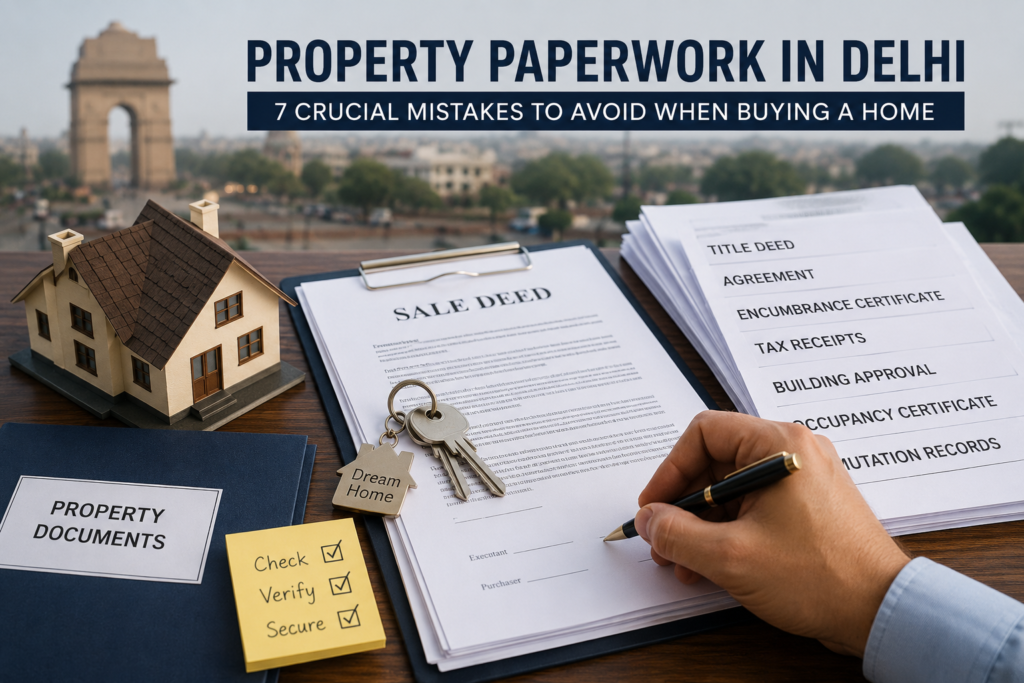
Property paperwork in Delhi is one of the most important parts of buying a home safely. Buyers must carefully verify the chain of title, encumbrances, registration records, property tax, approvals, and other documents before paying a token amount or signing a sale agreement.
Buying a property in Delhi can be exciting, but the paperwork involved can also be complicated. From DDA properties and builder floors to independent houses and apartments, every property can have a different documentation history. A single missing document or incorrect record can create serious problems during registration, home loan processing, resale, or future ownership disputes.
For buyers looking at areas such as Vasant Vihar, Greater Kailash, Dwarka, Rohini, Punjabi Bagh, or other parts of Delhi, understanding the documentation process is essential. This guide explains seven common property paperwork mistakes in Delhi and shows how buyers can reduce the risk of legal and financial problems.
Why Property Paperwork in Delhi Matters Before Buying a Home
Property paperwork in Delhi involves more than simply checking the seller’s Sale Deed. Buyers should understand how ownership was created, transferred, recorded, and maintained over the years.

Depending on the property, documents may involve the Delhi Development Authority (DDA), Municipal Corporation of Delhi (MCD), Sub-Registrar Office, Revenue Department, or other authorities.
The Delhi Revenue Department provides information related to property registration, registration records, e-search facilities, encumbrance search, circle rates, and property registration procedures. Buyers should use official government records wherever possible instead of relying only on documents provided by a seller or broker.
You can also review official property registration information from the Delhi Revenue Department before completing your transaction.
Internal resource: Delhi real estate market expertise
Mistake 1: Not Verifying the Complete Chain of Title

One of the biggest mistakes in property paperwork in Delhi is checking only the current owner’s Sale Deed https://singhporperties.com/
A buyer should understand the complete ownership history of the property. This is commonly referred to as the chain of title. It means checking how ownership moved from one owner to another through documents such as Sale Deeds, Conveyance Deeds, inheritance documents, allotment letters, possession letters, or other relevant records.
For example, if the current seller purchased the property from another owner, the buyer should not automatically assume that the seller’s document proves the entire title. Earlier documents may also need to be examined.
For DDA properties, buyers may need to review documents such as the original allotment letter, possession documentation, conveyance deed, or other relevant DDA records depending on the property.
A missing link in the ownership history can create difficulties when you try to sell the property later or obtain financing.
What Buyers Should Check
Before buying a property, check:
- Previous Sale Deeds or Conveyance Deeds
- Original allotment documents where applicable
- Possession documents
- Inheritance documents, if applicable
- Death certificates and succession documents where relevant
- Previous transfer documents
- Property registration records
- Seller’s identity and ownership details
Do not depend only on verbal confirmation from the seller. Proper property paperwork in Delhi requires documentary verification.
Mistake 2: Ignoring Encumbrances and Existing Liabilities
Another important part of property paperwork in Delhi is checking whether the property has any registered encumbrance, mortgage, charge, attachment, or other liability.
An Encumbrance Certificate or relevant registration search can help buyers investigate registered transactions affecting a property. However, buyers should understand that no single document should automatically be treated as proof that there can never be any dispute or liability.
The Delhi Revenue Department provides online information and search facilities for property registration records and encumbrance searches. Buyers should verify the relevant records through official sources and, where necessary, conduct additional legal due diligence.
A seller saying that the property is “completely clear” is not enough.
Documents and Checks to Consider
Before paying a substantial amount, consider checking:
- Registration records
- Encumbrance or registered charge information
- Existing mortgage or loan documents
- Court-related information where relevant
- Seller’s declaration regarding liabilities
- Original title documents
- Bank NOC, if the property was financed
- Relevant government records
For complicated transactions, professional legal verification can provide an additional layer of protection.
Internal resource: personalized property search in Delhi
Mistake 3: Miscalculating Circle Rate and Stamp Duty
Stamp duty and registration charges are another important part of property paperwork in Delhi.
The amount payable can depend on the applicable consideration value, circle rate, type of document, and other rules. The Delhi Revenue Department currently states that stamp duty for a Sale Deed is 6% for a male buyer and 4% for a female buyer, while registration fee is generally 1% of the total value, subject to applicable rules and charges.
Because government rates and procedures can change, buyers should always verify the latest information from the official Delhi Revenue Department before registration.
Do not simply calculate the charges based on information from an old property agreement, broker, or social media post.
Why Accurate Valuation Matters
A buyer should compare the transaction value with the applicable circle rate and understand which value is relevant for stamp duty and registration.
Under-declaring the value of a transaction to reduce taxes can create legal and financial risks. Buyers should maintain accurate documentation and follow the applicable government requirements.
The official Delhi Revenue Department provides information about property registration, circle rates, and related procedures.
External resource: https://revenue.delhi.gov.in/revenue/property-registration
Mistake 4: Ignoring MCD Property Tax Records
Property tax records are another important part of property paperwork in Delhi.
Before buying a property, buyers should check whether property tax payments are up to date and whether the property details match the actual property being purchased.
The Municipal Corporation of Delhi provides an online property tax portal where users can search property details, manage property tax information, and access services related to mutation or e-change of name.
Buyers should carefully compare the property address, owner details, UPIC information, and available tax records.
Check These Property Tax Details
Before completing the purchase, review:
- Latest property tax receipts
- Outstanding tax amounts
- Property address
- Owner information
- UPIC details
- Property classification
- Relevant MCD records
- Mutation or e-change of name information where applicable
The MCD portal states that a UPIC, or Unique Property Identification Code, is used for property tax-related services.
External resource: https://mcdonline.nic.in/
Do not assume that an old tax receipt automatically proves clear ownership. Tax records and title documents serve different purposes and should be checked separately.
Mistake 5: Forgetting to Verify Building Approvals and Occupancy Documents
Another common mistake in property paperwork in Delhi is focusing only on ownership documents while ignoring the legality of the building itself.
A property may have an ownership document but still have issues related to construction approvals, sanctioned plans, additional floors, building permissions, or occupancy requirements.
This is particularly important when buying builder floors, independent houses, or properties that have undergone structural changes.
What Should You Verify?
Depending on the property type, buyers should consider checking:
- Sanctioned building plan
- Completion-related documents
- Occupancy Certificate, where applicable
- Building permissions
- Number of approved floors
- Covered area
- Property layout
- Relevant DDA or MCD approvals
- Any notices or violations affecting the property
Do not assume that every floor visible in a property is automatically approved.
If the actual construction does not match the sanctioned plan, the buyer could face problems later. A professional property lawyer or qualified expert can help determine which approvals are required for the specific property.
Mistake 6: Assuming Sale Deed and Mutation Are the Same
A registered Sale Deed and mutation are not the same thing, and confusing them can create problems in property paperwork in Delhi.
The Sale Deed is the document through which the property transaction is legally documented and registered according to applicable law. Mutation, on the other hand, relates to updating the relevant government or municipal records after a transfer.
MCD provides an online service for mutation or e-change of name in municipal records. The exact process can depend on the type of property and the authority maintaining the relevant record.
Why Mutation Matters
After purchasing a property, buyers should determine whether mutation or e-change of name is required and complete the applicable process.
Depending on the property, this can help update records relating to:
- Municipal property records
- Property tax records
- Owner information
- UPIC-related information
- Other applicable government records
Do not assume that registration automatically updates every government record.
External resource: https://mcdonline.nic.in/portal/mService
Mistake 7: Paying Token Money Before Proper Document Verification
One of the most expensive mistakes buyers can make is paying a large token amount before completing document verification.
A property may look perfect during a site visit, but the legal documents can reveal issues that are not visible physically.
Before paying a substantial token amount, buyers should first review the available title documents, seller details, property tax records, registration information, approvals, and other relevant paperwork.
A Simple Pre-Purchase Document Checklist
Before committing to the transaction, check:
- Seller’s identity documents
- Complete title chain
- Current Sale Deed
- Previous ownership documents
- Registration records
- Encumbrance or charge information
- Property tax receipts
- UPIC details where applicable
- Building approvals
- Occupancy-related documents where applicable
- Bank NOC if applicable
- Mutation status
- Relevant DDA, MCD, or Revenue Department records
- Any available litigation or dispute information
This checklist does not replace professional legal advice, but it can help buyers identify obvious documentation gaps before moving forward.
Property Paperwork in Delhi: How Singh Properties Can Help
At Singh Properties, we understand that buying a Property Paperwork in Delhi is not only about finding the right location and price. Proper property paperwork in Delhi is equally important for protecting your investment.
Our approach focuses on helping buyers understand the documentation involved in a property transaction and identify areas that require further verification.
From title-related documents and registration records to property tax information and local documentation, each transaction requires careful attention to detail.
Our Delhi real estate market expertise helps buyers understand the local property market, while our personalized property search in Delhi focuses on matching buyers with suitable properties.
For complicated legal matters, we recommend consulting a qualified property lawyer before signing binding documents or making significant payments.
Final Checklist for Property Paperwork in Delhi
Before buying a home, do not rush through the documentation process.
Make sure you have reviewed the ownership history, current title documents, registration records, property tax information, applicable building approvals, and mutation requirements.
Most importantly, never rely only on verbal promises. Proper documentation should support every major claim made about the property.
Final Property Paperwork in Delhi and Buying Checklist
- Verify the complete chain of title.
- Check registration records.
- Investigate encumbrances and registered liabilities.
- Confirm applicable circle rates and registration charges.
- Review MCD property tax records.
- Check UPIC information where applicable.
- Verify sanctioned building plans.
- Check occupancy-related documents where applicable.
- Understand the mutation or e-change of name process.
- Get legal advice before signing important documents.
- Keep copies of all important documents and receipts.
Conclusion
Property paperwork in Delhi should never be treated as a minor formality. It is one of the most important parts of protecting your ownership, finances, and future resale prospects.
From verifying the chain of title and checking registration records to reviewing Property Paperwork in Delhi tax, building approvals, and mutation requirements, buyers need to approach the transaction carefully.
If you are planning to buy a home in Delhi, take the time to verify the documents before paying a major amount or signing a binding agreement. A careful documentation process today can help prevent expensive legal and financial problems tomorrow.
For professional assistance with your property search, explore our Delhi real estate market expertise or start a personalized property search in Delhi.
Property paperwork in Delhi is one of the most important parts of buying a home safely. Before making a payment, buyers should carefully check ownership documents, registration records, tax receipts, approvals, and other relevant paperwork.
Buying a home can be exciting, but incorrect or incomplete documents can create serious problems later. A property may look perfect during a site visit while its paperwork contains ownership disputes, unpaid dues, or approval issues.
The first step in property paperwork in Delhi is verifying the seller’s ownership. Buyers should check the current Sale Deed and compare the seller’s name, property address, identification details, and other information with the available official records.
Buyers should also examine the complete chain of title. Previous Sale Deeds, Conveyance Deeds, allotment documents, possession documents, or inheritance papers may be required depending on how the property was originally acquired.
Another important part of property paperwork in Delhi is checking for registered encumbrances. Buyers should investigate whether the property has an existing mortgage, charge, attachment, or other registered liability before completing the transaction.
An Encumbrance Certificate or appropriate registration search can provide useful information about registered transactions. However, buyers should not depend on one document alone when making an important property investment.
Property tax records should also be reviewed before buying a home. Buyers can check available MCD records, tax receipts, outstanding dues, and property identification details to ensure that the information is consistent.
A buyer should pay particular attention to the property’s UPIC details where applicable. Differences between municipal records and the documents provided by the seller should be investigated before moving forward.
Stamp duty and registration charges are another important consideration. The applicable amount can depend on the property’s value, applicable circle rate, ownership structure, and current government rules.
Buyers should always verify the latest circle rates and registration requirements through official government sources. Avoid relying on outdated information provided by an agent, seller, or an old property agreement.
Building approvals are equally important in property paperwork in Delhi. Buyers should check whether the property’s actual construction matches the sanctioned building plan and whether additional floors or modifications have been properly approved.
Occupancy and completion-related documents may also be relevant depending on the type of Property Paperwork in Delhi . These documents can help buyers understand whether the building complies with applicable construction and occupancy requirements.
Builder floors and independent houses require particular attention because unauthorized construction can create significant problems. Buyers should compare the actual property with approved plans before paying a substantial amount.
Mutation is another area that buyers often misunderstand. Registration of a Sale Deed and updating municipal or other relevant records are separate processes, so buyers should understand whether mutation or e-change of name is required.
Before paying token money, buyers should review as many important documents as possible. A large payment should not be made simply because the seller promises that all paperwork will be completed later.
A written agreement should clearly mention important transaction terms, including the property details, payment schedule, responsibilities of both parties, and conditions related to documentation and outstanding dues.
Buyers should keep copies of every document received during the transaction. Digital scans can provide an additional backup, while original documents should be handled carefully and verified whenever required.
Professional legal verification can be especially useful for properties with complicated ownership histories. A qualified property lawyer can review documents and identify potential legal issues that may not be obvious to an ordinary buyer.
At Singh Properties, we understand that property paperwork in Delhi requires careful attention to local documentation and property-specific requirements. Buyers can benefit from a structured approach instead of relying only on verbal assurances.
Our Delhi real estate market expertise helps buyers understand different property options, while our personalized property search in Delhi can help them identify suitable homes according to their requirements.
The safest approach is to complete documentation checks before signing important agreements or making major payments in Property Paperwork in Delhi . Taking extra time during the verification stage can help buyers avoid unnecessary financial and legal complications.
In conclusion, property paperwork in Delhi should never be treated as a simple formality. Checking title documents, registration records, tax information, approvals, mutation requirements, and liabilities can make the home-buying process much safer and more transparent.
If you are planning to purchase a home and Property Paperwork in Delhi, make documentation verification a priority from the beginning. Careful property paperwork in Delhi can help protect your investment and give you greater confidence before completing the purchase.

Thank you https://singhporperties.com/